

World News
Why Is Erdogan’s Turkey Still Treated Like a Western Ally?
Erdogan is escalating against Zionism, Congress is warning against F-35 sales, and Israel is moving toward Armenian Genocide recognition
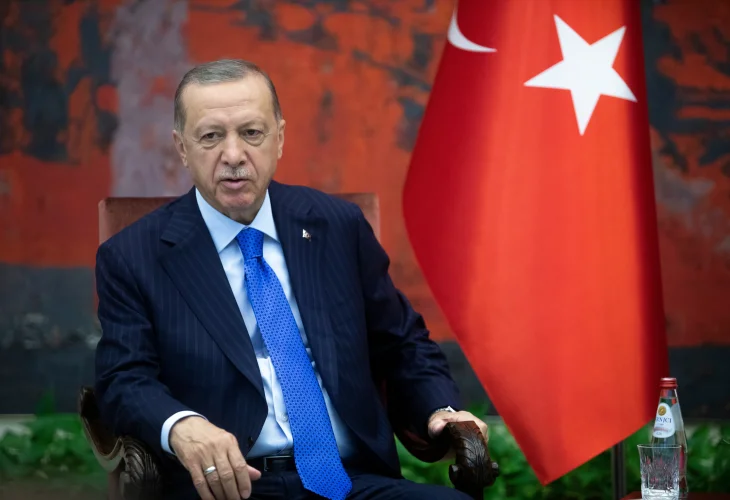 Erdogan (Shutterstock
Turkish President Recep Tayyip Erdogan escalated his confrontation with Israel yesterday, saying that “the genocidal, occupying, expansionist ideology called Zionism” threatens not only himself or his political camp, but “everyone.”
“When we struggle against Zionism, we are not waging this struggle for ourselves or for personal reasons,” Erdogan said. “We are doing it for our own survival and for the survival of our nation.”
The remarks raised a basic question now being asked in Washington and Israel: why is Erdogan’s Turkey still treated like a Western ally?
The answer begins with NATO. Turkey joined the alliance in 1952, during the Cold War, when its geography made it one of the West’s most important front-line states against the Soviet Union. For NATO, Turkey helped block Soviet expansion southward. For Turkey, NATO offered protection from Moscow.
That is why Washington has not cut Ankara loose. Turkey still sits in a place NATO cannot ignore, even as Erdogan keeps testing how much the alliance is willing to tolerate.
The clearest sign of the tension is the Trump administration moving ahead with a sale of more than $700 million in fighter jet engines to Turkey. At the same time, Congress is still wary because Turkey was kicked out of the F-35 program after buying a Russian air defense system in 2019, which U.S. officials feared could put American military technology at risk.
Rep. Mike Lawler warned that the administration’s push to sell F-35 fighter aircraft to Turkey “raises significant national security concerns.”
“While Turkey is a NATO ally, President Erdogan has repeatedly taken actions that call into question the country’s reliability as a strategic partner,” Lawler said. He added that Congress prohibited the transfer of F-35s to Turkey “in the first place” and said he remains “deeply opposed” to selling one of America’s most advanced military platforms to Ankara.
For Israel, the concern is not only Erdogan’s language. Defense officials fear that advanced American aircraft in Turkish hands could harm Israel’s military edge in the region and limit the Israeli Air Force’s freedom of action.
Israel also moved on another front. Foreign Minister Gideon Sa’ar said he will bring a resolution before the government for official Israeli recognition of the Armenian Genocide, referring to the mass killing and deportation of Armenians by the Ottoman Empire during World War I. The proposal is later expected to go to the Knesset for a vote.
“Recognizing the genocide perpetrated against the Armenian people in the final years of the Ottoman Empire is both a moral and historical duty,” Sa’ar said. He added that Israel must condemn “any denial, minimization, or distortion of the historical truth.”
Israel has avoided official recognition for years, partly because of the sensitivity of relations with Turkey, which rejects the genocide label and says the mass deaths were not a planned extermination campaign. Erdogan has also widened the issue beyond Gaza. Earlier this month, he said Israeli strikes in Syria and Lebanon had reached a level that threatened Turkey as well.
That is the heart of the Turkey dilemma. Ankara is still too strategically important for Washington to ignore. But Erdogan is making it harder for the U.S. and Israel to treat Turkey as a normal ally.

