

Behind the News
Explained: Netanyahu’s New Push for a “Broad National Government”
Netanyahu is trying to widen his coalition path beyond his usual right-wing bloc, without giving up his core national red lines
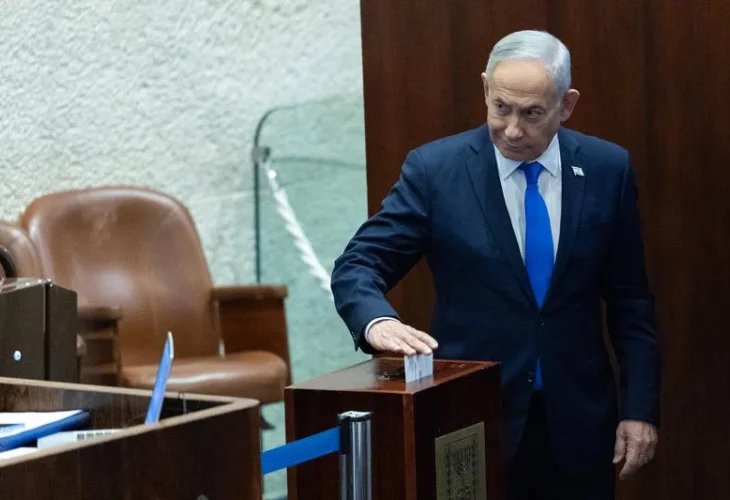 Benjamin Netanyahu (Yonatan Sindel/Flash90)
Prime Minister Benjamin Netanyahu is making a new election pitch: Israel needs a “broad national government,” and he says this is the government he intends to form after the election.
“Israel needs a broad national government — and that is the government I will form,” Netanyahu said, presenting the message as Israel faces security threats abroad and deep divisions at home.
In Israeli politics, a broad national government means a coalition that goes beyond one narrow political camp. For Netanyahu, that would mean reaching beyond his usual “natural bloc” of Likud, Shas and United Torah Judaism, Religious Zionism and Otzma Yehudit. He would still lead the government, but he would try to bring in Zionist parties, voters or political figures from outside his current camp, especially from the center-right.
That could include figures such as Gadi Eisenkot of Yashar and Benny Gantz of Blue and White, former IDF chiefs who appeal to many security-minded centrists, or Naftali Bennett of Beyachad, a former right-wing prime minister who opposes Netanyahu politically. But Netanyahu is making clear that the door is open only to parties that accept his basic national principles.
Those are the voters and politicians Netanyahu is trying to appeal to. Many of them may agree with him on major security issues, Jewish statehood or opposition to a Palestinian state, but they are not with him now because of deep distrust of Netanyahu personally and politically. Some blame him for the failures that led to October 7. Others oppose the judicial reform push, fear the influence of Ben Gvir and Smotrich, or object to the Chareidi draft situation. Netanyahu is trying to break through that wall by saying the election should not be about boycotting him personally, but about joining a government built around shared national red lines.
Those red lines are clear. “Israel is the nation-state of the Jewish people,” Netanyahu said. He added that “Israel will defend itself by itself,” and that the country must ensure “economic, energy and weapons independence.”
He also set a firm condition on the Palestinian issue: “No Palestinian state will be established between the sea and the Jordan…Whoever accepts these principles is invited to join,” Netanyahu said.
The timing is also intentional. Netanyahu is heading into an election environment where his usual bloc may not be enough. If Likud and its natural partners cannot reach a Knesset majority on their own, he needs a way to appeal beyond them. The “broad national government” message lets him tell center-right voters that another Netanyahu term does not have to mean the same narrow coalition.
It also gives him a direct campaign contrast. Netanyahu framed the election as a choice between “a broad national government led by me — or a narrow left-wing government that will depend on the Arab parties,” meaning if the anti-Netanyahu camp cannot reach a majority on its own, it would need Arab-party support to form a government.
But the pitch carries risk. Ben Gvir and other right-wing partners may see it as a sign that Netanyahu is preparing to weaken the current right-wing camp after the election. Eisenkot and Netanyahu’s opponents, meanwhile, rejected the unity message. Eisenkot accused Netanyahu of using boycotts as an old campaign tactic and said he had deepened Israel’s divisions after October 7, while opposition figures argued that he cannot present himself as the leader who will heal the country.
Netanyahu is trying to change the question of the election. Instead of asking only whether voters want another Netanyahu government, he wants them to ask who can build a government broad enough to govern Israel during war and internal crisis.
His offer is broad in coalition math, not in ideology. Netanyahu is trying to bring more parties into the room, while keeping the room built around his national red lines.

