

Raising Children
Why Are So Many Children Struggling to Read?
New data show steep declines in reading proficiency among American students—yet some educational settings suggest that purpose and meaning may be key to reversing the trend
Do you have a fourth-grader—or a younger child—who can read books and understand them? If so, you might want to pause for a moment of appreciation. This is not a given. In fact, many parents in your position do not have children who demonstrate this level of reading ability.
To people who are not currently raising children or involved in education, this may sound surprising. To the rest of us, it feels all too familiar. The data are clear, and the reading crisis among American students has rarely looked more severe.
Recent national data paint a troubling picture of reading achievement in the United States. According to the latest results from the National Assessment of Educational Progress (NAEP)—often referred to as the “Nation’s Report Card”—only about 31% of fourth-grade students demonstrate reading proficiency. Put differently, roughly seven in ten American fourth-graders do not reach the NAEP “Proficient” benchmark, representing more than two million children nationwide. This marks a deterioration from 2019, when approximately 34% of fourth-graders met the proficiency standard.
The decline is especially alarming because fourth grade represents a critical transition in children’s education. During the early elementary years, students learn to read; by fourth grade, they are increasingly expected to read in order to learn. Weak reading skills at this stage therefore hinder learning across virtually every academic subject, including science, history, and mathematics.
Even more concerning is the growing number of students with very weak literacy skills. In 2024, 40% of fourth-graders scored below NAEP’s “Basic” level, indicating serious difficulties with foundational reading abilities. The steepest declines have occurred among the lowest-performing students, suggesting that educational inequalities have widened rather than narrowed in recent years.
The broader educational picture remains challenging. A recent national assessment found that while younger children have largely recovered from the pandemic’s disruption, older students continue to struggle. Reading performance among thirteen-year-olds remains below pre-pandemic levels and is approximately where it stood in the early 1970s. At the same time, fewer students report reading for pleasure than in previous decades—a trend many researchers believe further undermines literacy development.
Why are students struggling so much with reading? It is easy to assemble a long list of culprits: pandemic disruptions, screen addiction, rising mental health challenges, ineffective parenting, weak instructional methods. One can choose a preferred explanation—or cite them all. But it is also worth looking at educational systems where the crisis is far less pronounced, and asking what they do differently.
In many religious Jewish schools, educators and parents report that far more than 31% of fourth-graders achieve reading proficiency. While precise comparative data are difficult to obtain, evidence from Israel offers a useful point of reference. A study by Yariv Feniger, Yossi Shavit, and Hanna Ayalon, based on data from the 2000 PISA assessment, found that students in religious schools achieved higher scores in reading comprehension than students in non-religious schools.
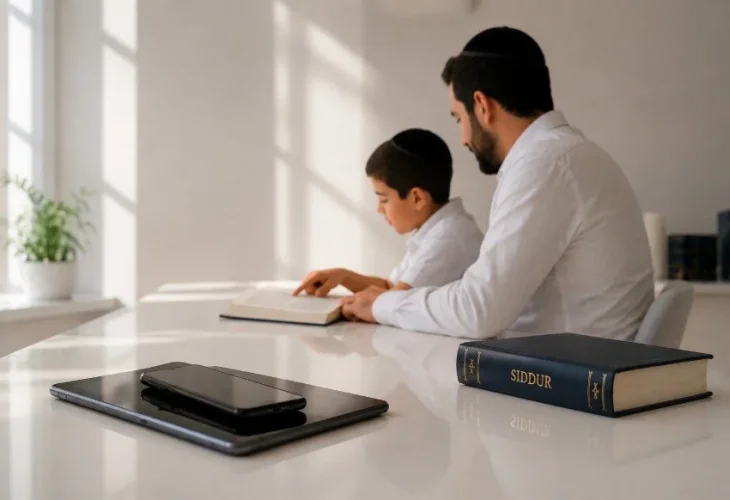
Multiple factors may contribute to this difference, but one is worth considering in particular: in religious Jewish life, reading is a prerequisite for much of daily practice. One cannot pray from a siddur or engage with Torah study without basic reading proficiency. Traditionally, reading has not been treated merely as a functional academic skill, but as an entry point into religious life itself. The Tosefta states: “Once [the child] knows how to speak—his father teaches him the Shema and the Holy Tongue… Once he knows how to read—his father teaches him Torah.” Rabbinic discussions of early education consistently present reading as a gateway to Torah learning.
Traditional customs further reflect this understanding. In Ashkenazi communities, it was customary for a child beginning to learn to read to lick honeyed letters of Tanakh verses from a special cake baked for the occasion, symbolically associating Torah with sweetness. In this framing, learning the alphabet is not an end in itself, but an introduction to a much larger purpose.
Jewish tradition has long emphasized education for all, well before modern states established systems of compulsory schooling. The Talmud describes an evolution from parental responsibility alone to organized communal systems of teachers, until it became standard for every community to provide instruction for children. Yet the purpose of that instruction remained clear: engagement with the word of God. Reading, in this context, acquired deep spiritual significance.
It is easy, as noted, to identify many causes for declining reading achievement. But the Jewish educational example may prompt a more basic question: why do we teach reading in the first place? Do children understand its purpose? Do we succeed in imbuing the learning process with a sense of meaning and direction? If those questions were answered more fully, we might find that reading proficiency improves as well.

