

Behind the News
Could Gantz, Hendel And Simchi’s Merger Decide Israel’s Next Government?
The possible merger would target center-right voters who oppose Netanyahu’s current coalition but do not want to join the Israeli left
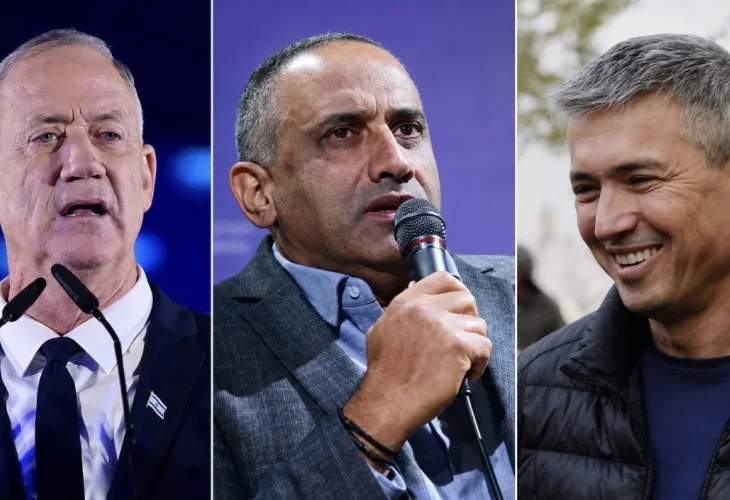
Benny Gantz, Yoaz Hendel and Dedi Simchi are moving toward a possible joint run as Israel’s center-right map becomes crowded with small parties fighting to survive the electoral threshold.
Gantz, the head of Blue and White, is a former IDF chief of staff and former defense minister. His brand is experience, security and national responsibility. Hendel, a former communications minister, now leads the Reservists Party and has focused his campaign on draft equality, reservists, a state commission of inquiry into Oct. 7 and a Zionist government without Arab or Chareidi parties. Simchi, a brigadier general in reserves and former Fire and Rescue commissioner, is the bereaved father of Guy Simchi HY”D, who fell on Oct. 7 after saving others at Re’im. He presents himself as a public-service and security figure trying to connect Israel’s political blocs.
Gantz, Hendel and Simchi are all struggling to become decisive political forces, hovering near or below the electoral threshold Israel’s electoral threshold is 3.25%, about 4 seats. A party that fails to cross it receives no Knesset seats, and its votes are effectively lost.
The proposed merger, however, is still unlikely to produce Israel’s next prime minister, but it could still affect who has a path to form the next government. Together, a recent Channel 12 poll gave a joint Gantz-Hendel-Simchi list about six seats, enough to enter the Knesset but not enough to give either political bloc a 61-seat majority.
The voter lane they are seeking is the “soft right” and center-right: Israelis who are Zionist, security-minded, concerned about the draft burden and uncomfortable with Netanyahu’s current coalition, but who do not see themselves as left-wing.
This is why the merger is more of a “threshold-and-leverage” project. The three are not trying to become the largest party, but a small, necessary party that can prevent wasted center-right votes and push the next government toward a broader coalition.
That is where the phrase “broad government” becomes important. A narrow government means a coalition built mainly from one bloc, often with just enough seats to reach 61. In the current Israeli context, that usually means a Netanyahu-led coalition relying on Likud, Chareidi parties and hard-right parties.
A broad government means a coalition that crosses bloc lines and has a wider majority. In the language used by Gantz, Hendel and Simchi, it means a broad Zionist government “that reduces the power of small sectoral or ideological parties.”
Gantz said in an Israel Hayom interview that they were “days away from mergers” and warned, “A narrow government is a prelude to the next massacre.” He has also blamed Netanyahu for Oct. 7 and said he must end his term, while still presenting himself as a politician who wants a broad Zionist government rather than a left-wing bloc.
Hendel has taken the sharpest line. He said he would sit only in a government that establishes a state commission of inquiry and passes a draft law. He also said, “I am not interested in a government that includes Arabs or Chareidim. These are not Zionist parties.”
Simchi’s emphasis is different. In an interview with Kan Reshet Bet, he said he and Gantz were in “very advanced talks” to create “something new.” He said his contribution would be greater by connecting the blocs than by strengthening one side, while also saying the current Arab parties should not be part of a future coalition, “certainly not after Oct. 7.”
This also separates them from Bennett and Lieberman. Bennett is asking voters to make him the alternative prime minister. Lieberman is asking voters to back a hard secular-right fight, especially on Netanyahu and Chareidi draft exemptions.
Some voters may see Bennett as too large a gamble because he is running to lead the country and still carries memories of his previous coalition with Arab parties. Others may agree with Lieberman on the draft issue but see his style as too confrontational or too sharply secular-right.
The Gantz-Hendel-Simchi pitch is aimed at voters who want change, draft reform and a broader government, without feeling they have joined the left or backed a hard anti-Chareidi campaign.
That is why the merger could matter far beyond its size. If Gantz, Hendel and Simchi cross the threshold together, they may not decide who leads Israel, but they could help decide which bloc has a path to build a government. If they fail to unite, their voters could fall below the threshold and disappear from the next Knesset altogether.

