

Depression and Anxiety
Fear of Flying? Pilots Reveal the Truth That Can Help Calm Your Anxiety
From turbulence myths to cockpit safety procedures, experienced pilots explain why flying is safer than most people think and share practical tips for overcoming flight anxiety
- Shira Priant
- | Updated
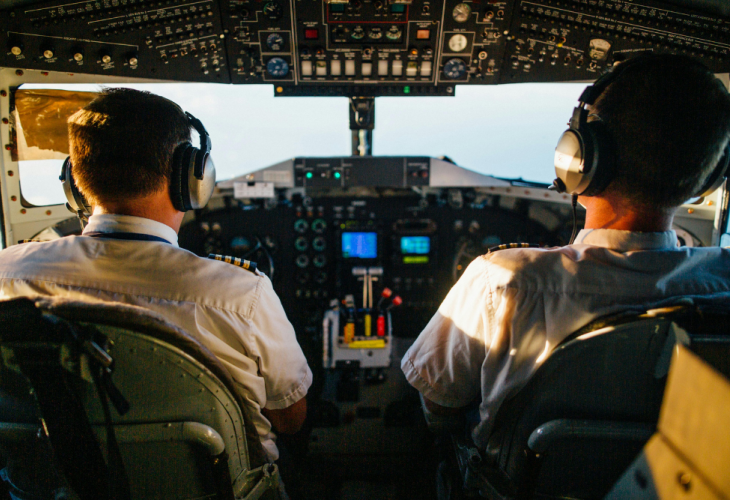
Packing a suitcase for an upcoming vacation is exciting... until you arrive at the airport.
Whether you're flying to pray at the resting place of Rabbi Nachman of Breslov in Uman or to enjoy a vacation in Eilat, many travelers experience the same thing just before takeoff. Your heart starts beating faster, your palms become sweaty, and your mind begins imagining worst case scenarios.
Fear of flying is a common experience, but aviation experts say the problem is not an objective danger. Rather, it stems from the gap between the technical reality of flying and the way our minds interpret it.
We gathered some of the key insights shared by experienced pilots, who explain what flying looks like from the cockpit and how understanding the facts can make your next flight far more relaxing.
What Are We Really Afraid Of?
Many people struggle with flight anxiety, and some avoid flying altogether. In most cases, however, the fear is not caused by the flight itself but by our brain's interpretation of the situation.
Some of the most common fears include:
Loss of control: In everyday life, we make countless decisions for ourselves. On an airplane, we place our trust in a stranger, the pilot, and enter a sealed metal cabin. The inability to simply "pull over" or change course creates a deep sense of helplessness for many people.
Uncertainty: The human brain naturally fears the unknown. Every unfamiliar sound or movement can easily be interpreted as a sign of danger, when in reality it is often a completely normal part of flight.
Claustrophobia: For some passengers, the airplane itself is not the problem. The confined space is. Knowing there is no quick exit can trigger panic, increasing feelings of anxiety.
Fear of the fear itself: This is often the most powerful cycle. Many people are not only afraid of flying but also afraid they might have a panic attack in front of other passengers. The fear of appearing vulnerable or losing control creates even greater anxiety and can become a self fulfilling prophecy.
The Biggest Myth: Turbulence
One of the greatest fears among airline passengers is turbulence. While it can feel frightening in the cabin, pilots view it as a routine part of flying.
Aircraft are engineered to withstand forces far greater than even the strongest natural turbulence. Turbulence is not an "air pocket" or a hole in the sky. It is simply a change in airflow that poses no threat to the aircraft's structure.
Pilots often compare turbulence to driving over a bumpy road. As long as passengers keep their seat belts fastened, it presents no safety risk.
Aviation Is the Safest Form of Transportation
Concerns about the mechanical condition of an aircraft are another major source of anxiety. Pilots emphasize that commercial aviation is one of the most carefully maintained industries in the modern world.
Every critical aircraft system has at least one backup, and often two or even three. Even in the extremely rare event of an engine failure, modern aircraft are fully capable of continuing to fly safely and landing without incident.
Before every departure, pilots and maintenance crews complete an extensive series of inspections and safety checks. An aircraft simply does not take off without full technical clearance.
Inside the Cockpit
Many people imagine pilots becoming stressed when something unexpected happens. In reality, the opposite is true.
Pilots undergo intensive simulator training every six months, repeatedly practicing emergency situations and extreme scenarios. They do not rely on instinct or improvisation. Instead, they respond using carefully rehearsed procedures designed for virtually every possible situation.
Throughout every flight, pilots also maintain constant communication with air traffic controllers and meteorological specialists on the ground, who continuously monitor weather conditions and the aircraft's route in real time.
Practical Ways to Calm Flight Anxiety
Aviation experts recommend several simple psychological and physical techniques that can help reduce anxiety while flying.
Talk to the cabin crew. Flight attendants receive specific training in helping passengers who experience flight anxiety. Letting them know how you feel can significantly reduce your stress.
Control your breathing. Anxiety naturally causes breathing to become shallow and rapid. Instead, try slow diaphragmatic breathing: inhale for four seconds, pause for one second, then exhale slowly for six seconds. This signals to your nervous system that your body is safe.
Keep your mind occupied. Rather than focusing on the changing sounds of the engines, which naturally vary throughout the flight, engage your brain with an activity that requires concentration, such as reading a challenging book or working on crossword puzzles.
With the right knowledge and perspective, flying becomes far less mysterious and much less intimidating. Understanding what is actually happening behind the scenes can replace fear with confidence and allow you to enjoy the journey.
Have a pleasant flight!

