

Health and Nutrition
How a 20-Minute Brain Procedure Helped End One Man's Opioid Addiction
After years of opioid addiction, one patient experienced a dramatic turnaround through an experimental brain treatment now being tested at only four hospitals worldwide.
- Michal Ariel
- | Updated
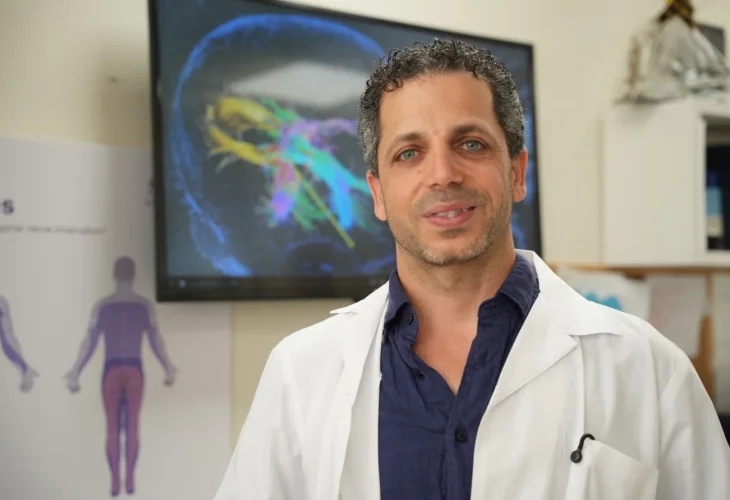 Dr. Lior Lev-Tov, director of the Functional Neurosurgery Unit at Rambam
It started five years ago with what seemed like an ordinary accident.
While swimming one summer day, Arye, a man in his forties, suffered a serious neck injury. Doctors discovered fractures in his cervical vertebrae. Although the injury did not require surgery, it left him with severe, chronic pain.
To help manage the pain, doctors prescribed opioid medications.
"The pain disappeared," Arye would later say, "but the pills stayed."
What began as legitimate medical treatment gradually turned into a devastating addiction. Over time, Arye reached the point of taking nearly 130 painkillers every day.
No family physician was willing to prescribe such large quantities, forcing him to seek the medication through other channels at enormous financial and emotional cost. His addiction devastated his entire family. His wife, children, and mother all watched helplessly as his life spiraled out of control.
Then, last month, something extraordinary happened.
After a procedure lasting only about 20 minutes, Arye reported that the overwhelming craving that had dominated his life for five years had simply disappeared.
When Neuroscience Meets High Tech
Dr. Lior Lev-Tov, director of the Functional Neurosurgery Unit at the Neurosurgical Division of Rambam Medical Center, shared Arye's story and explained the groundbreaking technology behind the treatment.
"Our goal is to make advanced neuromodulation treatments available to patients with neurological disorders," Dr. Lev-Tov explains. "Neuromodulation allows us to precisely influence the electrical activity that takes place between the brain, spinal cord, and nervous system."
His team treats patients with complex movement disorders such as Parkinson's disease and essential tremor, as well as severe chronic pain, epilepsy, obsessive compulsive disorder (OCD), and major depression.
"Is There a Connection Between All These Conditions?"
"On the surface, they seem completely unrelated," Dr. Lev-Tov says. "But when you look deeper, they all involve abnormal electrical activity within the brain."
"My job is to identify where that disruption is occurring and determine which neural circuit is responsible for the patient's symptoms."
Although the same technology is used, every treatment is personalized.
"We identify the specific electrical pathway involved in that patient's condition and tailor the treatment accordingly."
A New Approach to Treating the Brain
One of the primary tools used by Dr. Lev-Tov's team is focused ultrasound technology developed by the Israeli medical technology company Insightec.
"This technology has been approved by both the U.S. Food and Drug Administration and Israel's Ministry of Health for about 13 years," he explains.
Until now, focused ultrasound has been used primarily to treat tremors associated with Parkinson's disease.
Using MRI guidance, doctors direct highly focused ultrasound waves to precise locations deep within the brain, creating tiny lesions in areas responsible for abnormal movement.
"The precision is extraordinary," says Dr. Lev-Tov. "We're working with an accuracy of just two to three millimeters, allowing us to treat patients without opening the skull or performing traditional brain surgery."
A Device That Doesn't Destroy Brain Tissue
The new technology being tested takes that concept even further.
"This completely changes the way we think about treatment," Dr. Lev-Tov explains.
"Unlike previous systems, we no longer need to destroy tissue. We don't heat the brain, and we don't perform irreversible procedures."
Instead, the new device temporarily alters electrical activity within specific brain regions.
"It's essentially a noninvasive virtual electrode," he says. "I can move between precisely defined locations deep inside the brain and adjust their electrical activity without damaging the tissue."
"For years I dreamed of reaching this point. Now it's finally here."
Only Four Hospitals Were Chosen
The technology is currently being evaluated as part of an international clinical trial designed to address the global opioid addiction crisis.
Only four hospitals worldwide were selected to participate.
Three are in the United States.
The fourth is Rambam Medical Center in Haifa, the only participating hospital outside the U.S.
"In the United States alone, roughly nine million people develop opioid dependence each year," says Dr. Lev-Tov.
"These medications are highly effective painkillers, but they are also extremely addictive. Israel faces lower numbers, but addiction remains a serious problem here as well."
"Our goal is to help ordinary people whose addiction began with a medication prescribed after an injury and eventually took over their lives."
"What Happened in Arye's Case?"
"As part of the procedure, we targeted the brain's reward and craving center," Dr. Lev-Tov explains.
"The focused ultrasound generated electrical stimulation that temporarily recalibrated activity in that region."
The results were immediate.
"While Arye was still inside the MRI scanner, we saw a dramatic reduction in his craving. He told us in real time that his desire for the pills had dropped from overwhelming to zero."
One week later, laboratory tests confirmed that no opioids remained in his system.
"He told us emotionally that he had gotten his life back."
Will the Results Last?
"The honest answer is that we don't know yet," Dr. Lev-Tov says.
"Science requires long-term follow-up before we can draw firm conclusions."
Even so, the early findings are encouraging.
"We already have patients in the United States who underwent this treatment about a year ago, and their improvement has remained stable. Their cravings have not returned."
Still, he believes technology alone is unlikely to be enough.
"My view is that patients will continue to need counseling, follow-up care, and emotional support."
"We may eliminate the physical craving, but life continues. What happens if someone later offers the patient a pill? What if they encounter emotional triggers? Those are exactly the questions we're now studying."
Why Is It Still Experimental?
Despite the promising early results, Dr. Lev-Tov stresses that the treatment remains experimental.
"We're still in the middle of the research process," he emphasizes.
"We need larger studies before we can accurately determine its effectiveness, safety profile, and long-term outcomes."
He notes that addiction remains one of medicine's most difficult conditions to treat.
"Current detoxification approaches—including medication assisted treatment, behavioral therapy, and counseling—have relapse rates approaching 90 percent."
While the new technology offers hope, it is unlikely to become widely available immediately.
"It will probably be several more years before the research is complete," he says.
Even after approval, he expects patients will first need to try conventional treatments before becoming eligible for this more advanced option.
Looking to the Future
For Dr. Lev-Tov, treating addiction may be only the beginning.
"I've been dreaming about this since I first encountered focused ultrasound technology in 2013," he says.
"My goal has always been to influence deep brain activity without permanently damaging brain tissue."
He believes the technology could eventually transform the treatment of many neurological and psychiatric disorders.
"Our next goals include treatment resistant epilepsy, post traumatic stress disorder, major depression, central pain syndromes, and severe eating disorders."
Looking even further ahead, he hopes the technology may one day help patients with attention deficit disorders, Alzheimer's disease, Parkinson's disease, and other complex neurological conditions.
"We're only seeing the tip of the iceberg," he says. "Our mission is to continue advancing this technology so we can bring hope and relief to thousands of people."

