

Israel News
IDF Phone Lost Inside Southern Syria Shows Israel’s New Challenge Near The Golan
Israel’s activity in southern Syria is aimed at keeping hostile forces away from the Golan after Assad’s fall
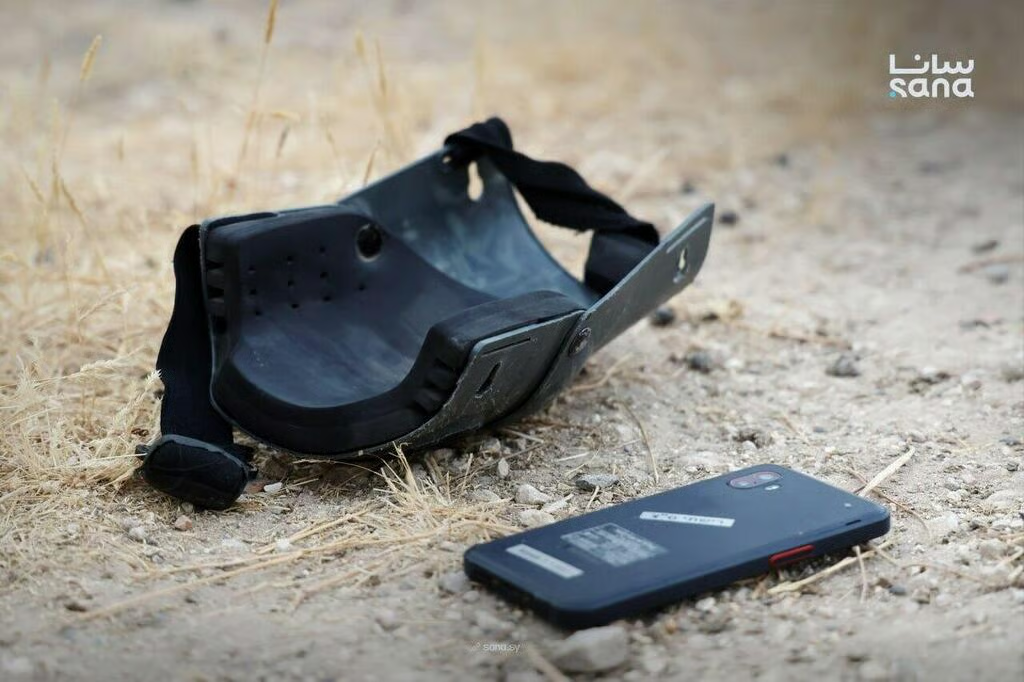
A classified IDF phone lost during a clash near the village of Abdin in southern Syria has drawn attention to Israel’s new security challenge near the Golan Heights.
The incident began after gunfire was directed at IDF troops stationed near Tel Qudna. The IDF responded with artillery and mortar fire, followed later by fire from an attack helicopter. During the confusion, one reservist lost a classified military phone, which was taken by a Syrian resident. The device was reportedly locked remotely to reduce possible damage.
One reservist stationed in the area told Ynet that civilians had gathered near the post before the force withdrew. “There was a gathering of civilians. Many people came to the area of the post, and the soldiers had to pull back,” he said.
But the lost phone is only one part of a wider story. Since the fall of Bashar Assad’s regime on December 8, 2024, Israel has treated southern Syria as an unstable security front. Israeli forces moved into the former buffer-zone area and took positions near the Golan, including on the Syrian side of Mount Hermon. Israel has said the deployment is defensive and aimed at protecting communities in the Golan Heights.
Defense Minister Israel Katz previously warned: “Any attempt by the Syrian regime and terrorist organizations to establish themselves in the security zone in southern Syria will be met with fire.”
Israel’s concern is not only the new Syrian leadership in Damascus. Southern Syria remains filled with local armed factions, former regime infrastructure, smuggling routes and militant networks. Israeli officials fear Hezbollah-linked cells, Iran-backed weapons routes, jihadist groups or other hostile forces could use the vacuum to move closer to the border.
That is why the Daraa-Quneitra area matters. It sits near the Golan and includes roads, village entrances, high ground and movement corridors that Israel wants to monitor or block. For Israel, the issue is not only who controls Damascus, but who controls the approaches to the Golan.
The Abdin clash also appears to be part of a wider pattern. The Syrian Observatory for Human Rights said it documented more than 60 Israeli incursions into Syrian territory during June. Those incidents included patrols, temporary checkpoints, reported arrests and interrogations around Daraa and Quneitra.
That pattern has created growing friction with local residents. Syrian footage from Abdin showed residents throwing stones at Israeli troops, while residents fled the village during the strikes. “The whole town was evacuated. No one stayed,” one resident told Syrian state media.
Damascus has framed the Israeli activity as a violation of Syrian sovereignty. Syria’s Foreign Ministry said: “We condemn the Israeli attacks and incursions into Syrian territory in the Quneitra and Daraa provinces. The continuation of these methods harms efforts to establish security and stability and worsens the suffering of civilians.”
The pressure is also regional. Turkey and several Arab states condemned the latest Israeli activity, describing it as a violation of Syrian sovereignty, international law and the 1974 disengagement agreement between Israel and Syria.
For now, the incident is not expected to trigger a direct regional confrontation. But it shows the new tension around Israel’s activity in southern Syria: the IDF says it is preventing threats from forming near the Golan, while Syria, Turkey and Arab states say Israel is violating Syrian sovereignty.
The lost phone was an operational failure. The larger issue is Israel’s security presence in southern Syria, which Israel presents as defensive and necessary, but which is now drawing more resistance on the ground and more criticism abroad.

