

World News
Supreme Court Takes Up Orthodox Jew’s Home Prayer Permit Case
Daniel Grand says University Heights officials used zoning rules to stop a Shabbos minyan in his Ohio home
 Screenshot/X
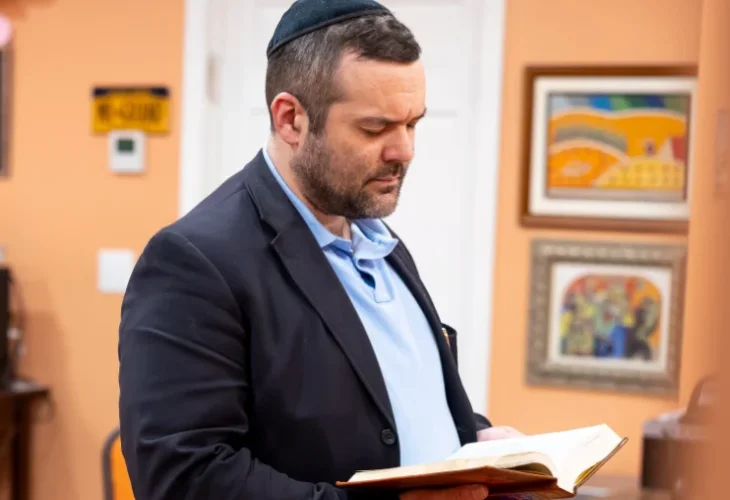
The U.S. Supreme Court has agreed to hear the case of Daniel Grand, an Orthodox Jew from University Heights, Ohio, who says city officials required him to obtain a special-use permit before hosting Shabbos prayer gatherings in his home.
The case will not immediately decide whether the city violated Grand’s religious freedom. The justices will first consider whether his lawsuit can proceed after lower courts said the case was not ready for review because he withdrew his permit application before the city issued a final decision.
Grand, who lives in the Cleveland suburb, invited about a dozen neighbors in January 2021 to join him for a Shabbos minyan in his home. A minyan is a quorum of 10 Jewish men required for certain communal prayers. Orthodox Jews do not drive on Shabbos, making nearby prayer access a central part of religious life.
After a neighbor forwarded Grand’s email to then-Mayor Michael Dylan Brennan, city officials sent Grand a cease-and-desist letter. The city said it had been made aware that he intended to use his home as a “place of religious assembly” and warned that the property could not be used as a “shul or synagogue” without approval under local zoning rules.
Grand then applied for a special-use permit, but later withdrew the application. He said he did not want to operate a house of worship as defined by the zoning ordinance. He later sued the city and several officials, alleging violations of the First Amendment and federal religious land-use protections.
The federal district court and the Sixth Circuit Court of Appeals sided with the city on procedural grounds. The city argued that Grand withdrew the application before the planning commission made a final decision and that no enforcement action followed. In its Supreme Court brief, the city said, “the ordinance did not apply, Grand withdrew his application, and the City did nothing further.”
Grand is now represented by Alliance Defending Freedom and Orrick, Herrington & Sutcliffe. ADF said the city’s actions prevented a private religious gathering from taking place inside a home.
“Every American has the right to host a prayer gathering in his home,” said ADF Senior Counsel John Bursch. He said the case involves “a troubling trend of weaponizing zoning laws against people of faith.”
Several Jewish and religious-liberty groups filed briefs supporting Grand, including Agudath Israel of America, the National Jewish Advocacy Center, the Orthodox Union and the National Council of Young Israel. Agudath Israel’s general counsel, Daniel Kaminetsky, said, “This case strikes at the very heart of religious freedom in America.”
University Heights’ current mayor, Michele Weiss, who was elected after the events at issue, told JTA that “everyone has a right to worship in their home with a small group of people (a minyan) without city involvement.” She added that a larger congregation using a residence should have a path through the city planning process.
The Supreme Court will hear the case next term. The immediate question is whether Grand may pursue his religious-freedom claims in federal court.

