

Interesting
War's Unexpected Legacy: Bird Nests Made From Drone Cables
Birds near Ukraine's front lines are using abandoned fiber optic drone cables as nesting material, highlighting war's surprising impact on the natural world.
- Shira Davush
- | Updated
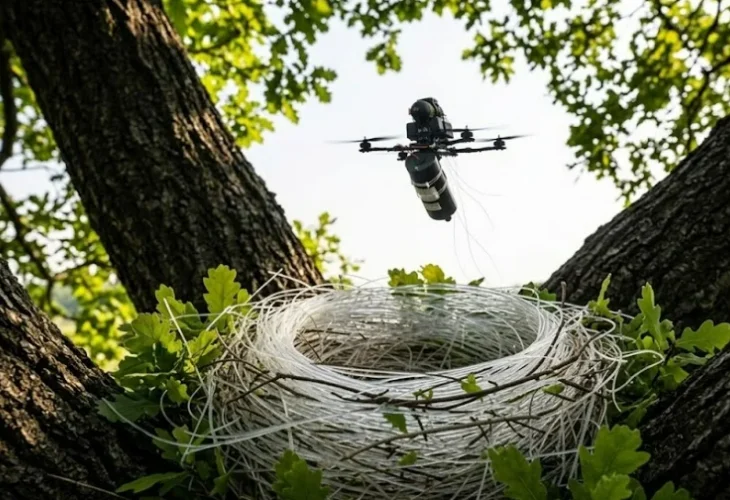
More than four years of war in Ukraine have dramatically reshaped the landscape. Open fields have become battlefields, forests have been destroyed, and military positions now cover large areas of the country.
Amid this devastation, soldiers recently made an unexpected discovery near the front lines: bird nests woven not only from twigs and grass, but also from fiber optic cables once used to control military drones.
Researchers say the nests offer a striking example of how war affects not only people, but also the wildlife that shares the same environment.
Adapting to a Changing Environment
According to Dr. Yana Hrynko, a senior researcher at the War Museum in Kyiv, birds naturally build their nests using whatever materials they can find nearby.
Normally, that includes branches, grass, leaves, feathers, animal hair, and occasionally bits of thread or plastic left behind by people.
Now, however, birds have begun incorporating discarded fiber optic cables into their nests.
"They simply see the cables as another available building material," Hrynko explained. "They have no way of knowing that what they are using is a remnant of war."
Why Are So Many Cables Scattered Across the Landscape?
Along Ukraine's roughly 1,200 kilometer front line, thousands of thin fiber optic cables now cover the ground.
Both Ukrainian and Russian forces use these cables to operate certain military drones. Unlike drones controlled by radio signals, these drones remain connected to their operators through extremely thin fiber optic cables, making them much more resistant to electronic jamming.
During a mission, a drone may release as much as 20 kilometers of cable behind it. Once the mission ends, the cables remain where they fall, draped across trees, tangled in vegetation, stretched over rooftops, or scattered across fields.
In sunlight, they often shimmer like enormous spider webs.
A Discovery That Surprised Researchers
One of the nests examined was built primarily from dry grass, with fiber optic strands tightly woven throughout its structure.
According to Hrynko, the nests illustrate how modern warfare is changing not only human lives but the natural world as well.
The nests were collected by Ukrainian soldiers serving near the front lines and donated to the War Museum in Kyiv.
Reuters also interviewed soldiers stationed in the Donetsk, Kharkiv, and Zaporizhzhia regions, several of whom reported finding similar nests. Some had even shared photographs and videos online, suggesting the phenomenon may be more widespread than initially believed.
Scientists Hope to Identify the Birds
Researchers still do not know which species built the nests.
One nest will remain at the War Museum in Kyiv as part of an exhibit documenting the environmental impact of the war. The second will be sent to the Netherlands for detailed scientific analysis before eventually being returned to Ukraine.
Dutch biologist Auke Florian Hiemstra, who studies the use of human made materials in bird nests, said he had never encountered anything quite like it.
Scientists hope to recover traces of DNA from the nests to identify the birds responsible. According to Hiemstra, Ukraine is home to many bird species, leaving several possible candidates.
Could the Cables Help or Harm Birds?
Researchers say it is still too early to know whether the fiber optic cables ultimately benefit or endanger the birds.
On one hand, the cables could pose a risk if birds or chicks become tangled in them.
On the other hand, fiber optic cables are both strong and flexible, meaning they could reinforce the nests and make them more durable.
For now, the unusual nests stand as a powerful reminder that the effects of war extend far beyond the battlefield, reaching even the smallest corners of the natural world.

