

Between the Straits (The Three Weeks)
From Breach to Destruction: The Maharal's View of the Three Weeks
Discover the Maharal's explanation of how the tragedies of the Three Weeks unfolded from beginning to end.
- Yehosef Yaavetz
- | Updated
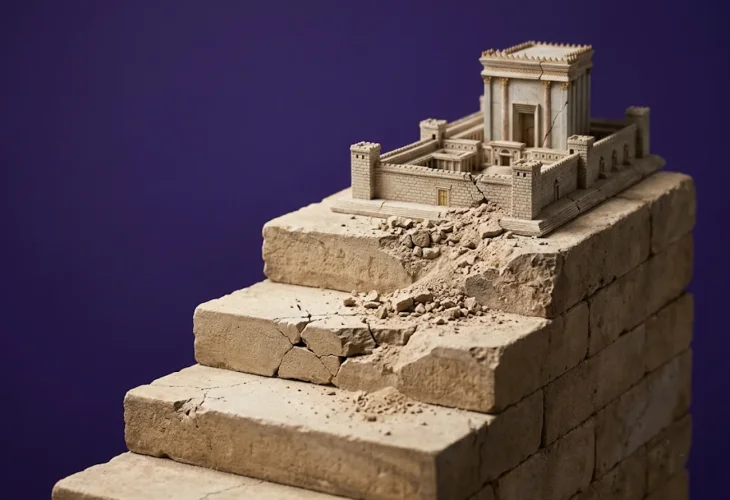
The period of Bein HaMetzarim, also known as the Three Weeks, begins on the Seventeenth of Tammuz and continues until Tisha B'Av. During these weeks, the Jewish people mourn the events that led to the destruction of the Beit HaMikdash and reflect on the spiritual causes of exile.
The Mishnah (Ta'anit 4) teaches that five tragedies occurred on the Seventeenth of Tammuz and another five on Tisha B'Av.
On the Seventeenth of Tammuz, the following took place:
- The Tablets of the Covenant were broken.
- The daily offering ceased.
- The walls of Jerusalem were breached.
- Apostomus burned a Torah scroll.
- An idol was placed in the Sanctuary.
On Tisha B'Av, five additional calamities occurred:
- The generation of the spies was sentenced to die in the wilderness.
- The First Beit HaMikdash was destroyed.
- The Second Beit HaMikdash was destroyed.
- Beitar fell.
- Jerusalem was plowed over.
The Beginning and the End of Calamity
In Netzach Yisrael (Chapter 8), the Maharal explains that everything in creation has its appointed time. Even Israel's enemies have times when they are given greater power.
The Seventeenth of Tammuz, he explains, is not the time of complete destruction. Rather, it marks the beginning of calamity.
The months of Tammuz and Av come at the end of the yearly cycle, when the summer heat reaches its greatest intensity. The Maharal describes Tammuz as the "edge" or beginning, while Av represents the conclusion.
This distinction helps explain the events associated with each day.
The breaking of the Tablets marked the beginning of the consequences of the Golden Calf, but new Tablets were later given.
The daily offering ceased, but it could eventually be restored.
The breach of Jerusalem's walls, the burning of the Torah scroll, and the placement of an idol in the Sanctuary all represented serious spiritual and national setbacks, yet none of them marked complete destruction. The Beit HaMikdash could still be restored, as it later was during the Hasmonean period.
Tisha B'Av, however, represents the final stage.
The destruction of the Beit HaMikdash, the decree following the sin of the spies, the fall of Beitar, and the plowing of Jerusalem all marked irreversible turning points that led to the long exile of the Jewish people.
The Symbolism of the Two Hands
The Maharal compares the five tragedies of the Seventeenth of Tammuz to the five fingers of the right hand and the five tragedies of Tisha B'Av to the five fingers of the left hand.
The right hand symbolizes beginnings. People naturally begin important actions with their stronger hand.
The left hand represents completion, bringing a process to its final stage.
In the same way, the Seventeenth of Tammuz marks the beginning of tragedy, while Tisha B'Av marks its completion.
Why the Sin of the Spies Was So Significant
The Maharal explains that the sin of the spies had lasting consequences because it separated two events that were meant to be one.
Hashem took the Jewish people out of Egypt in order to bring them into the Land of Israel.
Had the generation that experienced the Exodus also entered the Land, those two events would have formed one continuous act.
Since the Exodus was accomplished through open miracles, its connection to entering the Land would likewise have carried an eternal quality.
Instead, the generation of the spies refused to enter the Land, and Hashem decreed that they would die in the wilderness. A new generation would eventually enter instead.
As a result, the Exodus and the entry into the Land became two separate events.
The Exodus itself remains eternal because it was accomplished through miracles that transcend the natural order. But the opportunity for the first generation to complete that journey was permanently lost.
The Meaning of the Number Ten
The Maharal notes that Chazal identify ten major tragedies during this period, five on the Seventeenth of Tammuz and five on Tisha B'Av.
This number is significant.
Although ten often represents holiness and completeness, it can also symbolize the complete strength of forces that oppose Israel.
The destruction of the Beit HaMikdash reached its full expression on the Tenth of Av, after the period of judgment had reached its culmination.
Three Stages of the Destruction
Chazal describe the destruction of the Beit HaMikdash as unfolding in three stages.
On the Seventh of Av, the enemy entered the Sanctuary and took control of it.
On the Ninth of Av, they set the Beit HaMikdash on fire.
On the Tenth of Av, the fire continued to burn, completing the destruction.
The Maharal explains that by the Seventh of Av, the process had already advanced beyond its midpoint, allowing Israel's enemies to gain control of the Sanctuary.
On the Ninth of Av, as the day drew to a close and evening approached, they were given the ability to ignite the Beit HaMikdash.
The destruction itself reached completion on the Tenth of Av, when the fire continued to consume the Temple.
Through this progression, the Maharal shows that the events of Bein HaMetzarim were not random tragedies. Rather, they unfolded in carefully ordered stages, from the first breach to the final destruction, reminding us that both judgment and redemption unfold according to Hashem's plan.

