

World News
Swiss Teen Sentenced to One Year for Antisemitic Stabbing and Planned Synagogue Attack
A 17-year-old Swiss national received a maximum one-year sentence for a 2024 antisemitic stabbing and planned synagogue massacre.
- Hidabroot
- | Updated
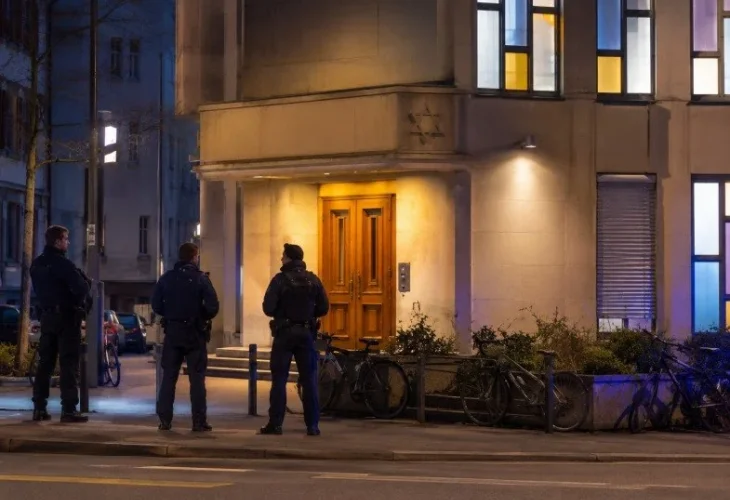
A Swiss court is expected to sentence a 17 year old to one year in prison for a brutal antisemitic stabbing attack in Zurich, in which he stabbed a Haredi Jewish man 17 times and had planned a far larger massacre at a synagogue. The verdict is due on Tuesday, July 7, at 1:30 p.m. local time. This is the maximum term permitted under Swiss juvenile law, since the attacker was 15 years old at the time of the assault on March 2, 2024.
The defendant, a Swiss Tunisian national, refused to answer questions during the proceedings, responding to each one with “no comment.” Judges relied on statements he made during earlier investigations, which revealed that he had hoped to be shot dead by police after the assault so he could die as a “shahid” and reach paradise.
According to the indictment, the teenager underwent rapid radicalization following the Hamas massacre of October 7, 2023. By January 2024, he was searching online for information about the Islamic State and methods for manufacturing explosives, and exchanged messages with a like minded individual about bomb production. After concluding that building an explosive device was too complicated, he chose to carry out a knife attack instead.
The day before the assault, he bought a butcher’s knife at a Zurich shopping center and used social media to determine when worshippers gathered at the synagogue. His stated goal, according to prosecutors, was to “kill as many Jews as possible.” On the day of the attack, he activated a livestream on his phone before arriving at the synagogue. Because of a technical fault, only audio was recorded. In the recording, he can be heard complaining that the synagogue door was locked, then saying he would wait for someone to come out. Moments later, he is heard saying, “Now I have one,” followed by the sound of running, the sounds of the attack, cries of “Allahu Akbar,” and the arrival of emergency services.
A 50 year old Haredi Jewish man was attacked from behind and stabbed repeatedly. The assailant initially aimed at his neck and head, then attempted to slit his throat, inflicting a total of 17 stab wounds. Although the man managed to flee several meters into the street, the attacker pursued him and continued stabbing until bystanders overpowered him on the hood of a car that had stopped at a red light. He was rushed to the hospital in serious condition, suffering from multiple lung injuries, and survived only after emergency surgery.
Addressing the technical failure during the proceedings, the judge noted: “The entire event was recorded on a mobile phone, but he had it in his pocket. That is why there is only an audio recording.”
Prosecutors are seeking the maximum sentence of one year in prison on multiple counts of attempted murder. The defense has requested an acquittal on those charges and a six month sentence instead. Swiss juvenile law prioritizes rehabilitation over punishment, and even for the most serious offenses, sentences are far lighter than those applicable to adults. For adults, multiple counts of attempted murder can result in many years in prison, while murder carries a maximum sentence of life imprisonment. Judges may also order that the defendant be placed in a closed educational institution until the age of 25, and are expected to rule on whether to strip him of his Swiss citizenship, a step that could lead to his deportation to Tunisia.
The expected sentence has drawn sharp public criticism. Prof. Jan Agar, a criminal law specialist at the University of Zurich, explained that the lenient framework rests on two central principles: rehabilitation is seen as more effective than harsher punishment in preventing repeat offenses, and research suggests that adolescents have not yet fully developed behavioral self control, leading legislators to treat their criminal responsibility as reduced. “Harsher sentences do not lead to fewer crimes. Effective treatment does,” Agar said.
The possibility that a teenager who planned a mass killing could serve no more than one year in prison has fueled calls for legislative reform. Swiss lawmakers have begun advancing a proposal that would allow significantly harsher sentences when minors commit ideologically motivated terrorist offenses. A previous effort to raise the maximum sentence for 15 year olds from one year to two years stalled in parliament, and observers note that even if new legislation is passed, the process in Switzerland is likely to take years.

