

Israel News
Experts Confirm Rare Box Jellyfish Sighting in Eilat Bay
A rare box jellyfish has been spotted in Eilat Bay, but officials say only a few were seen and there is no need to avoid swimming.
- Yuval Aviv
- | Updated
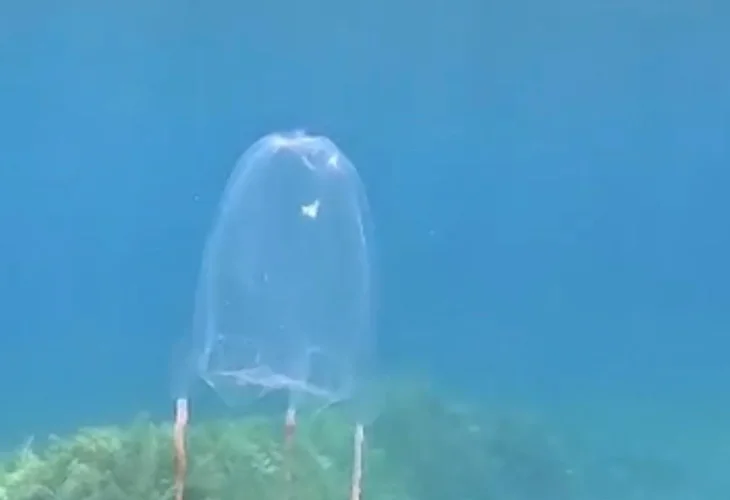 The box jellyfish (Photo: Courtesy of the Israel Nature and Parks Authority)
An unusual marine sighting has been reported in the waters of Eilat Bay: a small number of the rare box jellyfish Alatina grandis were recently spotted in the Red Sea, in what experts describe as a rare event for the area.
The Israel Nature and Parks Authority emphasized that this is not a large-scale phenomenon or a jellyfish bloom, but rather the sighting of only a few individual specimens. As a result, there is no recommendation to avoid swimming—only to continue enjoying the sea while remaining aware of your surroundings.
The jellyfish was identified by Dr. Tzafrir Koplik and Professor Tamar Guy-Haim after DNA testing and an examination of its unique physical characteristics. Among the features that confirmed the identification were its distinctive square-shaped bell and its characteristic tentacles, which distinguish it from other jellyfish species.
According to Dr. Assaf Zvuloni, Eilat Bay ecologist at the Israel Nature and Parks Authority, the likelihood of encountering one of these jellyfish is extremely low.
"There is absolutely no reason for panic or to avoid swimming," he said. "Alongside enjoying the sea, it is simply important to be aware of and familiar with the natural environment around you."
Box jellyfish are known worldwide because some species, particularly the Australian "sea wasp," are among the most venomous marine animals on Earth. However, the Israel Nature and Parks Authority stressed that the jellyfish found in Eilat Bay is not the deadly Australian species. While its sting can be painful and, in some cases, potentially dangerous, its venom is far less potent than that of the notorious Australian box jellyfish.
The authority said the appearance of Alatina grandis in Eilat Bay may be linked to changes in ocean currents and wind patterns, which could explain why the species is only rarely seen in the area. Officials also noted that climate change may be influencing the distribution of marine life, but stressed that there is currently no indication of a broader trend and that this appears to be an isolated event.

