

History and Archaeology
Archaeologists Just Discovered the Lost Temple of a Biblical Pharaoh
A remarkably preserved temple from Egypt's 26th Dynasty provides new historical context for one of the Bible's most significant periods.
- Yehosef Yaavetz
- | Updated
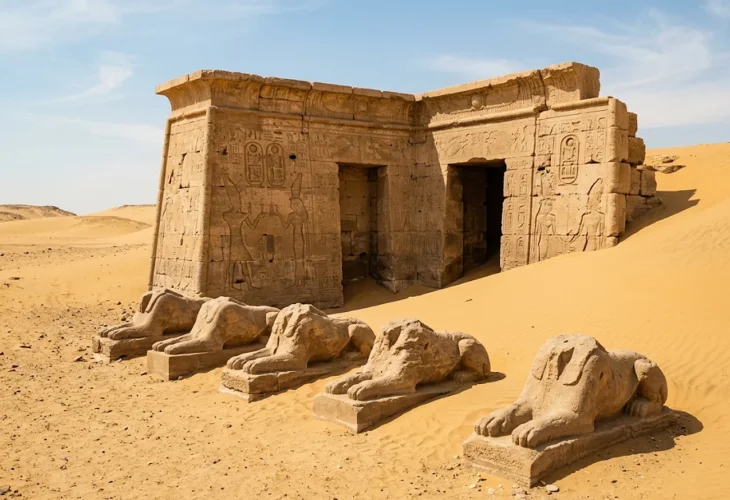
In February 2026, archaeologists announced one of the most significant discoveries in recent years: the remains of a long lost temple belonging to Pharaoh Apries of Egypt's 26th Dynasty were uncovered in the ancient city of Memphis.
The discovery is especially striking for Bible readers because Pharaoh Apries is mentioned by name in the Book of Jeremiah. There, the prophet delivers a warning about the Egyptian ruler's fate:
"Thus said Hashem: Behold, I will deliver Pharaoh Apries king of Egypt into the hand of his enemies and into the hand of those who seek his life, just as I delivered Zedekiah king of Judah into the hand of Nebuchadnezzar king of Babylon, his enemy and the seeker of his life" (Jeremiah 44:30).
A Remarkably Well Preserved Temple
The temple was built from fine limestone, and its exceptional state of preservation surprised researchers.
Large sections of its walls remain standing, decorated with reliefs and inscriptions showing Pharaoh Apries presenting offerings before Egyptian deities. The king's royal cartouche and official titles also appear throughout the complex.
Among the most impressive discoveries was a row of five limestone sphinxes guarding the entrance. Although the heads of the sphinxes have been lost over the centuries, their bodies remain largely intact, standing watch over the temple more than 2,500 years after they were carved.
Pharaoh Apries and the Prophet Jeremiah
To understand the importance of the discovery, it is necessary to return to the sixth century BCE.
Apries ruled Egypt during a period of intense political conflict as the Babylonian Empire under King Nebuchadnezzar II expanded throughout the region.
At the same time, the Kingdom of Judah sought Egyptian support in its struggle against Babylon. King Zedekiah, Judah's last king, placed great hope in an alliance with Egypt, believing Pharaoh Apries would come to Jerusalem's aid.
The prophet Jeremiah repeatedly warned that relying on military alliances rather than returning to Hashem was a tragic mistake. He prophesied not only Jerusalem's destruction but also that Pharaoh Apries himself would ultimately fall into the hands of his enemies.
Jerusalem was eventually destroyed by Nebuchadnezzar, and Apries later lost both his throne and his life, fulfilling Jeremiah's prophecy.
A King Seeking to Restore Egypt's Glory
According to the archaeologists, the newly discovered temple demonstrates that Apries invested heavily in strengthening both his political authority and his religious legitimacy.
In addition to leading military campaigns against Babylon, he undertook ambitious building projects in Memphis, Egypt's ancient capital, presenting himself as the rightful heir to the great pharaohs of earlier generations.
The magnificent temple reflects his desire to reinforce his rule through monumental architecture and traditional religious symbolism.
A Window Into the World of Jeremiah
One of the most fascinating aspects of the discovery is its connection to events described in the Book of Jeremiah.
After the assassination of Gedaliah son of Ahikam, groups of Jewish refugees fled to Egypt, taking the prophet Jeremiah with them. Scripture specifically mentions Tahpanhes, Noph, and other Egyptian cities.
Noph is the biblical name for Memphis, making this temple part of the very cultural and religious landscape encountered by the Jewish exiles who sought refuge there after the destruction of the First Temple.
Evidence of Egypt's International Army
The inscriptions uncovered at the site also provide new historical insights.
One inscription refers to "foreign soldiers" serving in Egypt's military.
Historical sources already indicate that Apries relied heavily on Greek mercenaries as well as soldiers from other nations. Researchers suggest that migrants and refugees from neighboring regions may also have become integrated into Egypt's military and administrative systems during this period.
Built With Egypt's Finest Stone
Scientific testing revealed that the temple's limestone originated from the famous Tura quarries on the eastern bank of the Nile.
For thousands of years, these quarries supplied the finest building stone for Egypt's most prestigious monuments.
The discovery shows that even during the final centuries of ancient Egyptian independence, the kingdom still possessed the organizational ability to transport massive quantities of stone and construct monumental buildings on a national scale.
Hidden Layers Beneath the Temple
Using advanced ground penetrating radar, archaeologists discovered that the temple stands atop even older remains dating to Egypt's New Kingdom, the era traditionally associated with the Exodus from Egypt.
The findings reveal that the site remained important across multiple periods of Egyptian history, with each generation building upon what came before.
From a biblical perspective, the discovery also highlights the dramatic historical contrast between Egypt's ambitions and the fulfillment of Jeremiah's prophecy. Apries sought to restore Egypt's former greatness, yet his reign ended in defeat. Following Babylon's rise, Egypt never fully regained the dominance it once held. Babylonian rule was eventually replaced by Persian control, and centuries later the country came under Greek rulers, marking the end of the ancient pharaonic era.
The newly uncovered temple therefore offers more than a remarkable archaeological discovery. It provides fresh historical context for one of the Bible's most significant periods, illuminating the world in which the prophet Jeremiah delivered his message and reminding us of the biblical theme that lasting security depends not only on political alliances or military strength, but ultimately on faithfulness to Hashem.

