

Iran Shuts Down the Strait of Hormuz as U.S. Strikes 140 Targets; Alerts Sound Across Gulf States
After a sweeping American assault on 140 targets in Iran, alerts were activated in Qatar, Bahrain, and the United Arab Emirates. Iran’s Revolutionary Guards claimed they destroyed a command-and-control center at Prince Hassan Air Base in Jordan. U.S. Defense Secretary Pete Hegseth said, "Iran made a bad choice, and now it is paying for it."
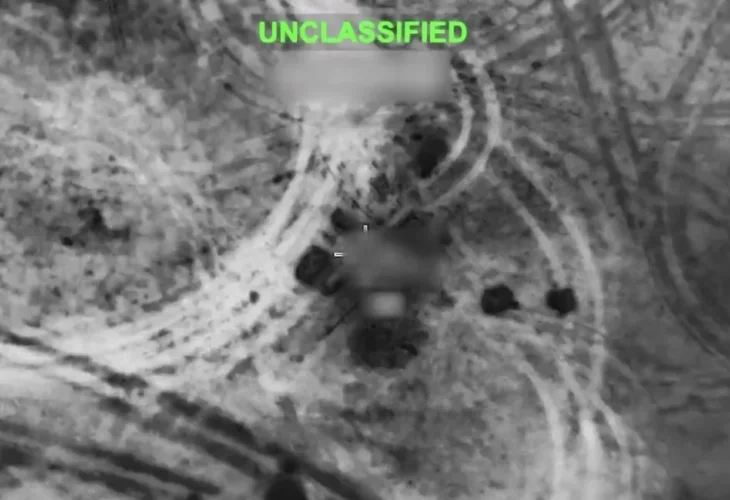 Footage of the strikes in Iran (Photo: U.S. Central Command)
Iran announced overnight — between Saturday night and Sunday — that it was closing the Strait of Hormuz "until American intervention in the region ceases," while simultaneously expanding the scope of its strikes against targets associated with the United States across Gulf states. The U.S. military completed a broad wave of strikes against Iran in the same period, hitting 140 military targets using precision munitions delivered from air and sea.
In a statement issued by the Islamic Revolutionary Guard Corps Navy, the closure of the Strait of Hormuz was declared "until further notice and until the end of American intervention in the region." Iran had earlier claimed that a vessel was traveling on an "unauthorized" route and that warning fire had been directed at it accordingly. In an official statement, Tehran warned that "if the enemy — under the pretext of this incident, which it itself provoked — carries out any further act of aggression, it will be met with a severe response, and new enemy bases in the region will be designated as targets."
The United States subsequently struck 140 military targets across Iran, including missile and drone launch sites, naval assets, weapons depots, and communications and surveillance infrastructure. According to U.S. Central Command, this represented the largest number of targets struck in a single night since the operation began. Central Command stated that more than 300 targets across Iran have been hit since the start of hostilities, with the declared objective of "degrading Iran's ability to attack civilian and commercial vessels transiting the strait."
American officials said the latest wave of strikes was triggered by a Revolutionary Guards assault on the container ship GFS Galaxy — sailing under a Cypriot flag — as it transited the Strait of Hormuz. According to the U.S. military, "one civilian crew member is missing, and the vessel is unable to continue its voyage due to an onboard fire and significant damage to the engine room."
U.S. Secretary of Defense Pete Hegseth addressed the escalation bluntly: "Iran made a bad choice, and now it is paying for it." Iran's chief nuclear negotiator Mohammad Bagher Ghalibaf responded to the American strikes with an equally pointed declaration: "The era of one-sided deals is over — keep your word, or pay the price."
Concurrent with the ongoing strikes, Iran broadened its campaign across the region. Since the resumption of hostilities, Tehran has launched attacks against targets in at least six countries hosting American military installations. Following the U.S. strikes in the Strait of Hormuz area, air raid alerts were activated in Qatar, Bahrain, and the United Arab Emirates.
The UAE Ministry of Defense confirmed that the country's air defense systems were actively responding to a combined missile and drone attack launched from Iran. Qatar's Ministry of Defense announced that its armed forces had intercepted a missile attack directed at the country. Interception systems were also activated across the UAE in response to incoming threats.
The Revolutionary Guards claimed responsibility for destroying a command-and-control center and aircraft hangars housing MQ-9 Reaper drones at Prince Hassan Air Base in Jordan. Iranian state news agency Fars reported that strikes against Bahrain had resumed, while local media reported that air raid sirens had been activated across the country.

