

Parashat Devarim
Every Good Deed Builds the Temple: A Powerful Tisha B'Av Lesson
How Torah, mitzvot, acts of kindness, and every sacrifice across the generations bring us one step closer to the rebuilding of the Beit HaMikdash
- Rabbi Moshe Sheinfeld
- | Updated
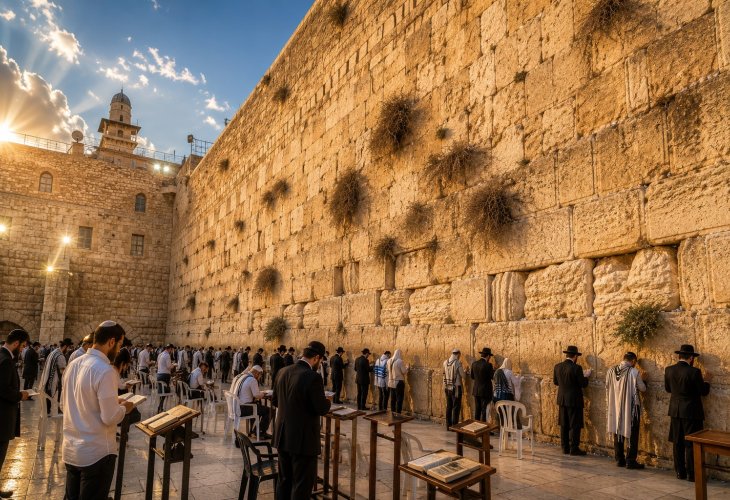
During the Three Weeks, we mourn the destruction of the Holy Temple.
In Parashat Devarim, Moses gently rebukes the people of Israel, reminding them, with great sensitivity and respect, of the places where they had angered God (see Rashi at the beginning of the parashah).
Among the events Moses recounts at length is the sin of the spies, the transgression that prevented that generation from entering the Land of Israel. We know that the night on which the Israelites wept over the spies' report was Tisha B'Av, the very day on which both Temples would later be destroyed.
Two Explanations for the Destruction
The Torah contains two sections of rebuke: one in Parashat Bechukotai and the other in Parashat Ki Tavo.
The Ramban writes (Leviticus 26:16) that the rebukes in Bechukotai refer to the events surrounding the destruction of the First Temple, while those in Ki Tavo describe the calamities that would accompany the destruction of the Second Temple.
When speaking about the Second Temple, the Torah identifies the cause of the destruction: "Because you did not serve the Lord your God with joy and gladness of heart, despite having an abundance of everything" (Deuteronomy 28:47).
The Torah explicitly states that the destruction of the Second Temple resulted from a lack of joy in serving God.
How does this fit with the well known statement of the Talmud?
"The Second Temple, whose generation was occupied with Torah, mitzvot, and acts of kindness, why was it destroyed? Because there was baseless hatred among them" (Yoma 9b).
What actually caused the destruction? Was it a lack of joy in serving God, or was it baseless hatred?
To answer this question, let us consider the remarkable insight of the Netziv of Volozhin in his introduction to the Book of Genesis.
When Hatred Dresses Itself as Holiness
The Netziv writes: "They were righteous, pious, and devoted students of Torah, but they were not upright in their dealings with others. Because of the baseless hatred they harbored toward one another, they suspected anyone who served God differently of being a Sadducee or a heretic. This led to bloodshed and countless other evils until the Temple was destroyed. God is perfectly just and cannot tolerate such righteous people unless they also conduct themselves with integrity in their relationships with others. Even if their intentions are for the sake of Heaven, crooked behavior ultimately brings destruction to the world and undermines civilization."
According to the Netziv, the people of the Second Temple period wrapped their hatred in the language of religious devotion. They convinced themselves that anyone who practiced Judaism differently was a heretic or an apostate.
On the surface, their disputes appeared to be "for the sake of Heaven." In reality however, they were fueled by baseless hatred.
Sadly, we continue to witness similar phenomena today. Entire communities become divided, relationships are shattered, and deep resentment develops. Everything begins with a disagreement that claims to be "for the sake of Heaven."
How many people justify their hostility by insisting that it is motivated by religious principle? Too often, this becomes nothing more than a convenient excuse to silence the conscience and give legitimacy to personal animosity.
Joy Leaves No Room for Baseless Hatred
The Netziv's insight may also resolve the apparent contradiction.
Baseless hatred of this kind can only develop where there is a lack of joy in serving God.
When a person genuinely delights in Torah, mitzvot, and closeness to God, hatred simply has no fertile ground in which to grow, certainly not hatred disguised as religious zeal.
Someone who finds joy in serving God is far less preoccupied with the weaknesses of others. Instead, such a person learns to recognize the good in himself and in those around him.
Joy in serving God elevates a person, enabling him to elevate others through unconditional love rather than baseless hatred.
Every Generation Builds the Temple
The Jerusalem Talmud teaches: "Every generation in which the Temple is not rebuilt is considered as though it destroyed it" (Yoma 1:1).
Elsewhere the teaching is phrased: "Every generation in whose days the Temple is not rebuilt is considered as though it was destroyed in its days."
What does this mean?
The Sefat Emet offers a remarkable explanation:
"It appears that throughout all the generations, every spiritual illumination created through the service of the Jewish people accumulates and combines to make the world worthy of redemption. Can anyone imagine that the generation of redemption alone will deserve redemption solely through its own merits? Rather, the merit of every generation contributes another part to the building of the Temple. Its construction continues throughout the entire exile, as implied by the phrase 'Builder of Jerusalem,' written in the present tense.
This is the meaning of the statement that every generation in which the Temple is not rebuilt is considered responsible. It means that its days did not become part of the ongoing construction.
The same is true of every individual. Every person should know that all of his deeds contribute to building the Temple. To the extent that we accept upon ourselves the yoke of Heaven, we assist in its construction" (Devarim 5634).
Adding Another Stone
Since the destruction of the Temple, every generation has been entrusted with the task of rebuilding it through Torah, mitzvot, and good deeds.
History is one continuous story. Each generation writes another page, and together they form a single harmonious book. The redemption will come through the accumulated good deeds performed by countless Jews from the day the Temple was destroyed until our own generation.
No single generation will complete the task alone.
Every generation contributes its share to repairing the world and rebuilding the Temple, and adds more light to the future redemption. Every one of us, every single day, has the opportunity to place another stone upon the ruins of Jerusalem.
King David writes: "You have counted my wanderings; place my tears in Your flask. Are they not recorded in Your book?" (Psalms 56:9; see also Shabbat 105b).
Every tear has been counted and carefully preserved. One day, that vessel will be full.
Millions of Jewish women lit Shabbat candles with tears streaming down their faces. Those tears were not forgotten. Every tear shed by a Jewish mother became another drop of water nourishing the seeds of redemption, and every act of self sacrifice entered that vessel.
When Jewish women in freezing lands broke through ice in order to fulfill the laws of family purity, their devotion was added to that same vessel.
When someone returned home exhausted after a long day of work but still studied a page of Talmud or a chapter of Mishnah before going to sleep, that effort was added to the vessel.
Every coin given to charity throughout the generations entered that vessel. Every prayer, every mitzvah, every act of kindness, and every thoughtful gesture toward another person.
Everything accumulates until the vessel is finally full, and the Temple will once again stand in all its glory.
One Question to Ask Every Day
When a generation gives up on its national mission and says, "There is nothing left for us to contribute. Previous generations have already done enough," it prevents the train from reaching its final destination.
Every generation in which the Temple is not rebuilt "in its days" is considered responsible because it failed to add its share to the ongoing construction.
Every day we are to ask ourselves one simple question: What stone did I place today in the rebuilding of the Temple?

