

Parashat Devarim
How the Five Books of the Torah Tell One Unified Story
Rabbeinu Bachya reveals the profound connection between Creation, faith, the Land of Israel, the Temple, and the final redemption
- Amitai Chania
- | Updated
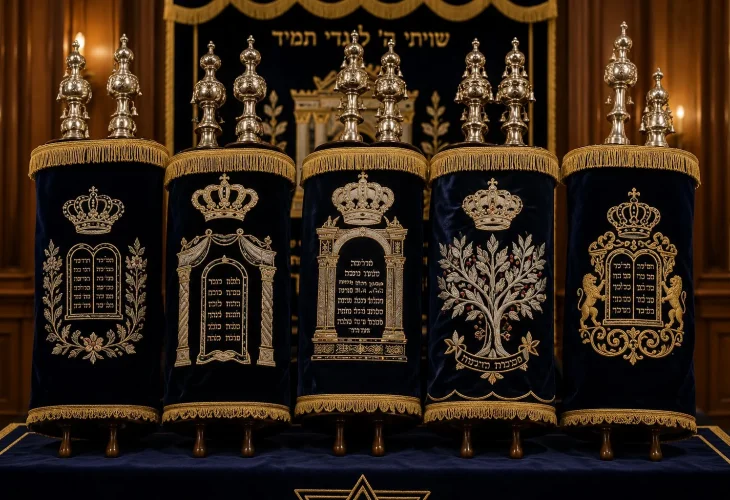
The Book of Deuteronomy is the fifth and final book of the Torah. Rabbeinu Bachya explains that although the Torah is divided into five books, they form a single, unified whole. Each book naturally follows the one before it, and together they present a complete spiritual journey that begins with Creation and culminates in the final redemption.
Genesis: The Foundation of Faith
The Torah begins with the Book of Genesis because the creation of the world is the foundation of faith.
Once a person believes that God created the world, he can understand Divine providence. From Divine providence comes the understanding that there is reward and punishment for human actions. Since these concepts are the very foundations of the Torah, Genesis focuses on the creation of the world and God's ongoing supervision of humanity, to whom He entrusted both positive and negative commandments.
The story of Adam and Eve illustrates this principle. Adam was rewarded by being placed in the Garden of Eden when he obeyed God's command, and he was punished with exile when he disobeyed.
Likewise, the story of the Flood powerfully demonstrates these same principles. Noah and his family were saved because of their righteousness, while the rest of humanity perished because of its sins.
As Rabbeinu Bachya writes: "The Torah begins with Genesis because the creation of the world is the root of faith. From belief in creation comes belief in Divine providence, and from providence comes the understanding of reward and punishment. Since these are the fundamental principles of the Torah, Genesis is devoted to creation and God's providence over mankind... The story of the Flood is likewise clear testimony to creation, providence, reward, and punishment, for Noah the righteous and his sons were saved because of their merit, while the people of that generation perished because of their sins."
Exodus: From Creation to Belief in One God
Genesis is followed by the Book of Exodus, which tells the story of the patriarchs Abraham, Isaac, and Jacob, who embraced faith in the One God and established the foundations of monotheism.
For this reason, Genesis and Exodus are closely connected. Faith in creation naturally leads to faith in God's absolute unity.
Rabbeinu Bachya writes: "After Genesis comes Exodus, which recounts the story of the Patriarchs, Abraham, Isaac, and Jacob, who upheld the faith and became the foundation of belief in God's unity. Therefore Genesis and Exodus are linked together, because belief in creation leads a person to belief in the unity of God."
Leviticus: Drawing Close to God
The next book is Leviticus, which centers on the sacrificial service.
The sacrifices were not merely ritual acts. Their essential purpose was to bring a person closer to the Creator.
Rabbeinu Bachya explains: "After Exodus comes Leviticus, which deals with the sacrifices. The essence of God's unity is expressed through the sacrifices, for they unite all spiritual forces with the First Cause, may He be exalted. Through the offering, the righteous person directs everything toward the Creator."
Numbers: The Journey to the Land of Israel
Leviticus is followed by Numbers, which tells the story of Israel's journey toward the Land of Israel. These books are linked because the sacrificial service reaches its fullest expression only in the Land of Israel.
Immediately after receiving the Torah at Mount Sinai, the Jewish people were meant to enter the Promised Land. However, because of the sin of the spies, they remained in the wilderness for forty years.
Rabbeinu Bachya writes: "After Leviticus comes the Book of Numbers, which tells the story of the Land of Israel. These books are connected in order to teach that the primary place for offering sacrifices is the Land of Israel. As soon as Israel received the Torah at Sinai, they were worthy of entering the land, had the sin of the spies not delayed them in the wilderness for forty years."
Deuteronomy: Looking Toward the Final Redemption
Finally comes the Book of Deuteronomy.
Unlike the previous books, Deuteronomy looks beyond Israel's immediate future toward the ultimate redemption, when the Jewish people will attain complete and permanent settlement in the Land of Israel.
This final redemption will never again be followed by exile.
Rabbeinu Bachya explains that the Torah deliberately concludes with this vision because the final redemption represents the completion of the entire process that began with Creation itself.
Just as Genesis opens with the creation of the world, Deuteronomy closes with the ultimate purpose of that creation: a redeemed world in which Israel reaches its full spiritual destiny.
One Unified Story
Rabbeinu Bachya concludes that the Five Books of the Torah form one continuous chain.
Creation leads to belief in God's unity, belief in God's unity finds expression through the sacrificial service, the sacrificial service reaches its fullest expression in the Land of Israel, and the complete fulfillment of the Jewish people comes only with the final redemption, after which there will be no further exile.
As he writes: "After the Book of Numbers comes Deuteronomy. Since Israel's true settlement in the Land of Israel was not fully realized during the First or Second Temple periods, but only in the final redemption after which there will be no more exile, the Torah concludes with this book, which ends by speaking of that ultimate redemption. This redemption parallels the creation of the world, for it is the ultimate purpose of creation. Thus the Torah ends where it began, with its conclusion bound to its beginning. Creation leads to belief in God's unity, God's unity is expressed through the sacrifices, the sacrifices belong primarily in the Land of Israel, and Israel reaches its complete perfection only in the final redemption, after which there will be no further exile."

