

Israel News
IDF Uncovers Hezbollah's Underground "Nerve Center" in Southern Lebanon
New IDF footage reveals an extensive Hezbollah tunnel complex built with Iranian assistance beneath Beaufort Ridge in southern Lebanon.
- Shlomi Diaz
- | Updated
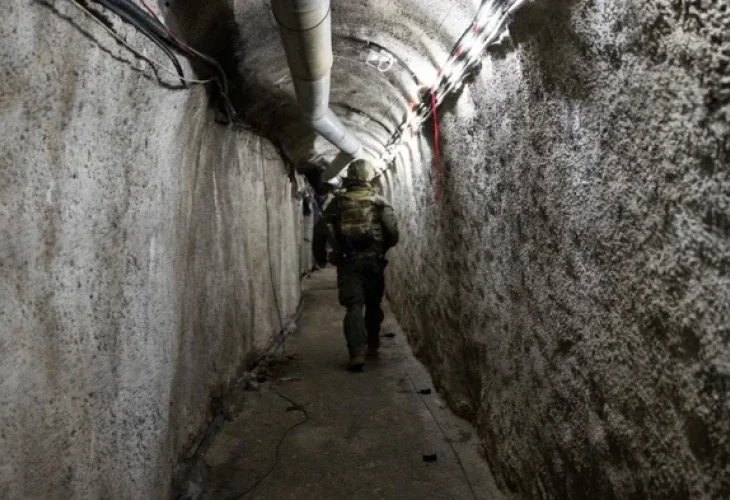 (Photo: IDF Spokesperson)
The IDF released footage on Sunday of an extensive Hezbollah tunnel network discovered beneath the Beaufort Ridge in southern Lebanon. According to the military, the underground complex was built with Iranian assistance and included living quarters, rocket launch positions, drone storage facilities, large stockpiles of weapons and explosives, and even an operating room for treating wounded terrorists.
The military described the underground complex as "Hezbollah's nerve center." The strategic ridge overlooks much of southern Lebanon, including the Ali al-Taher Ridge, Nabatieh, the areas connecting the Saluki and Litani rivers, as well as Israel's northern communities, including Metula and the Galilee Panhandle.
According to the IDF, the facility served as a major Hezbollah base for intelligence gathering and attacks against Israeli border communities. Over the years, Hezbollah built an extensive network throughout the area, including observation posts, combat positions, intelligence infrastructure, and underground passageways that were prepared for use during wartime.
Lt. Col. H., commander of Unit 1 in the Yahalom combat engineering unit, said the tunnel network was constructed with direct Iranian funding.
"These are large, well-built tunnels with water, electricity, communications, and sewage systems," he said. "There are bathrooms, showers, kitchenettes, living quarters, food, and water—everything needed to remain underground for an extended period."
According to Lt. Col. H., the newly uncovered tunnels are part of a much larger underground network built by Hezbollah across southern Lebanon.
"The tunnels are not all connected, and each one serves a different purpose," he explained. "Some are living areas, others are combat passageways or command-and-control centers, while some lead directly to firing positions used to launch attacks against Israeli forces and northern communities. Some tunnels stretch for hundreds of meters, while others extend for more than a kilometer."
The IDF said the underground complex was carved into the mountain over many years as part of Iran's broader effort to strengthen Hezbollah's underground military infrastructure in southern Lebanon.
Capt. B., operations officer of Unit 1, said Israeli forces gained control of the facility after a series of rapid operations.
"We reached the tunnel through a sequence of operations that allowed us to enter safely, and within just a few days we had full control of the entire underground complex," he said.
During the operation, Israeli troops discovered anti-tank missiles, anti-aircraft weapons, explosive devices, military equipment, and other supplies intended for Hezbollah terrorists.
"There are infantry weapons of every kind here," Lt. Col. H. said. "Everything was prepared to support the terrorists operating from this underground network."

