

Personal Stories
The Notebook That Survived the Holocaust: A Rabbi's Final Request
Passed through the window of a cattle car in 1944, a handwritten Torah notebook survived the Holocaust thanks to one courageous man and his family.
- Yehosef Yavetz
- | Updated
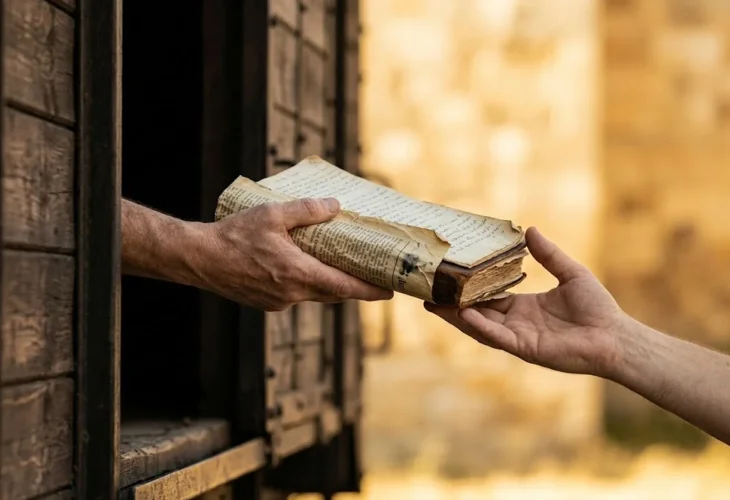
The train station in the Romanian town of Săplac, winter 1944. A train packed with people stood at the platform. Its cars were cattle cars. Families were crammed together in unbearable conditions, and as another group of Jews seized from their homes was forced into the last car, the small station filled with cries and sobbing.
Then, from one of the cars, a hand reached out.
In that hand was a small package wrapped in newspaper. The hand remained extended until a local worker named Lajos Bágosi, who worked at a nearby lime factory, noticed it. Bágosi had intended to return home that evening, but after missing curfew he was forced to spend the night at the factory.
He approached the train. From inside the crowded car, an elderly Jewish man called to him in a weak voice and asked him to safeguard the package. He explained that he knew where they were being taken, and that what was inside was all that remained of his life's work.
Bágosi took the package and hid it beneath his clothing. He could not read the Hebrew writing inside and had no idea what it contained, but he understood the importance of the request. A man on his way to almost certain death would not entrust a stranger with something so precious without reason.
When Bágosi later opened the package in a safe place, he found a handwritten notebook filled with Torah insights.
A Notebook Preserved for Generations
The notebook remained with the Bágosi family for decades. The story was passed from father to son until it eventually came into the hands of Avraham Elbaum, an architect, Torah scholar, and Holocaust survivor from Cluj who had escaped on the Kastner train as a child.
During one of his visits to Budapest, Elbaum met Lajos Bágosi's grandson, who had inherited both his grandfather's name and the notebook, along with a letter describing how it had been rescued. As trust developed between them, the grandson decided to give the notebook to Elbaum.
Nearly seventy years after it had been passed through the window of a deportation train, the notebook finally reached the Land of Israel.
Following Elbaum's passing in 2025, his widow, Ora, donated the notebook to the National Library of Israel. When experts examined it, they discovered that it contained Torah insights written by Rabbi Shmuel Shmelka Klein.
Rabbi Klein was the son of Rabbi Moshe, the rabbi of the Sălaj region in northwestern Romania, and the younger brother of Rabbi Shlomo Zalman Klein, who later served as the area's rabbi. The notebook was written in 5657 (1897), while Rabbi Shmuel Shmelka was living in Nagyšurány. Other records indicate that he was in Oradea in 5669 and later served as the rabbi of Aleșd beginning in 1920.
One Final Request
The identity of the man who handed the notebook through the train window cannot be established with certainty. It may well have been Rabbi Shmuel Shmelka Klein himself, although there is no definitive proof. His name does not appear clearly in surviving Auschwitz records, but based on the available evidence, it appears that he perished there.
Why did Rabbi Klein choose this particular notebook? Why preserve Torah insights he had written decades earlier, as a young man in 5657?
We cannot know for certain. Perhaps these were the first fruits of his Torah scholarship. Perhaps they contained teachings especially dear to his heart.
What makes the story so moving is the final concern of a Jewish rabbi facing deportation. He did not ask for food or water. He asked only that his Torah be preserved.
A Sacred Trust
Lajos Bágosi had no obligation to help. He could have walked away. He could have been afraid. He could have ignored the outstretched hand.
Instead, he reached out and accepted the package.
His family then continued safeguarding it for generations, recognizing that the small bundle placed into his trembling hands carried something sacred.
Because of that decision, more than eighty years later, the notebook speaks once again. Its author's Torah has been preserved, and his voice lives on through the handwritten insights now safeguarded in Israel's National Library.

