

Kabbalah and Mysticism
The Rambam and Kabbalah: What Did He Really Believe?
Many believe the Rambam opposed Kabbalah. Discover what he actually wrote about the hidden Torah and the sages of Israel.
- Daniel Bles
- | Updated
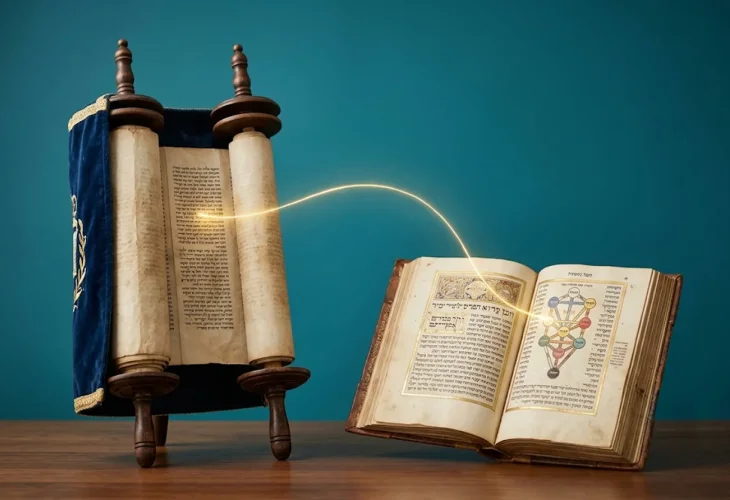
Avichai asks: "Hello, I have a neighbor who claims he follows only the teachings of the Rambam and therefore ignores Kabbalah and Chassidut. What should I answer him?"
Hello Avichai, and thank you for your question.
The teachings of the Zohar, Kabbalah, and Chassidut were revealed and published by great Torah scholars over the past 700 years. Since the Rambam lived more than 800 years ago, he naturally did not have access to the Zohar or to the Kabbalah teachings later revealed by the holy Ari. Even so, the Rambam explicitly writes that the hidden Torah does exist and is transmitted only among exceptional sages (Hilchot Yesodei HaTorah 4:11).
The Hidden Torah Is an Ancient Tradition
There is no doubt that a hidden tradition was passed down among the Torah sages of Israel. The Mishnah already teaches:
"One may not expound the laws of forbidden relationships before three, nor the Account of Creation before two, nor the Account of the Chariot before one, unless he is wise and understands on his own" (Chagigah 2:1).
"The Account of Creation" and "the Account of the Chariot" refer to the hidden Torah.
The Gemara likewise tells of the Tannaim who entered the deepest realms of spiritual knowledge:
"Four entered the orchard: Ben Azzai, Ben Zoma, Acher, and Rabbi Akiva" (Chagigah 14b).
These sources clearly demonstrate that a hidden dimension of Torah existed from ancient times and was taught only to select individuals. Indeed, the Rambam himself rules that these matters should be taught only to those who are worthy (Hilchot Yesodei HaTorah 2:12).
Trusting the Sages of Every Generation
The misunderstanding behind your neighbor's position stems from a lack of trust in the Torah sages.
Moshe Rabbeinu commanded us in the name of Hashem:
"According to the Torah that they teach you... you shall do" (Deuteronomy 17:11).
He also tells us:
"Ask your father and he will tell you; your elders, and they will say to you" (Deuteronomy 32:7).
The Rambam explains that this obligation applies in every generation:
"You are obligated to follow only the court of your own generation" (Hilchot Mamrim 2:1).
Judaism therefore teaches us to rely on the Torah sages of every generation, not for each individual to determine truth solely according to his own understanding.
We trust Hashem, who has guided the Jewish people throughout more than 3,300 years of history and continues to guide the sages who lead His nation in Torah.
The Torah Continues to Unfold
Hashem preserves the unbroken tradition that began at Mount Sinai while also guiding the sages of each generation to reveal deeper dimensions of Torah through Divine assistance.
This principle applies not only to Kabbalah, but also to halacha.
The Gemara relates that when Moshe Rabbeinu ascended to Heaven, he saw Hashem placing crowns on the letters of the Torah. Hashem explained that generations later Rabbi Akiva would derive countless laws from those tiny crowns.
Moshe then witnessed Rabbi Akiva teaching but could not initially understand what was being discussed. Only when Rabbi Akiva explained that the teaching was "a law given to Moshe at Sinai" was Moshe's mind put at ease (Menachot 29b).
This teaches that later revelations by the sages are rooted in the Torah given at Sinai.
Kabbalah and Chassidut
The Zohar, the teachings of the holy Ari, and later Chassidut reveal profound spiritual insights about Hashem and creation.
These teachings were entrusted to great Torah scholars and righteous individuals whom Hashem chose to reveal deeper layers of His Torah. While Kabbalah traces its roots back to Tannaim such as Rabbi Shimon bar Yochai, later generations expanded and clarified those teachings. This, too, is part of Hashem's plan, that the branches of Torah continue to grow while remaining firmly rooted in Sinai.
As Chazal teach:
"Scripture, Mishnah, halacha, Talmud, Tosefta, aggadot, and even what an experienced student will one day teach before his rabbi were all given to Moshe at Sinai" (Kohelet Rabbah 5:8).
This does not mean every future teaching was given word for word at Sinai. Rather, all authentic Torah insights have their roots there and were destined to be revealed in their proper time.
For this reason, "These and those are the words of the living God."
The Rambam and the Hidden Torah
Many people are surprised to discover that, in a certain sense, the Rambam himself can be seen as having explored many ideas that later appear in Kabbalah.
Although he did not receive the later kabbalistic tradition, many concepts in his writings closely parallel themes later developed by the holy Ari. The Rambam describes a hierarchy of spiritual spheres and intellects flowing from Hashem into creation. He speaks of ten levels of angels representing different forms of Divine providence, teaches that the deepest study after mastering halacha is the "Account of the Chariot," and in Moreh Nevuchim (Part III, chapter 51) discusses spiritual seclusion, elevated contemplation, and the unique closeness to Hashem attained by the righteous through higher levels of thought.
His son, Rabbi Avraham ben HaRambam, although deeply rational in approach, also founded the movement known as the Pious Ones of Egypt, which incorporated elements of spiritual practice that resemble later Kabbalah and Chassidut.
The Ongoing Revelation of Torah
The teachings of the holy Ari, the Alter Rebbe, and many other Torah giants were destined to be revealed in their respective generations. Their teachings draw directly from the eternal source of Torah given at Sinai, and Hashem chose these extraordinary sages as vessels through which deeper dimensions of His wisdom would become known.
For someone approaching these subjects for the first time, I would recommend beginning with Matan Torah by Rabbi Yehuda Ashlag. It presents profound Torah ideas in a clear and accessible way, and I believe it can offer a meaningful introduction to the depth and beauty of Kabbalah.

