

Israel News
Knesset Passes Law Freezing Arrests of Full-Time Torah Students
Israel’s Knesset approved a temporary measure freezing the arrest of yeshiva students whose Torah study is considered their full-time occupation. The law will remain in effect through the end of November 2026, following a heated debate and clashes in the plenum.
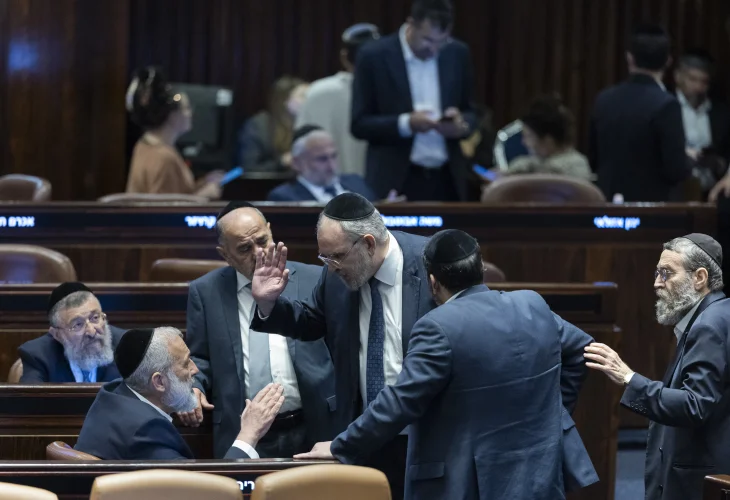 Knesset plenum session (Photo: Chaim Goldberg, Flash90)
The Knesset plenum approved a bill on Tuesday in its second and third readings establishing a special arrangement to temporarily suspend the arrests of yeshiva students who study Torah full time. The proposal passed by a vote of 58 Knesset members in favor and 54 opposed and will remain in effect from the date of its publication through November 30, 2026.
Under the temporary order, the arrangement is intended to suspend the arrests of yeshiva students in recognition of the importance of Torah study. The law defines a yeshiva student as someone who regularly studies Torah for at least 45 hours a week, or 40 hours a week in the case of a kollel, excluding the vacation periods customary in yeshivot, which will be determined by the defense minister. The defense minister will also be responsible for compiling the list of yeshivot included in the arrangement, according to criteria to be established in regulations.
A yeshiva will be included on the list after its director, or someone authorized on the director’s behalf, declares that Torah study is taking place there to the required extent. The defense minister, with the approval of the Foreign Affairs and Defense Committee, will also establish the conditions under which an institution may be removed from the list of yeshivot eligible for the arrangement.
To enforce the law and oversee its implementation, the defense minister will formulate dedicated guidelines and authorize inspectors. For this purpose, the minister may rely on inspectors with experience in the Education Ministry’s field inspection work, as well as on the ministry’s existing oversight system. If an inspector finds repeated absenteeism involving 20 percent or more of the students at a particular yeshiva, a warning will be issued to the head of the institution. If absenteeism at that level continues after the warning, the yeshiva will be removed from the list, and its students will be given the option of enrolling in another yeshiva.
Foreign Affairs and Defense Committee Chair MK Boaz Bismuth explained the rationale behind the measure: “The arrests have the opposite effect of what is intended and may harm recruitment efforts and reduce the number of people who actually enlist. There is broad agreement in Israeli society that someone who studies Torah should be able to do so without fear. At the same time, there is broad agreement that someone who does not study Torah must enlist. This is not a blanket exemption for the entire Haredi sector, but only for Torah students.”
MK Yinon Azoulay also defended the law, emphasizing that it is only a temporary measure. “The law says one simple thing: arrests will be suspended for a limited period, and only the arrests. We asked the army a simple question: How many yeshiva students who were arrested and detained in military prison ultimately enlisted? The answer was not a single one. The arrests did not help. We are doing this for the sake of Israeli unity for a limited period, and after the elections, we will introduce legislation that will benefit the entire population, both soldiers and Torah students.”

