

Israel News
Watch Out for Fake Government Texts Asking for Payment, Israel Cyber Officials Warn
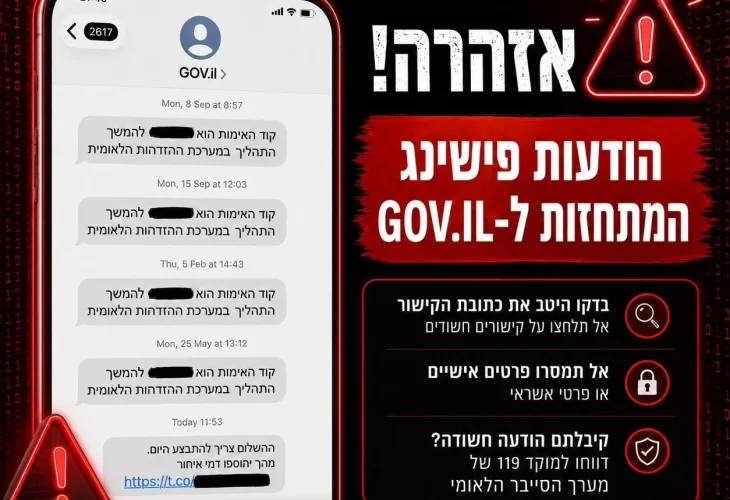
Israel’s National Cyber Directorate and National Digital Agency are warning the public about text messages posing as GOV.IL. The agencies said, "It is recommended not to click the link, not to enter personal details or credit card information, and for any payment request - to make it only by entering the official websites and the personal area."
 (Credit: Cyber Directorate)
Israel’s National Cyber Directorate and National Digital Agency issued an urgent public warning on Tuesday after fraudulent SMS messages impersonating the government portal GOV.IL began circulating. The messages include a payment request and a malicious link. What makes the scam particularly difficult to detect is that, on some devices, the messages appear within an existing legitimate GOV.IL message thread, making them appear to have been sent by the government.
The agencies stressed that government systems had not been breached. According to their review, the scam exploits the way SMS messages are displayed on certain devices. This allows attackers to send a message that appears to come from the official GOV.IL sender and have it appear within a legitimate message thread already stored on the device.
In an official statement, the agencies said: “The National Cyber Directorate and the National Digital Agency warn of a phishing message impersonating GOV.IL. Over the past hour, fraudulent SMS messages containing a payment request and a malicious link have been distributed. On some devices, they appear within an existing GOV.IL message thread. A review found that this is an exploitation of the way SMS messages are displayed on certain devices and not a breach of GOV.IL systems.”
The National Cyber Directorate said it is working to block the malicious link. The agencies instructed the public not to click the link under any circumstances and not to enter personal details, identification information, or credit card details on websites accessed through links received by text message.
The warning came just one day after the National Cyber Directorate alerted the public to a similar impersonation attempt involving the company Pango. In that case as well, phishing messages appeared within the company’s legitimate SMS thread, raising concern among users who found it difficult to distinguish the fraudulent messages from genuine ones.

