

World News
Trump Says Ground Operation in Iran Remains an Option
Donald Trump warned Iran that the U.S. will intensify its military campaign unless Tehran returns to negotiations, while new American strikes targeted Iranian positions.
- Shlomi Diaz
- | Updated
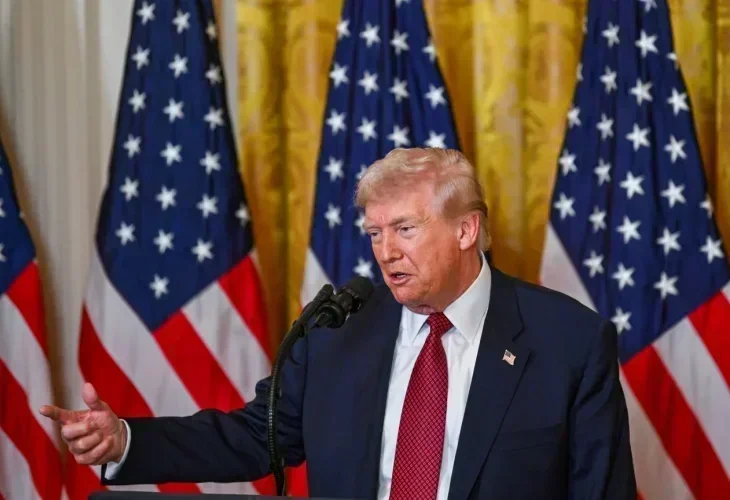 Trump (archive photo: Arie Leib Abrams/Flash90)
At midnight last night (between Tuesday and Wednesday), the U.S.-led naval blockade on Iran officially took effect, following approval by President Donald Trump a day earlier. In an overnight interview with Fox News, Trump said he is not ruling out a ground operation in Iran and even suggested the United States could move to seize Kharg Island, home to one of Iran's most important oil export terminals.
At the same time, U.S. Central Command (CENTCOM) completed a seven-hour wave of strikes against targets in Iran. According to reports, the attacks targeted missile and drone sites near the Strait of Hormuz and along Iran's coastline, with fighter jets, drones, and naval vessels taking part.
Asked whether he would rule out deploying ground forces, Trump replied: "I don't want to make a declaration about that, but I would say no. If I thought it was appropriate, I would act accordingly. Sometimes there is a need for a ground operation, but we have other parties that can carry out the ground activity for us."
Trump also said the U.S. military had already struck Kharg Island several times but had deliberately avoided its oil facilities.
"We already attacked Kharg Island twice, and even three times," he said. "My instruction was to hit everything except the oil facilities, to keep a safety distance of at least 25 yards and not touch the oil, because it represents a significant share of the global economy and I am not interested in harming it."
The president warned that if Tehran does not return to negotiations, Washington will expand its strikes next week to include bridges and power stations.
"Next week will be very bad for them, because next week the power stations are coming. Next week the bridges are coming. We will shut down all their power stations. We will shut down all their bridges, unless they come to the negotiating table. The strikes in Iran will continue until I say that it is enough."
Iran's Islamic Revolutionary Guard Corps responded by launching missiles toward countries in the Gulf and at a U.S. military base in Jordan. According to foreign reports, the IDF assisted in intercepting several missiles over Jordanian airspace. Missiles were also launched toward Bahrain and Kuwait.
In a statement, the Revolutionary Guards declared: "The operations will continue, and the Strait of Hormuz will remain closed until the U.S. stops its hostile actions. U.S. military actions have closed sea lanes to shipping and deprived the world of the region's oil and gas. In response, our forces attacked fuel vessels belonging to the U.S. Fifth Fleet in Bahrain. Either all the countries in the region export their oil and gas, or none of them will."
Meanwhile, Iran's Deputy Foreign Minister Kazem Gharibabadi said Tehran "currently has no commitments under the memorandum of understanding, including regarding the Strait of Hormuz."
According to Gharibabadi, "No agreement was reached on the Strait of Hormuz during the negotiations in Oman. The main framework of the understanding was ending the war against Iran and the other fronts—something that was violated on Iranian soil and in Lebanon. If the Americans think they can force us into negotiations by imposing a blockade, they are mistaken. Opening the route from the Oman coast was a mistake. The Americans exerted significant pressure to keep Oman's route open."

