

Wonders of Creation
The Box Jellyfish: Meet the World's Most Venomous Marine Creature
Transparent, lightning-fast, and armed with deadly venom, the box jellyfish is one of the ocean's most dangerous predators. Discover its extraordinary abilities, real-life survival stories, and the life-saving first aid every swimmer should know.
- Yosef Yaavetz
- | Updated
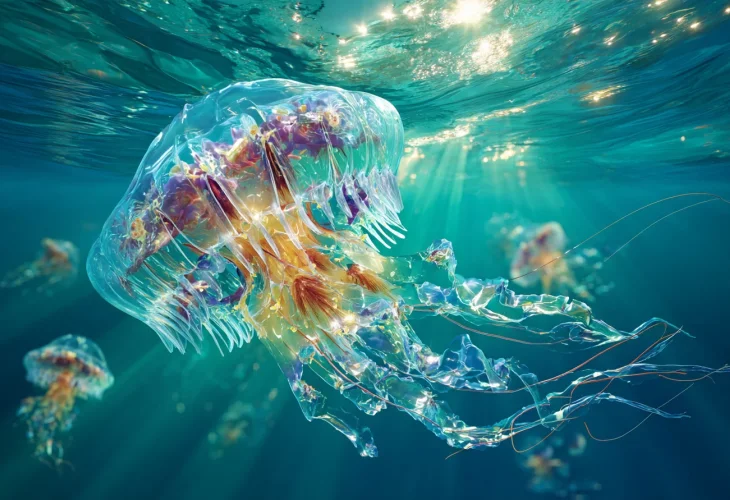
One of the most venomous marine animals in the world is the box jellyfish, often called the sea wasp. A close relative of the common jellyfish, it measures only about 30 centimeters (12 inches) across and has a bell-shaped body. But beneath its innocent appearance lies one of the ocean's most formidable predators. From its bell extend up to 60 hunting tentacles, each capable of reaching 3 meters (10 feet) in length.
Although it resembles an ordinary jellyfish, the box jellyfish has a remarkable advantage. While most jellyfish simply drift with ocean currents, the box jellyfish is an active swimmer. It can steer itself, avoid predators, and pursue prey with surprising speed. It can swim at around 4 knots (approximately 8 km/h or 5 mph). By comparison, the average person swims at only about 3 km/h (2 mph). If you happen to be in the water where a box jellyfish is present, it can easily outswim you.
Its natural habitat is primarily the coastal waters of northern Australia and parts of the Indo-Pacific region. Another challenge is that it is almost completely transparent, making it extremely difficult to spot in the water. In many cases, swimmers don't realize it's there until it is too late.
Its scientific name may sound harmless, but "sea wasp" is a far more fitting description.
The box jellyfish doesn't need to remain close to its prey. Each side of its body is equipped with clusters of telescoping tentacles that can be deployed in an instant. Every cluster contains numerous hunting tentacles that wrap around fish and inject an extremely potent venom.
Twenty-Four Eyes
If you're hoping the box jellyfish simply won't see you, think again.
It possesses 24 eyes, divided into four different types, with six eyes of each type. Each type is specialized for different visual tasks, giving the animal surprisingly sophisticated vision.
One of the most astonishing discoveries is that box jellyfish can see objects above the water's surface. For example, they are able to identify mangrove trees and navigate toward their roots, where many of their favorite prey species live.
A Microscopic Weapon
The tentacles are covered with millions of stinging cells called nematocysts.
Each nematocyst functions like a microscopic harpoon. When triggered, it fires an incredibly tiny dart loaded with venom at extraordinary speed.
The effects resemble those of a venomous snakebite. Victims may experience excruciating pain within seconds, followed by a dangerous drop in blood pressure, irregular heart rhythms, and, in severe cases, life-threatening cardiovascular collapse.
Scientists have developed antibodies against some components of the venom, but despite years of research, no antivenom has yet been proven consistently effective in treating severe box jellyfish stings.
Despite its terrifying reputation, the box jellyfish has no interest in hunting humans. Its primary diet consists of small fish. Once the venom stuns or paralyzes its prey, the jellyfish draws it toward its mouth and consumes it.
Unfortunately, the fact that humans are not on its menu offers little comfort. An accidental encounter can still be devastating.
A Surfer's Brush with Death
About two months ago, surfer Guy Rowles was surfing at the famous Cloudbreak in Fiji when he accidentally collided with a box jellyfish.
The venom spread rapidly through his arm, covering more than half of the limb — a condition doctors immediately recognized as life-threatening.
Rowles later described the sting as one of the most intense experiences of his life. Box jellyfish venom simultaneously attacks the nervous system, the heart, and the skin. He endured a terrifying 40-minute boat ride back to shore before being rushed to the hospital.
Doctors later told him that his youth, excellent physical condition, and overall health likely prevented complete systemic collapse. They also noted that he was extraordinarily fortunate the tentacles had not wrapped around his face or neck.
Rowles made a full recovery and eventually returned to surfing.
Since the incident, he has become an advocate for jellyfish awareness, urging surfers and swimmers in tropical waters never to enter the ocean without carrying a bottle of vinegar nearby.
According to current first-aid guidelines, pouring vinegar over the affected area helps deactivate any unfired stinging cells still attached to the skin, preventing them from releasing additional venom and potentially saving a person's life.
The Girl Who Survived Against All Odds
Another remarkable survivor is Rachael Shardlow, who in 2009 became the first person known to survive an extensive box jellyfish sting.
Rachael was just 10 years old when she and her 13-year-old brother were swimming in the Calliope River in Queensland, Australia.
Without warning, a box jellyfish wrapped its long tentacles around her arms and legs. She lost consciousness almost immediately.
In what many described as extraordinary providence, nearby campers happened to have a bottle of vinegar. They poured it over her legs, preventing additional stinging cells from firing.
During the journey to the hospital, Rachael required CPR. Doctors later described her legs as looking like "burnt tree trunks." Victims with injuries this severe typically die within four minutes.
Against all expectations, Rachael awoke after two weeks in a coma. Although she was left with extensive scarring on her legs, she made a remarkable recovery and survived one of the world's deadliest marine encounters.

