

Faith (Emunah)
The Arizal Told a Dying Rabbi One Thing Would Save His Life
Gravely ill and given only days to live, Rabbi Avraham HaLevi received one astonishing instruction from the Arizal.
- הרבנית חגית שירה
- | Updated
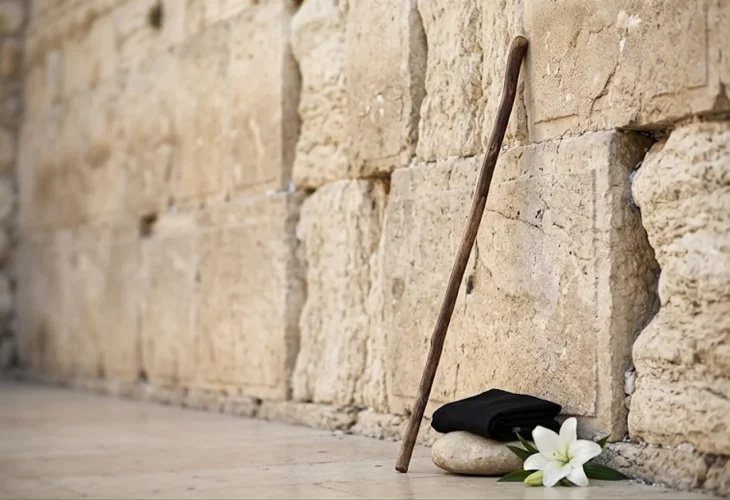
In the days of the holy Arizal, whose hillula (the anniversary of his passing) will, God willing, be observed this coming Sunday, there lived in Tzfat a remarkable Torah scholar named Rabbi Avraham HaLevi Beruchim. His entire being was devoted to feeling the pain of the Shechinah, the Divine Presence.
When people would ask him, "How are you?" he would answer with a question of his own:
"Did you pray for the redemption? Did you pray for the Shechinah?"
Every night, Rabbi Avraham would walk through the streets of Tzfat, tapping his stick against people's windows to awaken them for Tikkun Chatzot, the midnight prayers mourning the destruction of the Beit Hamikdash.
The Arizal testified about him, "This is the soul of the prophet Jeremiah," teaching that Rabbi Avraham was a reincarnation of the prophet who mourned the destruction of Jerusalem.
The Arizal's Extraordinary Promise
One day, Rabbi Avraham became gravely ill. The physician who examined him concluded that he had only a few days left to live.
His family summoned the holy Arizal, who immediately recognized the seriousness of his condition.
The Arizal then told Rabbi Avraham something astonishing:
"Know this: if you rise from your bed, gather your strength, travel to Jerusalem, reach the Western Wall, and merit seeing the Shechinah, you will live."
Although he was dangerously weak, Rabbi Avraham accepted the challenge.
With tremendous self sacrifice, he mounted a donkey and began the nearly week long journey from Tzfat to Jerusalem.
A Journey of Faith to the Western Wall
By the time the caravan arrived in Jerusalem, it was late at night. The other travelers wanted to rest after the exhausting trip.
But Rabbi Avraham refused.
"Please," he begged them, "take me to the Western Wall now."
Despite his illness and the difficult journey, he would not postpone the opportunity.
Finally, they brought him to the Wall.
Standing before its ancient stones, Rabbi Avraham burst into tears.
Then, through his weeping, he saw the figure of a woman dressed in black.
He immediately understood that he was beholding the holy Shechinah.
The overwhelming experience caused him to faint.
The Shechinah's Promise
According to the tradition, it was the Shechinah Herself who awakened him.
Some sources say she now appeared dressed in white and whispered these words into his ear:
"Take comfort, child of Abraham, for there is hope. Your children shall return to their borders. The House will yet be rebuilt."
Rabbi Avraham eventually returned to Tzfat.
When the Arizal saw him, he declared:
"You saw the Shechinah. You merited this vision. Your life has been restored."
Rabbi Avraham went on to live another 22 years.
The Shechinah Clothed in Black
A similar description appears in the words of the prophet Jeremiah.
He relates that while ascending to Jerusalem to mourn and comfort the city, he encountered a woman sitting atop the mountain. She was dressed in black, her hair was disheveled, and she cried out in grief:
"Who will comfort me?"
Jeremiah himself began to weep and answered, "Who will comfort me? Who will comfort me?"
As he approached her, he said:
"If you are a woman, speak with me. But if you are a spirit, depart from before me."
The woman replied:
"Do you not recognize me? I had a beloved husband and seven sons. One day my husband disappeared. I went searching for him but could not find him. When I returned home, I discovered that my house had collapsed upon my seven sons and killed them all. Now I do not know for whom to mourn more, my husband or my children."
Jeremiah responded:
"Are you greater than Mother Zion?"
The woman then revealed her identity:
"I am your mother, Zion. I am the one of whom it is written, 'Wretched, the mother of seven'" (Me'am Lo'ez, Eicha Rabbati, end of chapter 27).
This moving tradition reminds us that the pain of the Shechinah and the longing for the rebuilding of the Beit Hamikdash are not distant ideas, but living realities that have inspired the prayers, tears, and devotion of righteous Jews throughout the generations.

