

History and Archaeology
The Fall of Sennacherib: The Miracle That Saved Jerusalem
When the mighty Assyrian Empire surrounded Jerusalem, Hashem performed one of the greatest miracles in Tanach.
- Yonatan HaLevi
- | Updated
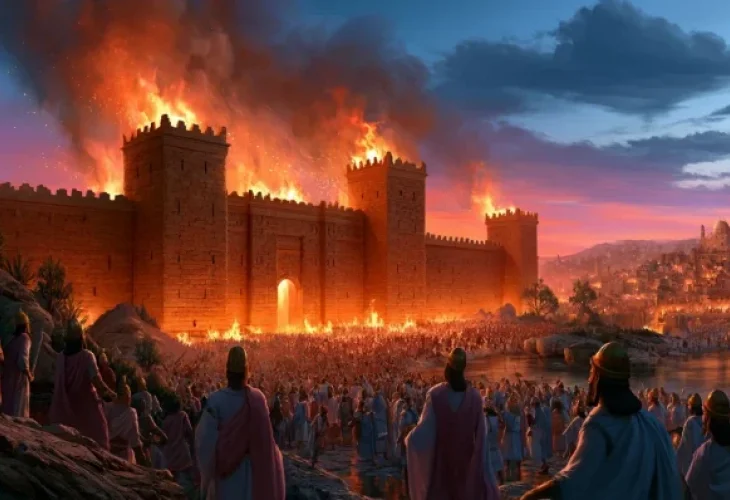
During the reign of King Hezekiah, in 701 BCE, Sennacherib, king of Assyria, launched one of the greatest military campaigns the ancient world had ever seen against the Land of Israel. His armies conquered Jaffa and Ashkelon, captured Ekron, overran the fortified cities of the Kingdom of Judah, and destroyed Lachish. Assyrian forces swept through Judah, leaving devastation in their wake, until they finally reached Jerusalem and laid siege to the city.
The Empire No One Could Defeat
At the time, Assyria was the unrivaled superpower of the ancient Near East. For decades, its kings had conquered one kingdom after another.
Tiglath-Pileser III subdued Ararat and other powerful northern kingdoms. A decade later, he conquered Aram, advanced into Samaria, and exiled the Ten Tribes of Israel.
After so many nations had fallen before Assyria, who could have imagined that Jerusalem would be the one city left standing?
The answer is found in the Book of Isaiah:
"Then the angel of Hashem went out and struck down one hundred and eighty-five thousand in the Assyrian camp.
When they arose early in the morning, behold, they were all dead corpses.
So Sennacherib king of Assyria departed, went away, returned, and remained in Nineveh.
And it came to pass, as he was bowing in the house of Nisroch his god, that Adrammelech and Sharezer his sons struck him with the sword... and Esarhaddon his son reigned in his place."
(Isaiah 37:36-38)
The Jewish historian Josephus also records the event:
"When Sennacherib returned from the war in Egypt to Jerusalem, he found there the force entrusted to Ravshakeh afflicted by the danger of plague.
For Hashem had sent a disease upon his army, resembling a plague, and on the first night of the siege one hundred and eighty-five thousand men died, along with their officers and commanders.
This disaster filled him with terrible fear and dread... and he fled with the troops that remained to his kingdom, called the kingdom of Nineveh."
(Antiquities of the Jews, Book 10)
The miracle was so extraordinary that Chazal teach that Hashem considered making King Hezekiah the Messiah and Sennacherib the final enemy of Gog and Magog (Sanhedrin 94a).
A Worldwide Sanctification of Hashem's Name
Jerusalem's miraculous deliverance made an enormous impression throughout the ancient world.
Among all the capitals that had rebelled against Assyria, only Jerusalem remained unconquered. News of its salvation spread far beyond the borders of Judah.
The Book of Divrei Hayamim records that even the leaders of Babylon sent emissaries to King Hezekiah:
"And so also in the matter of the envoys of the princes of Babylon, who sent to him to inquire about the wonder that had happened in the land."
(II Divrei Hayamim 32:31)
According to Seder Olam Rabbah, after Sennacherib's defeat, King Hezekiah released Egyptian captives whom the Assyrians had taken prisoner. When they returned home, they publicized the miraculous salvation they had witnessed.
Chazal explain that many accepted the sovereignty of Hashem, fulfilling the verse:
"The peoples heard, they trembled; terror gripped the inhabitants of Philistia."
(Exodus 15:14)
They even built altars dedicated to Hashem in Egypt, creating an extraordinary Kiddush Hashem, a public sanctification of Hashem's Name.
Isaiah likewise describes this remarkable transformation:
"On that day there will be five cities in the land of Egypt speaking the language of Canaan and swearing to Hashem of Hosts.
On that day there will be an altar to Hashem in the midst of the land of Egypt, and a pillar at its border to Hashem.
And Hashem will become known to Egypt, and the Egyptians will know Hashem on that day. They will serve with sacrifice and offering, vow vows to Hashem, and fulfill them."
(Isaiah 19:18-22)
A Foreshadowing of the Final Redemption
Isaiah later returns to the downfall of Jerusalem's enemies as a model for the future redemption.
He writes:
"And I will place a sign among them, and from them I will send survivors to the nations... and they shall declare My glory among the nations."
(Isaiah 66:19)
Similarly, the prophet describes the future redemption in stages:
"A shoot shall emerge from the stump of Jesse...
They shall swoop down on the flank of the Philistines to the west; together they shall plunder the people of the east."
(Isaiah 11:1, 14)
Later, Isaiah prophesies:
"Who is this coming from Edom, with crimsoned garments from Bozrah...
It is I, speaking in righteousness, mighty to save.
I have trodden the winepress alone...
For the day of vengeance was in My heart, and the year of My redemption had come."
(Isaiah 63:1-3)
These prophecies echo the pattern established by Sennacherib's downfall: overwhelming danger followed by miraculous Divine salvation.
Understanding the Book of Isaiah requires appreciating the magnitude of what occurred during King Hezekiah's reign. The miracle so profoundly affected the surrounding nations that even within that generation, people in Egypt and Babylon sought to understand the God of Israel. Egyptian cities built altars to Hashem, while Babylonian envoys traveled to Jerusalem to learn about the astonishing events they had heard about.
Psalm 76: A Song of Thanksgiving
Chazal explain that Asaph composed Psalm 76 in response to the miraculous salvation of Jerusalem during Sennacherib's siege.
The psalm begins:
"In Judah God is known; in Israel His name is great.
His shelter was in Salem, and His dwelling place in Zion.
There He broke the fiery bolts of the bow, shield and sword and war forever.
The stouthearted were despoiled, they sank into sleep.
At Your rebuke, God of Jacob, both chariot and horse were cast into deep sleep."
(Psalm 76)
According to this interpretation, "There" refers to Zion and Jerusalem, where Hashem shattered the enemy's weapons. The bows, arrows, shields, swords, and all the military strength of Assyria proved powerless before Him.
Asaph continues:
"You are radiant, more majestic than the mountains of prey."
At Jerusalem's darkest hour, Hashem revealed His glory. The once mighty Assyrian soldiers, who had terrorized nations across the region, suddenly fell into an everlasting sleep. Their strength vanished, their weapons became useless, and their chariots and horses fell silent.
The miraculous downfall of Sennacherib remains one of the greatest demonstrations of Divine providence recorded in Tanach. More than a military victory, it became a lasting testimony that no earthly empire, no matter how powerful, can prevail against the will of Hashem.

