

Parashat Devarim
Before Entering the Land: Moshe's 3 Foundations for the Jewish People
Before entering the Land of Israel, Moshe prepared the nation with Torah, justice, and unwavering trust in Hashem. Discover Rabbi Samson Raphael Hirsch's timeless insights into Parashat Devarim.
- Yehosef Yaavetz
- | Updated
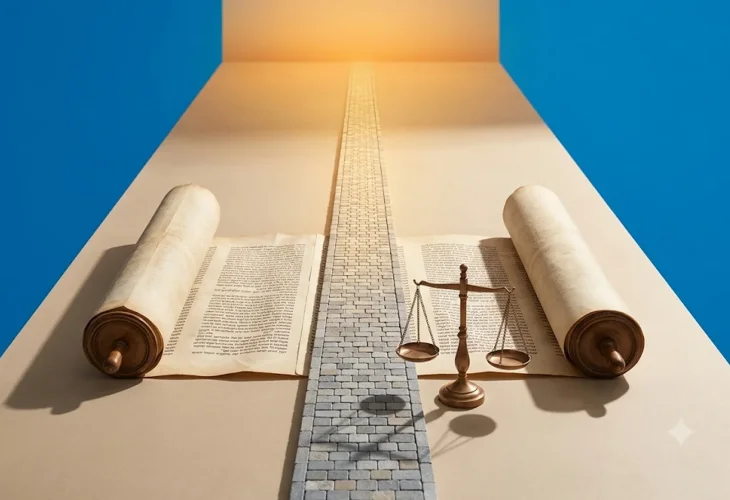
The Book of Deuteronomy is often called the book of Moshe Rabbeinu. Although it is spoken by Moses, it is not a personal memoir or farewell speech. Rather, it is a renewed explanation of the Torah for the generation about to enter the Land of Israel. That is why the book opens with the words: "Moses undertook to explain this Torah." Everything that follows is an explanation of the Torah he received at Sinai, preparing the nation for the next stage of its history.
From Mount Sinai to the Land of Israel
The entire book serves as preparation for entering and conquering the land, but that preparation is first and foremost spiritual.
The Torah had already been given. At first glance, it would seem that Israel now possessed everything it needed. "Hashem our God spoke to us at Chorev." Yet a new chapter was about to begin.
Hashem tells the people:
"You have stayed long enough at this mountain."
Chorev was the place of revelation, where the Torah was given, the covenant was forged, and Israel's spiritual foundation was established. But the Torah never intended for the Jewish people to remain at the mountain. Its goal was to bring the Torah from the heights of revelation into everyday national life.
That is why the command immediately follows:
"Turn and journey, and come to the hill country of the Amorites and to all their neighbors."
The challenge was no longer simply receiving the Torah, but living it.
The First Preparation Was Justice, Not Weapons
Standing on the threshold of conquest, one might expect Moses to speak about military strategy, weapons, generals, and battle plans.
Instead, he begins by appointing judges.
Rabbi Samson Raphael Hirsch highlights this striking choice:
"At that time you stood ready to conquer a settled land, inhabited by powerful nations trained in war, yet at that very moment I did not train you in weapons. I did not assign you to study war plans and battles, I did not command you to prepare weapons of war, and I did not appoint generals or military commanders for you."
The nation's first preparation for entering the land was moral, not military.
Its success would depend on a society governed by Torah and justice.
Choosing Leaders of Integrity
When selecting judges, the Torah commands:
"Bring forth from your tribes wise, understanding, and well-known men, and I will appoint them as your heads."
Rabbi Hirsch notes the significance of the phrase "well-known among your tribes."
Moses himself could recognize wisdom and understanding. Character, however, is revealed in everyday life.
A person's honesty, humility, and integrity are best known by those who live alongside him.
As Rabbi Hirsch explains, Moses could evaluate their knowledge, but only the people themselves truly knew their character.
Justice Is the Foundation of the Nation
Moses then instructs the judges:
"Hear cases between your brothers, and judge righteously between a man and his brother and his stranger."
He continues:
"You shall not show favoritism in judgment; you shall hear the small as well as the great. You shall not fear any man, for the judgment is God's."
A judge does not rule according to personal preference, fear, or family loyalty.
He serves Divine justice.
This legal system would become one of the foundations of Jewish national life. Before Israel could inherit the land, it first had to become a nation capable of administering justice fairly, protecting both the powerful and the weak, and judging the stranger alongside its own people.
The Lesson of the Spies
The parashah then returns to the episode of the spies.
Moses recalls the people's request:
"Let us send men ahead of us, and they will explore the land for us."
Rabbi Hirsch explains that the word "explore" suggests bringing something from uncertainty into the clear light of knowledge.
Ironically, the spies accomplished the opposite.
Rather than replacing uncertainty with confidence, they turned the Promised Land itself into a source of fear.
As Moses tells the nation:
"In this matter, you do not believe in Hashem your God."
This lack of faith came despite everything they had already experienced.
He reminds them that Hashem had continually guided them:
"Who goes before you on the way to seek out a place for you to camp, in fire by night and in cloud by day."
The generation of the wilderness witnessed miracles daily. They saw the pillar of fire and the pillar of cloud. They experienced Hashem carrying them "as a man carries his son."
Yet when they reached the point where faith required personal responsibility instead of open miracles, fear overtook them.
Conquest Within Divine Boundaries
The parashah then recounts Israel's encounters with the neighboring nations.
The people are instructed not to provoke Edom, not to attack Moab, and not to wage war against the descendants of Ammon.
Only afterward does Hashem command:
"See, I have given into your hand Sichon king of Cheshbon, the Amorite, and his land. Begin to take possession, and engage him in battle."
Rabbi Hirsch explains that these commands establish clear boundaries for Israel's conquest.
The Jewish people were never meant to become an empire seeking expansion in every direction.
Certain lands belonged to Esau and the descendants of Lot. The Land of Israel belonged to the Jewish people.
Both conquest and restraint were expressions of obedience to Hashem's will.
Three Foundations for Entering the Land
According to Rabbi Hirsch, Parashat Devarim presents the next generation with three essential foundations before they enter the Land of Israel.
The first is an explained Torah, reflected in the words:
"Moses undertook to explain this Torah."
The second is a just legal system:
"Bring forth from your tribes wise, understanding, and well-known men."
The third is practical faith in Hashem's guidance, illustrated by the contrast between the generation that feared entering the land and the confidence Moses now sought to instill in their children.
The spies searched for certainty that would eliminate all fear.
Moses teaches a different lesson.
True faith is not the absence of uncertainty. It is the willingness to trust Hashem and move forward despite it.
That is why his message to the next generation remains as relevant today as it was on the banks of the Jordan:
"Do not be afraid, and do not be broken."

