

History and Archaeology
From Glory to Destruction: A Powerful Portrait of Ancient Jerusalem
Through vivid storytelling rooted in Chazal and ancient sources, Rabbi Ariel David Fox brings the glory of Jerusalem and the tragedy of the Churban to life.
- Michal Arieli
- | Updated
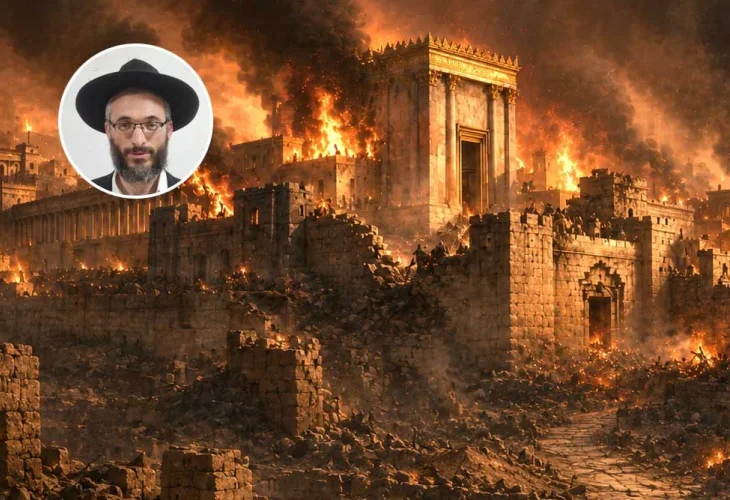 (Inset: Rabbi Ariel Fox)
Did you know that during the time of the Beit HaMikdash, Jerusalem was said to have an intricate network of hidden tunnels through which pilgrims could reach the Temple quickly and effortlessly? Or that the city's children played freely in its streets because Jerusalem was so safe that fear seemed unknown?
In those glorious days, Jerusalem radiated beauty and joy. People traveled from distant lands to bring gifts, gold, and offerings to its residents out of admiration for the Jewish people. The fragrance of the Ketoret (Temple incense) filled the city's streets, and our sages teach that no foul odor could be found in Jerusalem. Everyone who experienced the city understood the truth behind the famous saying: "Whoever has not seen Jerusalem in its glory has never seen a truly beautiful city."
These descriptions may sound familiar, yet for most of us they remain difficult to picture. We know the words, but we struggle to imagine what Jerusalem truly looked and felt like during the days of the Beit HaMikdash.
The same is true of the destruction. Beyond the verses of Megillat Eichah and the Midrashim we learned as children, it is hard to grasp the unimaginable devastation of those terrible days when the House of Hashem was destroyed.
"Hashem Opened My Eyes"
One man decided to bridge that gap and bring both Jerusalem's glory and its destruction to life.
Meet Rabbi Ariel David Fox, a respected Torah teacher at Chedvat HaTorah Yeshiva, who has spent years delivering classes and lectures to audiences across Israel and around the world.
"For many years, I searched for a book that could truly connect me to the days of Bein HaMetzarim and Tisha B'Av," Rabbi Fox explains. "I wanted something that was engaging, vivid, and emotionally compelling.
"I studied Megillat Eichah with many commentaries, immersed myself in the Midrashim of Chazal, explored both Talmuds, read historical works, and even modern literature. But I never found what I was looking for. The books contained extraordinary material, yet they didn't create the emotional or visual connection I was searching for. Eventually, I stopped looking for the book I wanted and decided to create it myself."
That decision launched what became a years long investigation. Rabbi Fox immersed himself in hundreds of books, ancient Midrashim, and historical testimonies, piecing together every available detail about Jerusalem before and during the destruction.
His goal was not simply to gather information, but to reconstruct a living, breathing picture of the city, first for himself and ultimately for his readers.
"I spent countless hours sitting before the remnant of our Beit HaMikdash, the Western Wall, until Hashem, in His mercy, opened my eyes," Rabbi Fox recalls.
And did you succeed?
Rabbi Fox smiles as he holds up the result of those years of research: his book, Building and Destruction: How.
Rather than presenting Midrashim in their original form, Rabbi Fox transforms them into vivid, story driven narratives. Readers meet Peretz, a government minister who preferred sleeping in the deserts surrounding Jerusalem to staying in luxurious foreign palaces. They are introduced to Abigail and her children, Netanel, Efrat, and baby Uri, who experience the peace and security of Jerusalem during its glory days.
Then the story shifts.
The joyful city gives way to the painful days of Bein HaMetzarim, when hunger spreads through Jerusalem and desperation fills its streets.
Rabbi Fox brings those final days to life through characters such as Eran and Elishama, who flee to a fortified watchtower overlooking the burning city. Looking through its narrow openings, they cling to the hope that the fortress might withstand the siege for another forty days.
That hope quickly fades.
Before their eyes, Jerusalem's mighty walls begin collapsing one after another beneath the assault of the Babylonian army. As the tower itself starts shaking under the enemy's siege engines, they realize that Heaven's protection has been withdrawn.
In their final moments, as the fortress crumbles around them, Eran whispers to his companion:
"It was not the Chaldeans who overpowered us. The One who once protected us is the One bringing us down now. When the power of the Shechinah leaves its place, no human force can protect it anymore."
Rabbi Fox continues with equally moving descriptions of Tisha B'Av itself, when the Beit HaMikdash was plundered and destroyed. Through vivid storytelling grounded in Midrashic sources, he allows readers to experience, if only for a moment, the overwhelming loss felt by those who witnessed the destruction firsthand.

