

Parashat Va'etchanan
Rabbi Samson Raphael Hirsch on the Three Foundations of Judaism
Discover Rabbi Samson Raphael Hirsch's profound insights into Parashat Va'etchanan and the three principles that define the Jewish people's relationship with Torah, Sinai, and Hashem.
- Yehosef Yavetz
- | Updated
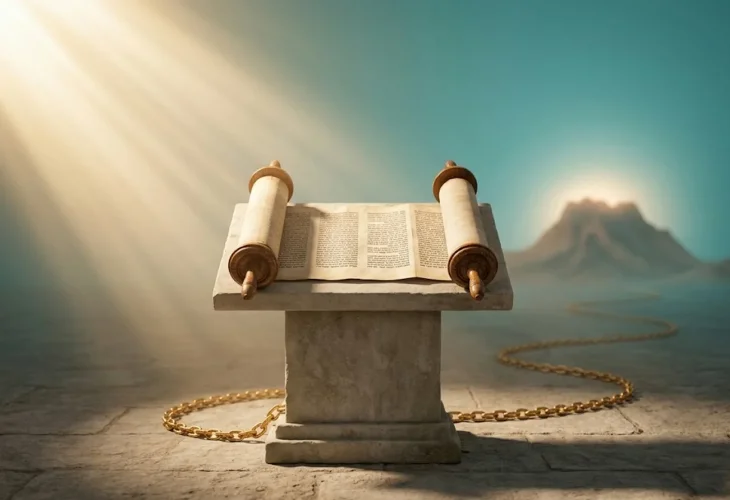
According to Rabbi Samson Raphael Hirsch, Parashat Va'etchanan presents three foundational truths about the identity and mission of the Jewish people:
- The Torah is eternal and cannot be changed.
- The revelation at Mount Sinai is an everlasting national testimony.
- The unity of Hashem is not merely a philosophical belief, but a way of life that shapes every aspect of our existence.
The Torah Is Not Open to Revision
The Jewish people could have viewed the Torah as a collection of inspiring ideas or timeless moral teachings. That is precisely why, in Parashat Va'etchanan, the Torah introduces a fundamental principle:
"Do not add to the word that I command you, and do not subtract from it."
This command teaches that the Torah is not simply a source of inspiration that each generation may adapt according to its own preferences. It is part of a Divine plan, and it must remain exactly as Hashem gave it.
Rabbi Hirsch points out that this prohibition is placed immediately after the reminder of what happened at Baal Peor:
"Your eyes have seen what Hashem did at Baal Peor."
At first glance, the connection seems unclear. What does Baal Peor have to do with adding to or subtracting from the Torah?
According to Rabbi Hirsch, the connection is essential. The tragedy of Baal Peor demonstrates what happens when people abandon Hashem's precise instructions and begin following their own ideas. Instead of remaining faithful to the Torah, they chose their own path and were drawn into idolatry.
The message is clear: the Torah is not ours to reshape.
Mount Sinai: An Eternal National Testimony
With this foundation established, Moshe returns to the revelation at Mount Sinai.
The giving of the Torah was not merely the beginning of Jewish history. It serves as the eternal testimony that the Torah is Divine and unchanging.
That is why the Torah commands:
"And you shall make them known to your children and to your children's children."
Rabbi Hirsch emphasizes that the revelation at Sinai was a real historical event witnessed by an entire nation. The Torah does not begin by asking us to admire its wisdom or appreciate its beauty. First, it asks us to recognize the historical reality that Hashem revealed Himself before the entire people of Israel, and that this event has been faithfully transmitted from generation to generation.
Because the revelation was experienced by the entire nation, no individual, not even a prophet, has the authority to alter the Torah.
A prophet receives revelation privately.
The Torah was given publicly.
That national revelation remains the highest authority.
Hearing Rather Than Seeing
Rabbi Hirsch also highlights another remarkable verse:
"You heard the sound of words, but saw no form, only a voice."
This detail teaches that Judaism is built upon listening and obedience rather than visual representation.
The Torah deliberately emphasizes that no image accompanied the revelation. Creating a physical representation of the Creator, even with good intentions, introduces something that distracts from the words Hashem spoke.
Our relationship with Hashem is built through His word.
We come closer to Him not by creating images, but by listening to His voice and living according to His commandments.
Living the Unity of Hashem
After accepting the Torah as Hashem's unchanging word, we are called to internalize its message.
The Torah declares:
"Know this day and bring it back to your heart that Hashem is God in the heavens above and on the earth below; there is none else."
These words follow Shema Yisrael because they continue its central message.
Recognizing Hashem's oneness is not simply an intellectual belief. It transforms the way a person views every part of life. Once we understand that there is no power apart from Hashem, we begin to recognize His presence in every circumstance and seek to fulfill His will in every moment.
Love Leads to Action
Shema Yisrael addresses the Jewish people as witnesses.
They heard Hashem's voice at Sinai. They heard Moshe transmit His Torah. Their continued observance throughout the generations serves as living testimony to Hashem's unity.
But the Torah does not stop with testimony.
It immediately continues:
"And you shall love Hashem your God with all your heart and with all your soul."
Rabbi Hirsch explains that true observance cannot remain an external obligation. Before the mitzvot can be fulfilled in their fullest sense, they must be rooted in love.
Once a person recognizes Hashem's unity and His presence throughout creation and throughout the Torah, love naturally follows.
As Rabbi Hirsch teaches, love of Hashem and love of His Torah are inseparable.
That love then expresses itself in every area of life:
"You shall teach them diligently to your children... speak of them... bind them as a sign upon your hand... and write them on the doorposts of your house and on your gates."
Love is never passive.
It always finds expression through action.
Parashat Va'etchanan begins with the command not to add to or subtract from the Torah, affirming that Hashem's word is eternal and complete. It concludes with a call to love Hashem with all our heart and soul, a love that inspires wholehearted obedience and faithful transmission of His Torah from generation to generation.

