

Wonders of Creation
Meet the Siphonophore: The Longest Animal on the Planet
It's longer than a blue whale and unlike any animal you've seen before. Discover the incredible siphonophore and why scientists say it's the longest animal ever recorded.
- Yehosef Yavetz
- | Updated
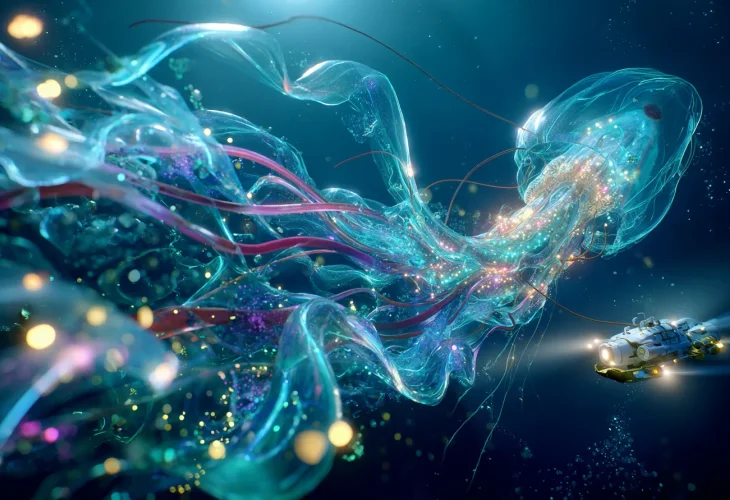
Giant snakes can grow to more than 40 feet (13 meters), and blue whales can reach nearly 100 feet (30 meters). But the longest animal ever recorded is neither a snake nor a whale. In fact, it looks more like a long, transparent strand floating through the ocean.
The remarkable creature was discovered in March 2020 during a deep-sea expedition off the coast of Ningaloo, Western Australia. Researchers aboard the Schmidt Ocean Institute's vessel Falkor were exploring underwater canyons using the remotely operated vehicle ROV SuBastian, diving to depths of up to 14,760 feet (4,500 meters).
Led by Dr. Nerida Wilson of the Western Australian Museum, the team completed 20 dives totaling 181 hours as they documented the little-known ecosystems hidden deep beneath the ocean's surface.
Then they encountered something extraordinary.
Coiled into a giant spiral was a creature that looked like a delicate thread suspended in the water. As the researchers followed it, they realized it just kept going. The animal measured an astonishing 45 meters (148 feet) in length.
The Schmidt Ocean Institute later described it as "the longest animal ever recorded."
Even Longer Than Scientists First Thought
The creature is known as a siphonophore, a fascinating marine organism unlike almost anything else on Earth.
Although the 45-meter specimen amazed researchers, they later discovered it wasn't fully grown. Since then, siphonophores measuring up to 119 meters (390 feet) have been documented, making them by far the longest animals ever observed.
The same expedition also identified around 30 previously unknown or rarely documented marine species, but it was the enormous siphonophore that captured the world's attention.
One Animal Made of Many Living Parts
What makes the siphonophore especially remarkable is that it is not a single organism in the way we usually think of an animal.
Instead, it is a colony made up of thousands of tiny, genetically identical organisms called zooids that function together as a single living creature.
Each zooid performs one specialized task. Some propel the colony through the water, others capture prey, some digest food, others handle reproduction, and still others provide protection.
Individually, the zooids cannot survive. Together, they function as one perfectly coordinated animal.
Like a Living Train
Scientists often compare a siphonophore to a living train.
At the front are specialized swimming structures that propel the colony forward. Behind them stretches an incredibly long chain of zooids, each carrying out its own job while remaining permanently connected to the rest.
Unlike most animals, which have organs inside a single body, the siphonophore operates more like a highly organized community, with each member contributing to the survival of the whole.
A Spiral-Shaped Hunter
When researchers observed the siphonophore, it was arranged in a giant spiral.
This is its hunting position.
Long tentacles armed with stinging cells extend into the surrounding water, creating a vast net that traps tiny fish and other prey. Once captured, the food is drawn inward, digested, and shared throughout the colony.
Siphonophores belong to the same animal group as jellyfish, sea anemones, and corals, all of which possess specialized stinging cells used to catch prey.
They typically hunt hundreds of meters below the ocean's surface, often around 600 meters (2,000 feet) deep.
The Ocean Still Holds Countless Mysteries
Despite centuries of exploration, scientists have studied only a small fraction of Earth's deep oceans.
Most of our planet lies beneath the sea, and much of that underwater world remains unexplored.
As technology allows researchers to venture farther into the depths, discoveries like the siphonophore remind us that some of nature's most astonishing creations may still be waiting to be found.

