

History and Archaeology
2,600-Year-Old Burned Beams From the First Temple Uncovered in Jerusalem
Just before Tisha B'Av, archaeologists announced the discovery of burned First Temple-era wooden beams in Jerusalem, a rare find that sheds new light on the Babylonian destruction.
- Yuval Aviv
- | Updated
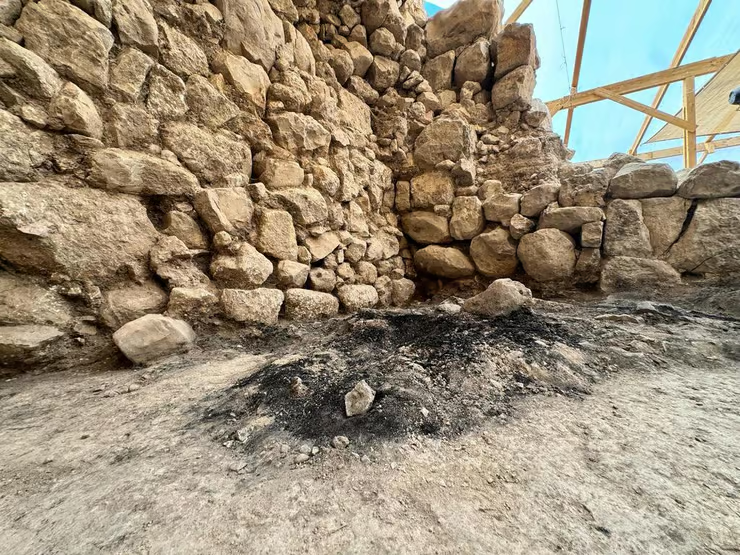 Remains of the destruction in the City of David excavations (Photo: Reut Wilf, City of David)
Here's a polished version in the same Hidabroot style: smooth American English, beginner-friendly, lightly improved, balanced paragraphs, and faithful to the original. I also removed repetition and tightened several sections.
Massive wooden beams that burned during the destruction of Jerusalem in 586 BCE have been uncovered in the Givati Parking Lot excavations in the City of David. The excavation, led by the Israel Antiquities Authority and Tel Aviv University in the Jerusalem Walls National Park, has revealed an exceptionally rare archaeological discovery that sheds new light on the destruction of the First Temple and may significantly improve researchers' ability to date finds from this period.
According to the archaeologists, the beams once supported the roof of an inner courtyard in a large First Temple-era building. When the Babylonians destroyed Jerusalem, the roof collapsed, leaving the charred beams buried beneath the ruins, where they remained preserved for approximately 2,600 years.
Excavation director Efrat Bocher explained that the circumstances of the destruction made the remarkable preservation possible.
"It appears these beams, which roofed an inner courtyard of a First Temple-period structure, collapsed onto the building's floor during the destruction. We believe the plaster that coated the walls melted in the intense fire and covered the charred beams, helping preserve them in such exceptional condition."
A Rare Opportunity for Precise Dating
Dr. Johanna Regev of the Israel Antiquities Authority, who is studying the discovery, said the large number of preserved tree rings makes the beams especially valuable for scientific research.
"It is very rare to find wood in Israel containing such a large number of tree rings," she explained. "Here in the City of David, we uncovered thick wooden beams with many rings, creating significant research potential."
According to Regev, the discovery could dramatically improve the accuracy of archaeological dating.
"The more rings a piece of wood contains, the more precisely we can determine its age. Until now, many finds could only be dated within a range of hundreds of years. These beams may allow us to narrow that window to as little as 10 years."
Preserving the Memory of Destruction
Excavation directors Dr. Yiftah Shalev of the Israel Antiquities Authority and Professor Yuval Gadot of Tel Aviv University said the remains clearly demonstrate the intensity of Jerusalem's destruction.
"It is evident that this large building was deliberately set on fire and collapsed all at once," they said.
The researchers also found evidence that during the Persian period, after the destruction, residents sealed off the entrance to this section of the building while continuing to live in adjacent areas.
According to the archaeologists, this was likely a deliberate decision to preserve the ruins as a memorial.
"Creating a memorial space is a basic human need, especially after a traumatic event. The residents consciously chose to leave the destruction untouched as testimony to what had happened, rebuilding alongside it rather than clearing it away."
Bocher noted that the discovery carries particular significance just before Tisha B'Av.
"It gives you the feeling that you are witnessing the very moment of the destruction," she said. "It is incredibly moving."
A Powerful Reminder Before Tisha B'Av
Heritage Minister Amichai Eliyahu described the discovery as one of great historical and national significance.
"The soil of Jerusalem continues to testify to what some seek to deny," he said. "These wooden beams, burned during the destruction of the First Temple, are silent yet powerful evidence of the Jewish people's presence in Jerusalem 2,600 years ago."
He added that the timing of the discovery is especially meaningful.
"On the eve of Tisha B'Av, this find reminds us that our connection to Jerusalem is rooted not only in faith, but also in history, archaeology, and our national memory. Our responsibility is to continue uncovering this truth, preserving it, and passing it on with pride to future generations."

