

Yom Kippur
Yom Kippur (Day of Atonement): The Holiest Day in Judaism
Everything you need to know about Yom Kippur 2026 — the dates, the 25-hour fast, the five prohibitions, Kol Nidre, and the prayers of the holiest day of the Jewish year.
- Hidabroot
- | Updated
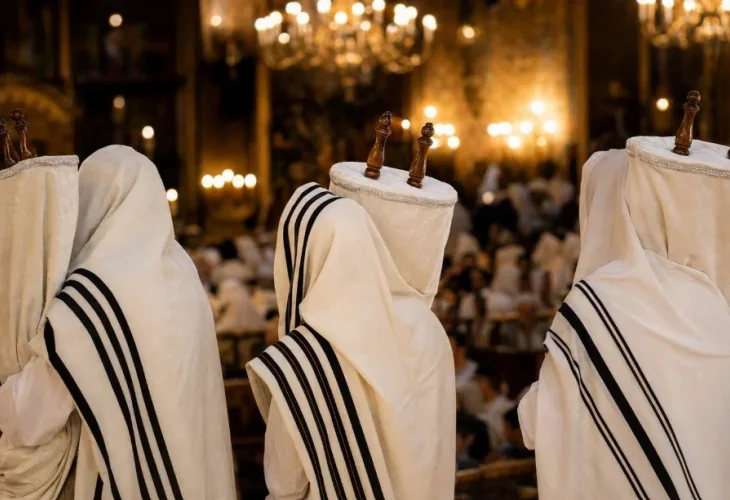 White-clad worshippers holding Torah scrolls during Kol Nidre on Yom
 Yom Kippur (the Day of Atonement) is the holiest day in the Jewish calendar — a 25-hour fast dedicated to repentance, prayer, and asking forgiveness from God and from fellow human beings. Observed on the 10th of Tishrei, it culminates the Ten Days of Repentance that begin with Rosh Hashanah. Five prohibitions are observed: no eating or drinking, no bathing, no anointing, no leather shoes, and no marital relations. In 2026, Yom Kippur begins at sundown on Sunday, September 20, and ends at nightfall on Monday, September 21.
Yom Kippur, the Day of Atonement, is the holiest day in Judaism — a day the Torah itself calls "Shabbat Shabbaton," a Sabbath of Sabbaths (Leviticus 23:32). For 25 hours, Jews around the world step away from food, drink, and the routines of daily life to stand before God in prayer and repentance. It is the closing day of the Ten Days of Repentance, the solemn period that opens with Rosh Hashanah, and tradition teaches that on this day the judgment written on Rosh Hashanah is sealed. Even Jews who rarely enter a synagogue during the year make a point of attending Kol Nidre and hearing the final shofar blast — a testimony to the unique hold Yom Kippur has on the Jewish soul. This complete guide covers everything you need to know for Yom Kippur 2026: the meaning of the day, exact dates and fast times, the five prohibitions, the prayer services from Kol Nidre to Ne'ilah, and the customs that surround the holiest day of the Jewish year.
What is Yom Kippur?
Yom Kippur is the annual Day of Atonement established by the Torah: "For on this day He shall provide atonement for you to cleanse you; from all your sins before God shall you be cleansed" (Leviticus 16:30). It is a day set aside entirely for teshuvah (repentance), prayer, and reconciliation — with God and with other people. The Torah commands two things on this day: to "afflict yourselves," understood by the Sages as fasting and related abstentions, and to refrain from all creative labor, exactly as on Shabbat (Leviticus 23:27–32).
The Meaning of "Yom Kippur"
In Hebrew, the Torah calls the day Yom HaKippurim — literally, "the Day of Atonements," in the plural, for it atones for many kinds of sin. The word kippur comes from the root k-p-r, meaning atonement, cleansing, and covering over of sin. The name expresses the day's essential promise: that sincere repentance is accepted, and that a person's past does not have to dictate his future.
Why It's Called the "Day of Atonement"
"Day of Atonement" is the standard English translation of Yom Kippur, drawn directly from Leviticus. The Mishnah teaches a crucial qualification: Yom Kippur atones for sins between man and God, but for sins between man and his fellow, Yom Kippur does not atone until he appeases his fellow (Mishnah Yoma 8:9). This is why asking forgiveness from the people we have wronged is an essential part of preparing for the day — atonement in Judaism is never a private transaction that bypasses the human beings we have hurt.
The "Sabbath of Sabbaths" (Shabbat Shabbaton)
The Torah twice calls Yom Kippur Shabbat Shabbaton — a Sabbath of complete rest (Leviticus 16:31; 23:32). All the labors forbidden on Shabbat are forbidden on Yom Kippur, and on top of them come the five afflictions, beginning with the fast. Far from being a day of gloom, the Sages describe it as one of the most joyous days of the year: "There were no days as festive for Israel as the fifteenth of Av and Yom Kippur" (Mishnah Ta'anit 4:8) — because there is no greater joy than the assurance of forgiveness.
When is Yom Kippur 2026?
Yom Kippur 2026 begins at sundown on Sunday, September 20, 2026, and ends at nightfall on Monday, September 21, 2026 (10 Tishrei 5787). The fast lasts approximately 25 hours, from just before sunset on Sunday evening until the stars emerge on Monday night.
Yom Kippur Dates for the Coming Years
| Year | Begins (sundown) | Ends (nightfall)eader 3 | Note |
|---|---|---|---|
2026 | Sunday, September 20 | Monday, September 21 | 10 Tishrei 5787 |
2027 | Sunday, October 10 | Monday, October 11 | 10 Tishrei 5788 |
2028 | Friday, September 29 | Saturday, September 30 | Falls on Shabbat |
2029 | Tuesday, September 18 | Wednesday, September 19 | 10 Tishrei 5790 |
2030 | Sunday, October 6 | Monday, October 7 | 10 Tishrei 5791 |
Dates verified against the Hebcal Jewish calendar. All Jewish days begin at sundown on the previous evening.
![Yom Kippur dates for upcoming years]() Yom Kippur dates for upcoming years
Yom Kippur dates for upcoming years
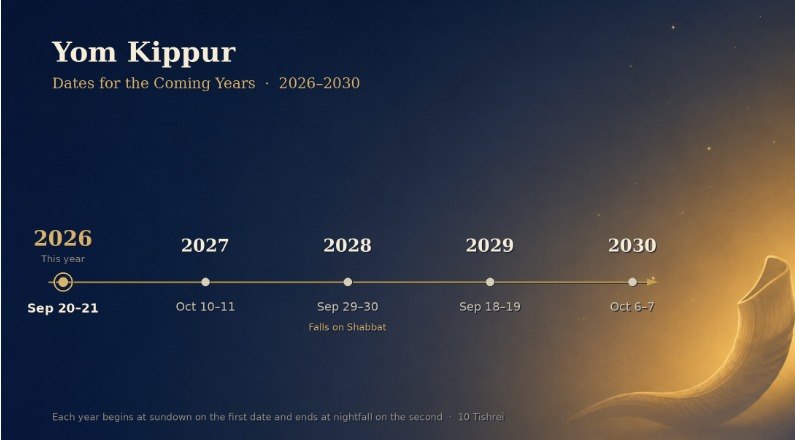 Yom Kippur dates for upcoming years
Yom Kippur and the Hebrew Calendar (10 Tishrei)
Yom Kippur always falls on the 10th day of Tishrei, the first month of the Jewish civil year — nine days after Rosh Hashanah, which falls on 1 Tishrei. Because the Hebrew calendar is lunisolar, the Gregorian date shifts from year to year, always landing between mid-September and mid-October. A noteworthy feature of the fixed Jewish calendar: Yom Kippur can never fall on a Sunday, Tuesday, or Friday. The calendar is structured so that the Day of Atonement is never immediately adjacent to Shabbat, which would create practical difficulties of two consecutive days on which food cannot be prepared.
Fast Times by Location (NY, NJ, FL, TX, LA)
The Yom Kippur fast begins at candle-lighting time — customarily 18 minutes before local sunset on the eve of Yom Kippur — and ends at nightfall the following day, when three stars are visible, roughly 25 hours later. Here are the times for Yom Kippur 2026 in five major American Jewish communities, per the Hebcal zmanim calendar:
City | Fast Begins (candle | Fast Ends (nightfall), |
|---|---|---|
New York | 6:38 p.m. EDT | 7:35 p.m. EDT |
Lakewood, NJ | 6:39 p.m. EDT | 7:36 p.m. EDT |
Miami, FL | 7:01 p.m. EDT | 7:52 p.m. EDT |
Houston, TX | 7:02 p.m. CDT7:02 p.m. CDT | 7:54 p.m. CDT |
Los Angeles, | 6:34 p.m. PDT | 7:28 p.m. PDT |
Times per Hebcal (candle lighting 18 minutes before sunset; fast end at nightfall). Some communities customarily end the fast several minutes later — always follow your own synagogue's schedule, and remember that the fast ends only at nightfall, not at sunset.
The Five Prohibitions of Yom Kippur
The Torah commands, "you shall afflict your souls" (Leviticus 23:27). The Mishnah (Yoma 8:1) defines this affliction as five abstentions, codified in the Shulchan Aruch (Orach Chayim 611): eating and drinking, washing, anointing, wearing leather shoes, and marital relations. All five apply for the full 25 hours, to men and women alike, from the age of bar or bat mitzvah.
![Infographic showing the five prohibitions of Yom Kippur]() Infographic showing the five prohibitions of Yom Kippur
Infographic showing the five prohibitions of Yom Kippur
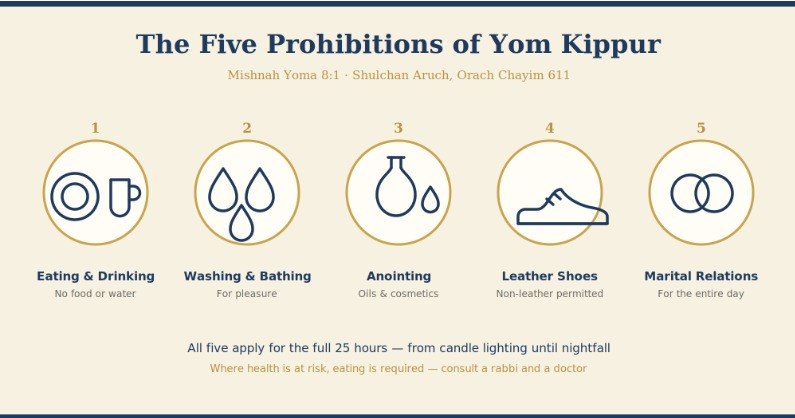 Infographic showing the five prohibitions of Yom Kippur
1. Eating and Drinking
The fast is the heart of Yom Kippur and the most severe of the five prohibitions — the only one whose deliberate violation carries the Torah's penalty of kareit (spiritual excision; Leviticus 23:29–30). No food or drink of any kind is consumed, including water. Even rinsing the mouth is prohibited (Shulchan Aruch, Orach Chayim 613). The halachah is equally emphatic in the other direction: a person whose life may be endangered by fasting is obligated to eat, as explained below in "Who is Exempt from Fasting?"
2. Washing and Bathing
Washing for pleasure or comfort is forbidden, whether in hot or cold water (Shulchan Aruch, Orach Chayim 613). Washing to remove actual dirt is permitted, as is the ritual washing of the fingers upon waking in the morning. The prohibition expresses the day's character: for one day, the body's comforts are set aside so the soul can take center stage.
3. Anointing with Oils or Cosmetics
Applying oils, lotions, creams, or perfumes to the body for pleasure is prohibited (Shulchan Aruch, Orach Chayim 614). In Talmudic times anointing with oil was a standard part of personal grooming; today the prohibition covers its modern equivalents in cosmetics and skin care.
4. Wearing Leather Shoes
Leather footwear — in Talmudic terminology, the "sandal" — is forbidden on Yom Kippur (Shulchan Aruch, Orach Chayim 614). This is why worshippers in synagogues around the world can be seen in canvas sneakers, rubber slippers, or cloth shoes beneath their holiday clothes. Leather shoes were the emblem of comfort and status; removing them is an act of humility on the day a person stands before God stripped of pretense.
5. Marital Relations
The fifth affliction is abstention from marital relations for the duration of the day (Shulchan Aruch, Orach Chayim 615). On Yom Kippur, the Jewish people are compared to the ministering angels, and every physical indulgence is set aside.
How to Observe Yom Kippur
Yom Kippur observance actually begins the day before, on the 9th of Tishrei, which the Torah and the Sages invest with its own significance. Here is the traditional order of the day, from the final meal to the breaking of the fast.
The Pre-Fast Meal (Seudah Hamafseket)
The Talmud teaches that eating on the eve of Yom Kippur is itself a mitzvah: "Whoever eats and drinks on the ninth of Tishrei is credited by Scripture as if he fasted on both the ninth and the tenth" (Yoma 81b). The final meal before the fast is called the seudah hamafseket — "the meal of separation." It is customarily a festive but simple meal of easily digestible foods, avoiding overly salty or spicy dishes that increase thirst, and it must end before candle-lighting time. Many parents bless their children after this meal, before leaving for Kol Nidre — one of the most moving moments of the Jewish year.
![Pre-fast meal (Seudah Hamafseket) before Yom Kippur]() Pre-fast meal (Seudah Hamafseket) before Yom Kippur
Pre-fast meal (Seudah Hamafseket) before Yom Kippur
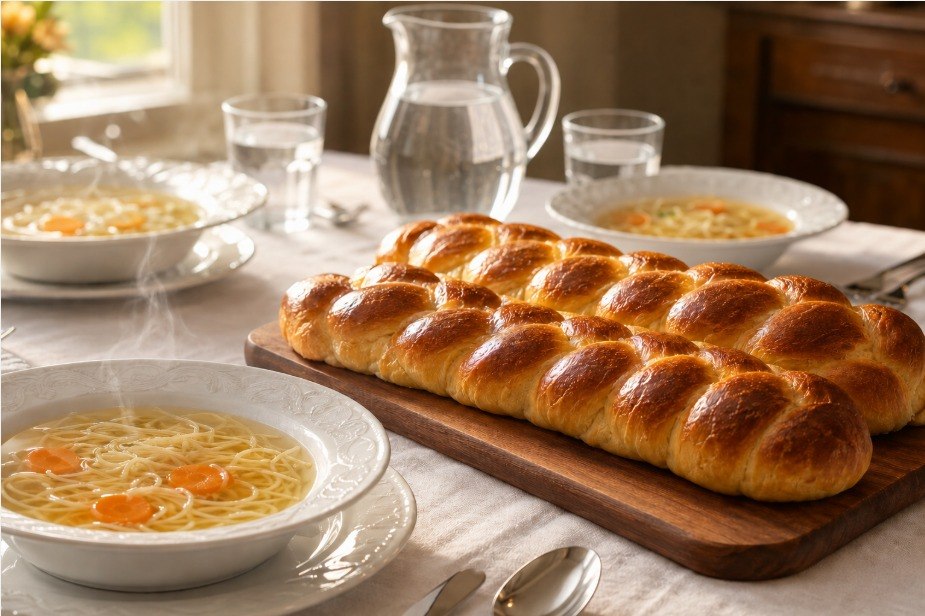 Pre-fast meal (Seudah Hamafseket) before Yom Kippur
Candle Lighting Before Yom Kippur
Candles are lit before sunset with the blessing "…asher kideshanu bemitzvotav vetzivanu lehadlik ner shel Yom HaKippurim," followed by the Shehecheyanu blessing. It is also widely customary to light a memorial (yahrzeit) candle for departed parents, and to light a long-burning flame that will remain lit throughout the day — needed after the fast for the Havdalah candle, which on Yom Kippur must be lit from a flame that burned through the day (Shulchan Aruch, Orach Chayim 624).
![Yom Kippur candle lighting before sundown]() Yom Kippur candle lighting before sundown
Yom Kippur candle lighting before sundown
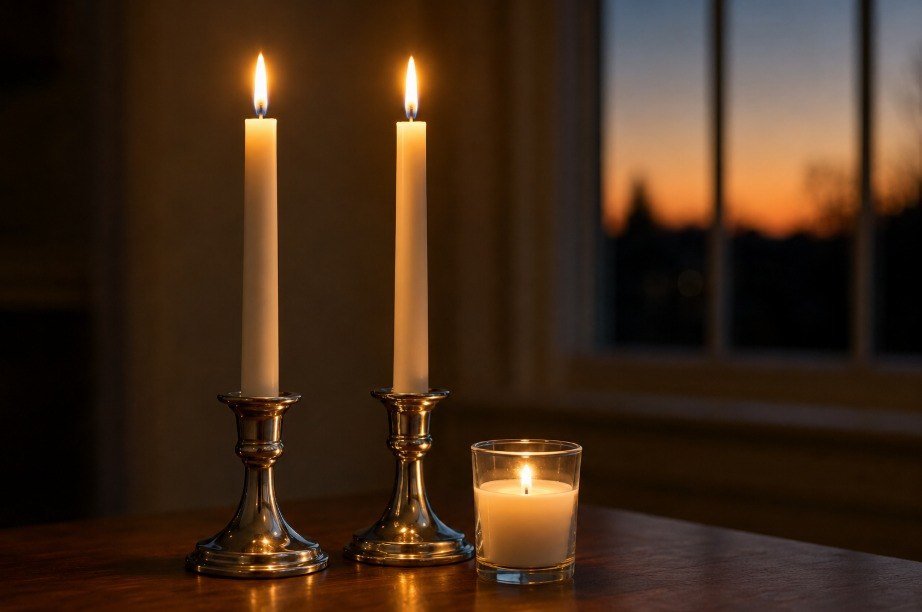 Yom Kippur candle lighting before sundown
The 25-Hour Fast Schedule
The fast begins at candle lighting, roughly 18 minutes before sunset, because halachah requires adding time from the ordinary day onto the holy day (tosefet Yom HaKippurim; Shulchan Aruch, Orach Chayim 608). It ends the next evening at nightfall, when three medium stars would be visible — about 25 hours in total. The evening begins with Kol Nidre and Ma'ariv; the day is spent largely in synagogue through Shacharit, Musaf, Minchah, and Ne'ilah; and the fast concludes with the blast of the shofar.
Wearing White — Kittel and Symbolism
It is customary to wear white on Yom Kippur, and many married men wear a kittel, a plain white robe. The white garments carry a double symbolism: they liken the Jewish people to the ministering angels, pure and free of physical need, and they echo the promise of the prophet: "If your sins are like scarlet, they will become white as snow" (Isaiah 1:18). The kittel also resembles burial shrouds, a sobering reminder of mortality that awakens the heart to repentance. Uniquely, the tallit (prayer shawl) is worn for the evening service of Kol Nidre — the only night of the year this is done.
![White kittel and tallit worn on Yom Kippur]() White kittel and tallit worn on Yom Kippur
White kittel and tallit worn on Yom Kippur
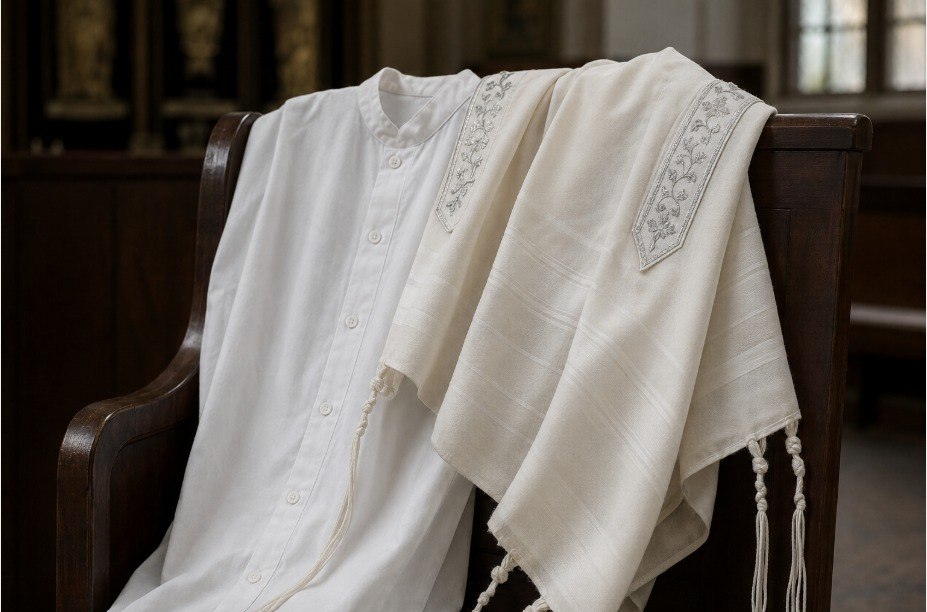 White kittel and tallit worn on Yom Kippur
Breaking the Fast
After the final shofar blast and the weekday Ma'ariv service, Havdalah is recited over wine, with the candle lit from the flame that burned throughout the day. It is wise to break the fast gently — beginning with a drink and light food before a full meal. A beloved custom follows immediately: many begin building the sukkah (or at least discussing or planning it) right after Yom Kippur ends, going straight from one mitzvah to the next as Sukkot arrives just five days later (Rema, Orach Chayim 624:5).
Yom Kippur Prayer Services
No day of the Jewish year has a liturgy like Yom Kippur's. It is the only day with five separate prayer services, and its melodies — above all Kol Nidre — are among the most recognizable in all of Jewish life.
Kol Nidre — The Opening Service
Kol Nidre (also spelled Kol Nidrei, "All Vows") is the dramatic opening of Yom Kippur, recited in the synagogue just before sunset while the Torah scrolls are held by members of the congregation. Composed mostly in Aramaic, it is a formal annulment of vows — releasing worshippers from personal vows made to God that were not fulfilled. It does not annul obligations to other people or oaths taken in court. The passage is recited three times, in a haunting ancient melody, traditionally beginning quietly and growing louder. Kol Nidre draws the largest synagogue attendance of the entire year. You can learn more in our dedicated Kol Nidre article.
The Machzor — The High Holiday Prayer Book
The prayers of Yom Kippur are gathered in the machzor, the special High Holiday prayer book, which differs substantially from the year-round siddur. Alongside the standard prayers it contains the confessional Vidui, Avinu Malkeinu, the Avodah service, and centuries of piyyutim (liturgical poems) that vary between Ashkenazi and Sephardic traditions. Choosing a machzor with a clear translation makes the long day of prayer immeasurably more meaningful for those less fluent in Hebrew.
Vidui — The Confessional Prayer
Vidui (confession) is the verbal heart of repentance: the Rambam rules that confession before God is the essential mitzvah of teshuvah (Hilchot Teshuvah 1:1; 2:2). On Yom Kippur the Vidui — the alphabetical "Ashamnu" and the longer "Al Chet" — is repeated throughout the day's services, beginning already at Minchah on the eve of Yom Kippur. It is said standing, bowed slightly, while gently striking the chest at each phrase. Notably, the confession is written in the plural — "we have sinned" — because the Jewish people stand before God as one responsible community.
![A Yom Kippur prayer book from the 14th century, used by the Jews of the Crimean Peninsula and donated to the National Library. (Photo: Courtesy of the National Library)]() A Yom Kippur prayer book from the 14th century, used by the Jews of the Crimean Peninsula and donated to the National Library. (Photo: Courtesy of the National Library)
A Yom Kippur prayer book from the 14th century, used by the Jews of the Crimean Peninsula and donated to the National Library. (Photo: Courtesy of the National Library)
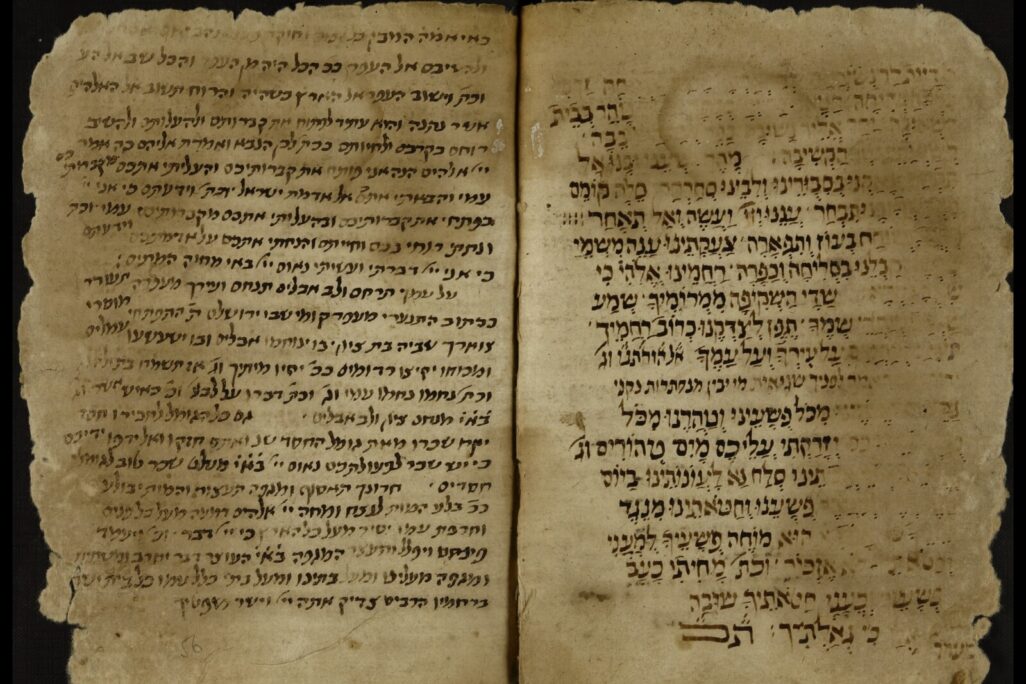 A Yom Kippur prayer book from the 14th century, used by the Jews of the Crimean Peninsula and donated to the National Library. (Photo: Courtesy of the National Library)
Avinu Malkeinu
"Avinu Malkeinu" — "Our Father, Our King" — is one of the most beloved prayers of the High Holidays, its core attributed by the Talmud to Rabbi Akiva, whose short prayer "Our Father, our King, we have no King but You" brought rain in a time of drought (Ta'anit 25b). The congregation recites its long litany of requests before the open ark. During the Ten Days of Repentance the wording asks "inscribe us"; on Yom Kippur it changes to "seal us" in the Book of Life. In Ashkenazi custom, Avinu Malkeinu is omitted when Yom Kippur falls on Shabbat, except at Ne'ilah.
The Five Services of Yom Kippur
Yom Kippur is the only day of the year with five prayer services: Ma'ariv (following Kol Nidre) on the eve; Shacharit, the morning service with its Torah reading; Musaf, featuring the Avodah; Minchah, with the reading of the Book of Jonah; and Ne'ilah, the closing service found on no other day of the year. Together with the recurring Vidui and the piyyutim, prayer fills nearly the entire day — a full day lived, as it were, in the world of the angels.
The Avodah Service
During Musaf, the congregation recounts the Avodah — the awe-inspiring service performed by the Kohen Gadol (High Priest) in the Holy Temple on Yom Kippur, as described in Leviticus 16 and Tractate Yoma. When the reader describes the High Priest pronouncing God's ineffable Name and the assembled people falling on their faces, congregations to this day kneel and bow to the ground — one of the only times of the year this is done, together with Aleinu of the High Holidays.
Yizkor — Remembering the Departed
Yizkor, the memorial prayer for departed parents and relatives, is recited in Ashkenazi congregations after the Torah reading of Shacharit. It is one of only four times a year Yizkor is said, and on Yom Kippur it carries special weight — the day's atonement is sought for the departed as well, and charity is pledged in their memory. Many who attend no other service of the year come to synagogue for Yizkor.
Ne'ilah — The Closing Service
Ne'ilah (also spelled Neilah) — literally "the locking [of the gates]" — is recited as the sun sets and Yom Kippur draws to its close. It exists on no other day of the calendar. The ark remains open for the entire service, the congregation standing before it, and the liturgy shifts from "inscribe us" to "seal us" — these are the final moments in which the year's judgment is sealed. Ne'ilah ends with the whole congregation proclaiming together: "Shema Yisrael" once, "Baruch Shem Kevod Malchuto" three times, and "Hashem Hu HaElokim" — "The Lord, He is God" — seven times.
The Final Shofar Blast
A single long shofar blast — the tekiah gedolah — pierces the synagogue at the end of Ne'ilah, announcing that the Day of Atonement is complete. It recalls the shofar of the Yovel (Jubilee) year, which was sounded on Yom Kippur (Leviticus 25:9), and it releases a day's worth of pent-up emotion in a single sound. The congregation then bursts into "L'shanah haba'ah birushalayim" — "Next year in Jerusalem!"
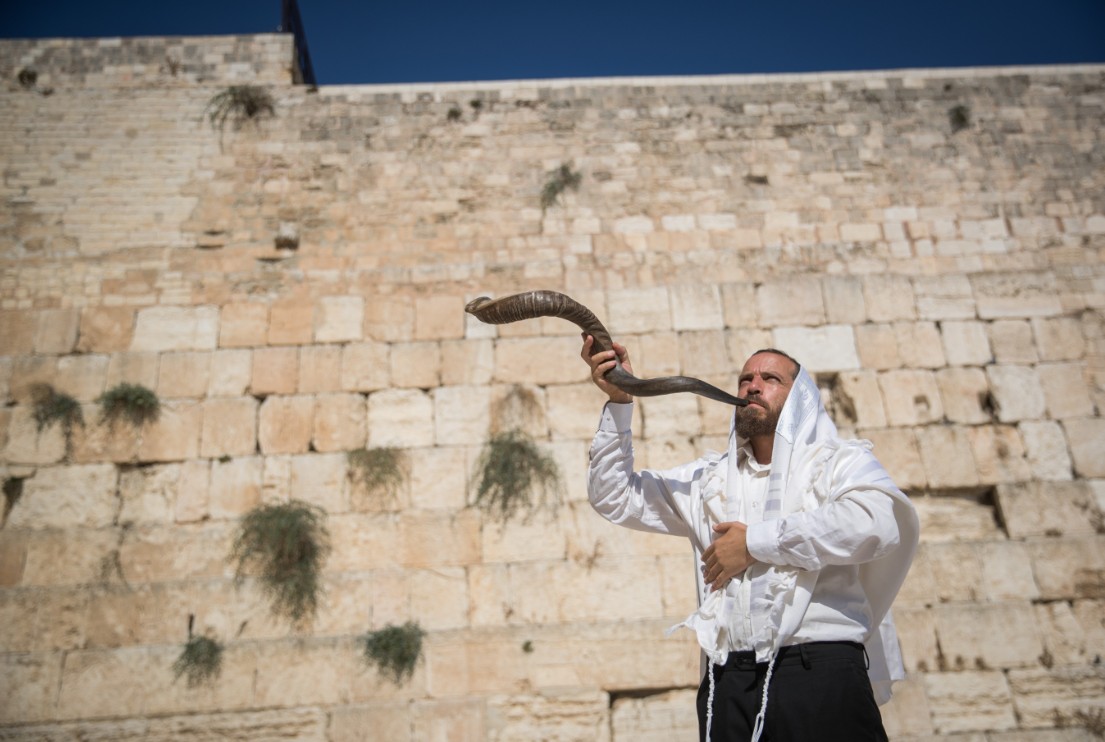 (Photo: Yonatan Sindel/Flash90)
Who is Exempt from Fasting?
Judaism holds human life sacred above nearly all else. The Talmud derives from the verse "you shall live by them" (Leviticus 18:5) that saving a life overrides the mitzvot, including the Yom Kippur fast (Yoma 85b). The rule of thumb of halachah: where there is genuine danger to life, eating is not merely permitted — it is required.
The Sick and Elderly
A person who is dangerously ill, or whom fasting could bring into danger, must eat on Yom Kippur, in accordance with the guidance of a doctor and a rabbi (Shulchan Aruch, Orach Chayim 618). Where possible, such a person eats in small measured quantities (shiurim) spaced several minutes apart, which lessens the severity of the act — but when full eating is medically necessary, it is done without hesitation. An elderly or frail person in this category should settle the practical details with a rabbi before the holiday, including questions of essential medications.
Pregnant and Nursing Women
The Shulchan Aruch rules that pregnant and nursing women fast the full fast on Yom Kippur (Orach Chayim 617). At the same time, any situation involving medical risk changes the picture entirely, and halachah itself carves out clear exemptions around childbirth. Practical questions in this area should always be brought to a qualified rabbi together with a doctor before the fast — this is precisely what rabbis are for, and the halachic tradition treats these questions with great seriousness and care.
Children Under Bar/Bat Mitzvah Age
Children below the age of mitzvot — thirteen for a boy, twelve for a girl — are not obligated to fast. Young children should not fast at all. In the years approaching bar/bat mitzvah, halachah prescribes gradual training (chinuch): healthy children close to the age of obligation practice fasting for a number of hours, as codified in the Shulchan Aruch (Orach Chayim 616). Children old enough to attend synagogue absorb the atmosphere of the day even without fasting.
Yom Kippur Customs and Traditions
Around the halachic core of Yom Kippur has grown a rich body of customs, some dating back to the Geonic era, that shape the day before and the day itself.
Kapparot Ceremony
In the days before Yom Kippur — customarily in the early morning of the eve of Yom Kippur — many perform kapparot: a chicken, or money designated for charity, is circled over the head while reciting a text asking that the atonement of the coming day spare the person. The custom is ancient but was debated by the great codifiers: the Shulchan Aruch records reservations about the practice, while the Rema and Ashkenazi tradition uphold it (Orach Chayim 605). Today many authorities encourage performing kapparot with money given to charity, which fulfills the custom while directly helping the poor.
Kapparot in Brief: (1) Take an amount of money designated for charity (or, in communities that maintain the original custom, a chicken). (2) Circle it over the head three times while reciting the kapparot text from the machzor — "This is my exchange, this is my substitute, this is my atonement…" (3) Give the money to the poor (or the chicken/its value to charity). Best performed in the early morning of Erev Yom Kippur, though it may be done throughout the Ten Days of Repentance.
Charity (Tzedakah) Before Yom Kippur
Giving tzedakah is bound up with the entire season: the Rambam writes that it is the universal Jewish custom to increase charity and good deeds between Rosh Hashanah and Yom Kippur beyond the rest of the year (Hilchot Teshuvah 3:4). The Unetaneh Tokef prayer, a centerpiece of the High Holiday liturgy, declares that "repentance, prayer, and charity remove the evil of the decree." Many give charity before candle lighting on the eve of Yom Kippur, and pledges for the departed are customarily made at Yizkor. You can dedicate prayers through the Hidabroot Tehillim Project in this spirit.
Asking Forgiveness from Others
Since Yom Kippur does not atone for offenses against other people until they have been appeased (Mishnah Yoma 8:9), the days before Yom Kippur are the traditional time to seek out anyone we have wronged — in word, in money, or in honor — and ask forgiveness sincerely. The Shulchan Aruch codifies this as practical law (Orach Chayim 606), adding that the injured party should not be cruel and should forgive readily. If the first attempt is rebuffed, one returns and tries again. No prayer service can substitute for this quiet, humbling work of repairing human relationships.
Yom Kippur Greetings — "Gmar Chatimah Tovah"
The classic greeting of the season is "Gmar Chatimah Tovah" — "may your final sealing be good" — reflecting the tradition that the judgment inscribed on Rosh Hashanah is sealed on Yom Kippur. From Rosh Hashanah onward one also hears "L'Shanah Tovah Tikatevu (v'techatemu)" — "may you be inscribed (and sealed) for a good year." Before the fast itself, it is common to wish others a tzom kal — "an easy fast" — or, more precisely in the spirit of the day, a meaningful one.
"Next Year in Jerusalem"
As Ne'ilah closes and the shofar sounds, congregations everywhere sing out "L'shanah haba'ah birushalayim" — "Next year in Jerusalem!" The declaration, also proclaimed at the end of the Passover Seder, expresses the eternal Jewish hope for the complete redemption and the rebuilt Temple, where the Yom Kippur service was once performed in its fullness. In Jerusalem itself, tens of thousands gather at the Kotel (Western Wall) for the closing prayers of the day.
![Worshippers praying at the Western Wall on Yom Kippur]() Worshippers praying at the Western Wall on Yom Kippur
Worshippers praying at the Western Wall on Yom Kippur
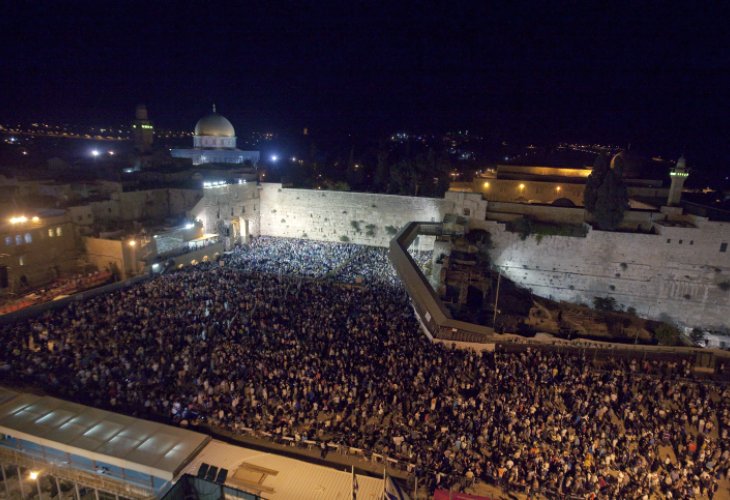 Worshippers praying at the Western Wall on Yom Kippur
The Ten Days of Repentance (Aseret Yemei Teshuvah)
Yom Kippur is the summit of a ten-day ascent that begins with Rosh Hashanah. These are the Aseret Yemei Teshuvah — the Ten Days of Repentance — also known as the Yamim Noraim, the Days of Awe.
From Rosh Hashanah to Yom Kippur
The Rambam writes: "Even though repentance and crying out are always beautiful, during the ten days between Rosh Hashanah and Yom Kippur they are especially beautiful and are accepted immediately, as it says: 'Seek God when He may be found'" (Hilchot Teshuvah 2:6, citing Isaiah 55:6). During these days, special insertions are added to the daily Amidah — "Remember us for life, King Who desires life" — and communities rise early for Selichot, the penitential prayers. On Rosh Hashanah the world is judged; the ten days are the God-given window to change the verdict before it is sealed.
The Book of Life
The Talmud teaches that three books are opened on Rosh Hashanah: the completely righteous are inscribed immediately for life, the completely wicked for the opposite, and the fate of those in between — most of us — is suspended from Rosh Hashanah until Yom Kippur (Rosh Hashanah 16b). This is the source of the imagery that fills the liturgy and greetings of the season — to be "written and sealed in the Book of Life" — and it is why the shofar is sounded and special prayers are said already on Rosh Hashanah, the Day of Judgment. The Unetaneh Tokef prayer gives the idea its most powerful expression: "On Rosh Hashanah it is written, and on the fast of Yom Kippur it is sealed."
Shabbat Shuvah
The Shabbat that falls between Rosh Hashanah and Yom Kippur is called Shabbat Shuvah — the Sabbath of Return — after the opening words of its haftarah: "Return, O Israel, to the Lord your God" (Hosea 14:2). It is customary in communities worldwide for the rabbi to deliver a major derashah (discourse) on this Shabbat, rousing the congregation to repentance in the final days before the seal. Many also increase their recitation of Tehillim (Psalms) throughout these days. Read more about teshuvah — the path of return.
The Origin and History of Yom Kippur
The Biblical Source (Leviticus 16 & 23)
Yom Kippur is commanded directly in the Torah. Leviticus 16 sets out the Temple service of the day in detail, concluding: "This shall be an eternal statute for you: in the seventh month, on the tenth of the month, you shall afflict yourselves… for on this day He shall provide atonement for you" (Leviticus 16:29–30). Leviticus 23:26–32 establishes the day for all generations — the affliction, the prohibition of labor, and its status as Shabbat Shabbaton — and Numbers 29:7–11 details its offerings. Yom Kippur is thus not a rabbinic institution or a later development, but one of the Torah's own appointed times, observed continuously for over three thousand years.
Moses and the Second Set of Tablets
According to Rabbinic tradition, the date of 10 Tishrei carries the memory of the greatest act of forgiveness in Israel's history. After the sin of the Golden Calf and the shattering of the first Tablets, Moses ascended Mount Sinai for a final forty days of pleading, and descended on the tenth of Tishrei with the second Tablets — the sign that God had fully forgiven His people (Rashi on Deuteronomy 9:18; Midrash Tanchuma, Ki Tisa). That day was fixed forever as a day of pardon and atonement.
The Yom Kippur Service in the Holy Temple
In the times of the Temple in Jerusalem, Yom Kippur centered on the most awe-inspiring service of the year, described in Leviticus 16 and elaborated in the Mishnah's Tractate Yoma. The entire service of the day was performed by the Kohen Gadol (High Priest) personally, who prepared for seven days beforehand and immersed himself five times in the course of the day, exchanging his golden garments for garments of plain white linen for the day's holiest rites.
The High Priest and the Holy of Holies
The Holy of Holies — the innermost chamber of the Temple — was entered by one man only, on one day only: the Kohen Gadol on Yom Kippur. There, in the place of the Ark of the Covenant, he offered the incense and sprinkled the blood of the day's offerings, and there he pronounced prayers for the welfare of the entire people. The Mishnah preserves the short prayer he recited upon exiting in peace, and describes how the people, seeing him emerge unharmed, celebrated — a moment the Avodah service of Musaf relives to this day: "How glorious was the appearance of the Kohen Gadol as he left the Holy of Holies in peace."
![The High Priest's Yom Kippur service in the Holy Temple (illustration)]() The High Priest's Yom Kippur service in the Holy Temple (illustration)
The High Priest's Yom Kippur service in the Holy Temple (illustration)
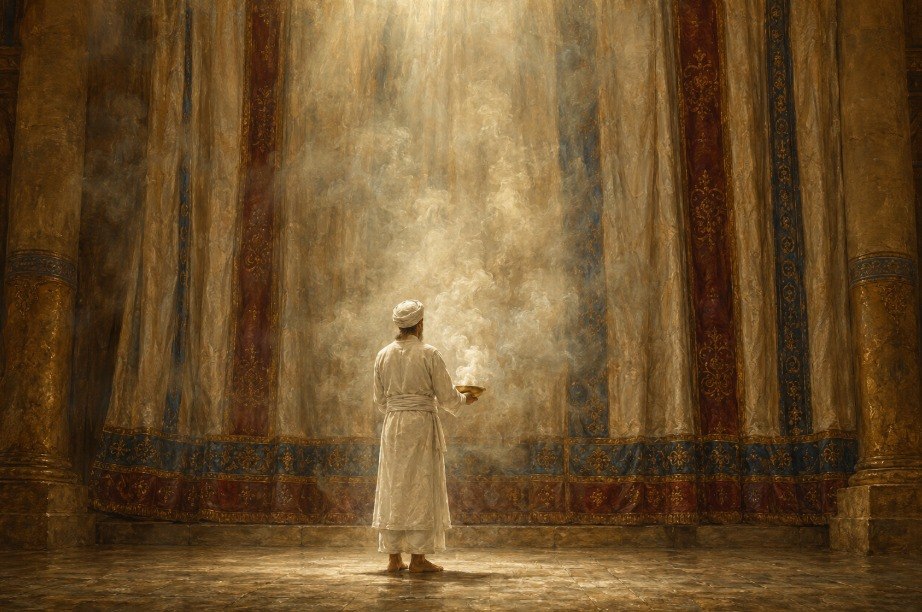 The High Priest's Yom Kippur service in the Holy Temple (illustration)
The Two Goats and the Scapegoat (Azazel)
The Torah commands that two identical he-goats be brought before the High Priest, who drew lots over them: one lot "for God," and one "for Azazel" (Leviticus 16:7–10). The first was offered in the Temple; the second — the se'ir la'Azazel, the origin of the English word "scapegoat" — symbolically carried the sins of Israel, confessed over it by the High Priest, and was led into the wilderness to a rocky cliff. The Talmud relates that a scarlet thread would turn white when Israel's sins were forgiven (Yoma 39a), in the spirit of Isaiah's promise: "If your sins are like scarlet, they will become white as snow" (Isaiah 1:18). Since the Temple's destruction, prayer, repentance, and the day itself stand in place of the offerings — and we await the restoration of the service, as we pray in every Musaf of Yom Kippur.
The Spiritual Meaning of Yom Kippur
Teshuvah — Return and Repentance
The Hebrew word teshuvah is usually translated "repentance," but it literally means "return" — a return to God, and to the pure self that sin conceals. The Rambam defines its essential elements: abandoning the sin, regretting the past, verbal confession before God, and a sincere resolution never to repeat it (Hilchot Teshuvah 2:2). Yom Kippur is the day given to the Jewish people for exactly this. In the language of the Rambam, "the essence of Yom Kippur atones for those who repent" (Hilchot Teshuvah 1:3) — the day has intrinsic power, but it asks for the partnership of the human heart.
Tefillah, Teshuvah, Tzedakah
The Unetaneh Tokef prayer distills the message of the Days of Awe into a single line: "Repentance, prayer, and charity remove the evil of the decree." Judgment is real, but it is never a closed door. These three responses correspond to the three dimensions of a person's life: teshuvah repairs the self, tefillah (prayer) repairs one's bond with God, and tzedakah (charity) repairs one's bond with other people. A Jew leaves Yom Kippur having worked on all three.
The Sealing of the Book of Life
Yom Kippur ends with chatimah — sealing. What was written on Rosh Hashanah is sealed as the gates close at Ne'ilah. Yet the Sages saw in this not dread but tenderness: God Himself, in His love, fixed a day of pardon for His people, and the day closes not with a wail but with the triumphant cry "The Lord, He is God!" and a shofar blast of confidence. The tradition is to go straight from Yom Kippur into the joy of building the sukkah — from awe to celebration — trusting that the sealing was for good. Hence the greeting that carries through to the end: Gmar Chatimah Tovah.
Yom Kippur vs. Tisha B'Av — Key Differences
Yom Kippur and Tisha B'Av are the only two fasts of the Jewish year that last a full 25 hours — from sunset to nightfall — and both share the five prohibitions. But their characters could not be more different. Tisha B'Av mourns the destruction of the two Holy Temples and the tragedies of Jewish history; it is a day of grief, when Jews sit on the floor reading the Book of Lamentations, and its restrictions express mourning. Yom Kippur's affliction, by contrast, expresses elevation — rising above the body to stand like angels before God. One looks back at what was lost; the other looks forward, to forgiveness and a new year.
Yom Kippur | Tisha B'Av | |
|---|---|---|
Source | Torah (Leviticus 16; 23) | Instituted by the Prophets/Sages |
Theme | Atonement, forgiveness, | Mourning the destruction of the Temples |
Length | ~25 hours | ~25 hours |
Five | Yes | Yes |
Labor | Forbidden, as on Shabbat | Permitted (work is |
Atmosphere | Awe and joy — "no days as | Grief — Lamentations, |
Tallit | Worn even at night | Donned only in |
| Central texts | Vidui, Unetaneh Tokef, | Eichah (Lamentations), |
How Yom Kippur Differs from Rosh Hashanah
Rosh Hashanah and Yom Kippur are twin peaks of the Days of Awe, but they play different roles: Rosh Hashanah is the Day of Judgment, Yom Kippur the Day of Atonement.
Rosh Hashanah | Yom Kippur | |
|---|---|---|
Date | 1–2 Tishrei | 10 Tishrei |
Role | Judgment is written | Judgment is sealed |
Shofar | Sounded throughout the day | One blast, at the very |
Meals | Festive meals, simanim | Complete 25-hour fast |
Prayer services | Regular festival | Five services, |
Greeting | "L'Shanah Tovah Tikatevu" | "Gmar Chatimah Tovah" |
Yom Kippur in American Jewish Communities
Yom Kippur draws more American Jews to synagogue than any other occasion of the year. Even Jews with little connection to observance the rest of the year commonly fast, attend Kol Nidre and Yizkor, and take the day off from work and school — many public school districts with large Jewish populations close for the day, and New York City suspends alternate-side parking. The day has also produced iconic moments of Jewish pride in America: in 1965, Hall of Fame pitcher Sandy Koufax famously declined to pitch Game 1 of the World Series because it fell on Yom Kippur — a decision still cited as a defining statement of Jewish identity in America. The day carries historical weight as well: on Yom Kippur of 1973 (October 6), Egypt and Syria launched the surprise attack that began the Yom Kippur War, and communities worldwide continue to remember Israel's fallen in that war on this day. After the fast, American communities gather for the beloved "break-fast" — traditionally a light dairy meal shared with family and friends — before turning, five days later, to Sukkot.
Watch: Yom Kippur Video Library
Deepen your preparation for the Day of Atonement with Hidabroot's video classes:
Sources
Torah (Chumash)
- Leviticus 16 — the Yom Kippur service in the Sanctuary: the High Priest's entry into the Holy of Holies, the two goats and the lot for Azazel, and the eternal command of the day (vv. 29–34).
- Leviticus 23:26–32 — the commandment to afflict the soul, the prohibition of labor, the penalty of kareit, and the designation "Shabbat Shabbaton."
- Leviticus 25:9 — the shofar of the Jubilee year sounded on Yom Kippur.
- Numbers 29:7–11 — the Musaf offerings of Yom Kippur.
Prophets (Nevi'im)
- Isaiah 1:18 — "If your sins are like scarlet, they will become white as snow."
- Isaiah 55:6 — "Seek God when He may be found" (applied by the Sages to the Ten Days of Repentance).
- Hosea 14:2 — "Return, O Israel" (haftarah of Shabbat Shuvah).
- Book of Jonah — read as the haftarah of Minchah on Yom Kippur.
Mishnah and Talmud
- Mishnah Yoma, chapters 1–8 — the Temple service of Yom Kippur; Yoma 8:1 (the five afflictions); Yoma 8:9 (Yom Kippur does not atone for offenses against one's fellow until he appeases him).
- Babylonian Talmud, Yoma 81b — the mitzvah of eating on the eve of Yom Kippur.
- Babylonian Talmud, Yoma 85b — saving a life overrides the Torah's laws ("you shall live by them"); the day's atonement.
- Babylonian Talmud, Yoma 39a — the scarlet thread that turned white.
- Babylonian Talmud, Rosh Hashanah 16b — the three books opened on Rosh Hashanah; judgment sealed on Yom Kippur.
- Mishnah Ta'anit 4:8 — "There were no days as festive for Israel as the fifteenth of Av and Yom Kippur."
- Babylonian Talmud, Ta'anit 25b — Rabbi Akiva and the origin of Avinu Malkeinu.
Halachic Codes (Poskim)
- Rambam (Maimonides), Mishneh Torah, Hilchot Teshuvah — 1:1–3 (confession and the atonement of the day); 2:2 (the elements of repentance); 2:6 (the Ten Days of Repentance); 3:4 (increasing charity between Rosh Hashanah and Yom Kippur).
- Rambam, Mishneh Torah, Hilchot Shevitat Asor — the laws of resting and affliction on the Tenth of Tishrei.
- Shulchan Aruch, Orach Chayim 604–624 — the complete laws of Yom Kippur, including: 605 (kapparot), 606 (appeasing one's fellow), 608 (the pre-fast meal and tosefet), 611 (the five afflictions), 613 (washing), 614 (anointing and shoes), 615 (marital relations), 616 (children), 617 (pregnant and nursing women), 618 (the ill), 624 (the close of Yom Kippur and Havdalah); with the glosses of the Rema.
- Rulings of Rabbi Ovadia Yosef zt"l, Chazon Ovadia — Yamim Noraim — contemporary Sephardic halachic rulings on the laws of the Days of Awe and Yom Kippur.
Liturgy
- Machzor for Yom Kippur (Ashkenaz and Sephard editions) — Kol Nidre, Vidui and Al Chet, Avinu Malkeinu, Unetaneh Tokef, the Avodah service, Yizkor, and Ne'ilah.
- Rashi on Deuteronomy 9:18; Midrash Tanchuma, Ki Tisa — Moses' descent with the second Tablets on the tenth of Tishrei.
Calendar Data
- Hebcal Jewish Calendar (hebcal.com) — verified Gregorian dates for Yom Kippur 2026–20
Questions & Answers
+What is Yom Kippur and why is it important?
+When is Yom Kippur 2026?
+How long is the Yom Kippur fast?
+What are the five prohibitions of Yom Kippur?
+What is Kol Nidre?
+Why do Jews wear white on Yom Kippur?
+What is the difference between Yom Kippur and Rosh Hashanah?
+What is the difference between Yom Kippur and Tisha B'Av?
+Who is exempt from fasting on Yom Kippur?
+Can I work on Yom Kippur?
+What does "Gmar Chatimah Tovah" mean?
+How do you break the Yom Kippur fast?
+What is Ne'ilah?
+What is Yizkor?

