

Magazine
The Child Who Belonged to All of Us
Why a missing child can make an entire country feel, for a moment, like one family
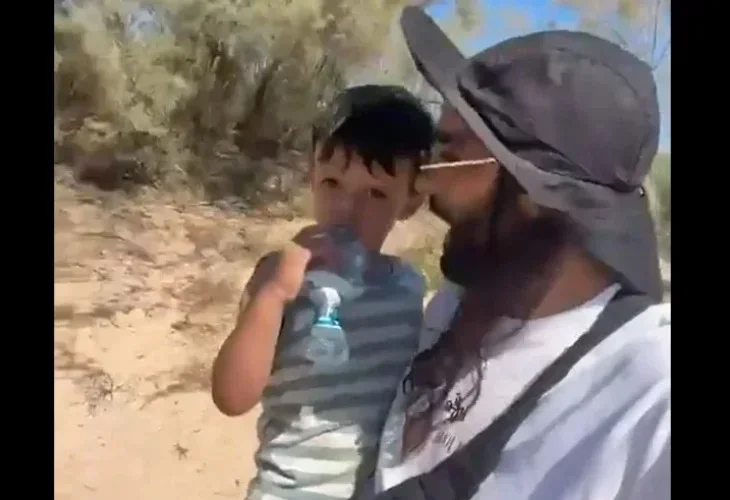
Last Friday, a friend wrote to me about a particularly awful day she'd had. While I was typing out a few words of encouragement, another message from her popped up on the screen. "At least they found Yuval Kogan, thank God," she wrote. And I, who hadn't checked the news in an hour, let out a breath of relief and rushed to check the news sites to make sure that he was safe and sound. My reaction, I quickly realized, was more or less the same as that of every Israeli who heard "the child's been found!"
By any objective measure, this was a story about a stranger. I had never met the Kogan family, never set foot on the stretch of Ashkelon coastline where four-year-old Yuval wandered off during a family outing the previous Thursday. And yet for about 30 hours, a nation that did not know Yuval held its breath, praying for him to be found.
The facts of the case, once they emerged, were almost unbearably human in their simplicity. Yuval had fallen a few steps behind his father during a beach outing with his sisters, believed he knew the way back, and started walking on his own. By the time the alarm went out, he had covered several kilometers along the coast. What followed was not a routine missing-persons search. Police, volunteers, and eventually the Shin Bet joined the effort, combing the dunes through the night and resuming at first light. And then, Friday afternoon, a ZAKA volunteer searching on horseback near Nitzanim Beach spotted a small figure standing beneath a tree. Yuval had slept there through the night, in the shade, and gone toward the sound of approaching horses when he heard them. He was dehydrated, exhausted, and completely fine. On the beach where he'd disappeared, people broke into song.
What strikes me, looking back, is not just that this was a happy ending — though God knows we needed one — but how uniform the emotional experience was across a country that agrees on almost nothing else. Religious and secular, left and right, people who had never heard the name Kogan before Thursday: all of them, it seemed, were checking their phones with the same knot in the stomach, and all of them exhaled at the same moment on Friday afternoon. That kind of synchronized feeling isn't really explicable by empathy alone. Strangers don't ordinarily grieve or rejoice together this completely. Something else is operating here, and Jewish tradition has a name for it.
The Talmud states plainly that all of Israel are guarantors for one another — arevim zeh ba-zeh. This isn't sentiment; it's framed as a legal and spiritual fact, derived from the moment the nation stood together to enter its covenant. Because we are bound to each other by that covenant, the tradition holds, what happens to one Jew is never purely private. The Midrash makes the same point through a parable: people share a single boat, and one of them begins drilling a hole beneath his own seat. When his neighbors object, he protests that he's only drilling under his own place. They answer him: the water will drown all of you together. A missing child on a beach in Ashkelon is, in this reading, a hole drilled in the boat we all share.
The kabbalistic and Chassidic tradition pushes this further, from metaphor into metaphysics. The Tanya argues that Jewish souls are not simply similar or sympathetic to one another — they are, at their root, a single unified soul that only appears fragmented in this world. Loving another Jew, in this framework, is not an act of generosity toward a separate being; it's closer to self-recognition.
None of this is abstract theology when you're refreshing a news site at midnight over a boy you've never met. It's the plainest possible explanation for why a nation held its breath for Yuval, and why, when he was found standing quietly under a tree, so many of us felt — for one Friday afternoon — like we'd gotten someone back.

