

Parashat Re'eh
Always at the Summit: The Unique Destiny of the Jewish People
The covenant at Mount Gerizim and Mount Ebal contains a profound message about the Jewish people. Discover what Parashat Re'eh and Isaiah reveal about Israel’s unique destiny.
- Rabbi Moshe Sheinfeld
- | Updated
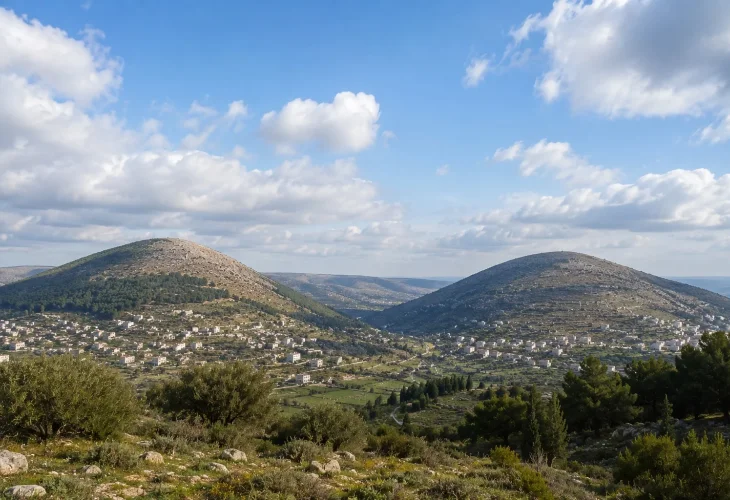
In this week’s Torah portion, Parashat Re'eh, Hashem commands the Children of Israel to hold a covenant ceremony at Mount Gerizim and Mount Ebal after entering the Land of Israel.
Mount Gerizim and Mount Ebal are two mountains in Samaria where the Children of Israel entered into a covenant with their Creator. The ceremony included offering sacrifices, writing the Torah, or parts of it according to several opinions, on stones, and proclaiming blessings and curses before the nation.
The commandment to hold this covenant appears in Parashat Re'eh and again in Parashat Ki Tavo. The ceremony itself took place after the Children of Israel entered the Land of Israel, as described in the Book of Joshua.
Six tribes ascended Mount Gerizim and six tribes ascended Mount Ebal, while the priests, Levites, and Ark of the Covenant stood below, between the two mountains. The Levites turned toward Mount Gerizim and proclaimed a blessing, to which both groups answered Amen. They then turned toward Mount Ebal and proclaimed a curse, and once again, both groups answered Amen (Talmud, Sotah 32a, cited by Rashi on Deuteronomy 27:12; there are additional opinions).
But there is something unusual about the arrangement of this ceremony.
Why Were the Levites Standing Below?
Usually, when someone addresses a large crowd, the speaker stands on an elevated platform while the audience gathers below. This allows the speaker’s voice to carry and ensures that everyone can hear.
At Mount Gerizim and Mount Ebal, however, the arrangement was reversed. The Levites needed to proclaim the blessings and curses before the entire Jewish people, yet they stood below while the Children of Israel stood above them on the mountains.
Why?
Rabbi Yosef Tzvi Salant, in Be’er Yosef on Parashat Re'eh, offers a beautiful explanation.
The fact that the Jewish people stood on the mountains during the covenant ceremony teaches us something profound about their status in the eyes of Hashem.
At all times and under every circumstance, Hashem sees the Jewish people at their highest level, as though they are always "at the top of the mountain." They remain elevated above the nations and constantly under Hashem’s watchful care.
Even in times of curse and condemnation, they remain elevated in Hashem’s hands. Whether the Jewish people find themselves in a state of blessing or a state of curse, their unique status remains visible to all.
Rabbi Salant develops this idea through the Haftarah read with this portion, the third of the seven Haftarot of consolation:
"O afflicted, storm tossed, unconsoled one, behold, I will set your stones in antimony and lay your foundations with sapphires. I will make your windows of rubies, your gates of sparkling stones, and all your borders of precious stones. And all your children shall be taught by Hashem, and great shall be the peace of your children" (Isaiah 54:11–13).
What is the deeper meaning of these words?
The Advantages and Dangers of Wealth
There are two basic economic conditions in the world: poverty and wealth. Each has its disadvantages, but each can also carry a certain advantage.
A poor person may lack basic necessities and struggle with food, clothing, housing, and other needs. Yet generally, such a person does not have to worry about protecting great possessions. Thieves do not usually covet what someone does not have. A poor person does not need to install elaborate security systems or spend every day worrying about protecting valuable assets.
A wealthy person, by contrast, can enjoy comfort, abundance, and the pleasures that wealth provides. But that wealth may also bring constant concern about protecting what has been accumulated from thieves and others who might seek to take it.
The same principle can apply to countries.
One country may possess poor, barren land with few minerals or natural resources. It must import what it needs from other countries, causing its wealth to flow outward. Its citizens may experience poverty and deprivation, but generally, neighboring countries have little reason to wage war simply to conquer its barren territory.
Another country may possess rich and fertile land overflowing with natural resources. Its citizens prosper through trade and enjoy tremendous abundance. Yet those very advantages can make the country a target for neighboring nations that desire its land and resources. Such a country must remain constantly vigilant, maintain a powerful military, and develop strong defense systems to deter its enemies.
Poverty is certainly not desirable, but it can bring a certain kind of peace. Wealth is desirable, but it can bring worries of its own.
This may be true among the nations of the world.
But when it comes to the Jewish people, the pattern seems to break down completely.
"Afflicted, Storm Tossed, Unconsoled"
When the Jewish people were scattered in exile among the nations, they were often poor and vulnerable. They had no sovereign territory of their own and seemingly possessed nothing that other nations needed to envy.
Under ordinary circumstances, one might expect such a people to be left alone.
There should have been little reason for governments and nations to concern themselves with Jews living peacefully within their borders. A Jewish community here and another there posed no military threat. Logically, Jews should have been able to live quietly alongside their neighbors without attracting the attention of rulers and governments.
Yet Jewish history tells a very different story.
Throughout the long years of exile and dispersion, hostile eyes were repeatedly turned toward the Jewish people for countless strange and irrational reasons. The so called "Jewish question" echoed throughout the world, from small kingdoms to powerful empires.
Again and again, the existence of the Jewish people became a matter of national and political "concern." Jewish history contains far too many pogroms, expulsions, persecutions, and wars to list.
This, Rabbi Salant explains, is the meaning of the prophet’s words: "Afflicted, storm tossed."
The prophet turns to the Jewish people and says: In exile, you are "afflicted." You possess the disadvantages of poverty. Logically, the nations should therefore turn their attention elsewhere.
But instead, you are also "storm tossed."
Despite your poverty and vulnerability, you are surrounded by turmoil. Nations and governments focus their attention on you as though you possessed a vast, fertile, flourishing kingdom that everyone desired to conquer.
You have the poverty, but not the peace that should accompany it.
You are "afflicted, storm tossed, unconsoled."
Yet the prophet does not end there.
Hashem promises that the Jewish people will ultimately be comforted:
"Behold, I will set your stones in antimony and lay your foundations with sapphires. I will make your windows of rubies, your gates of sparkling stones, and all your borders of precious stones."
A time will come when the Jewish people will possess abundance, represented by precious stones and jewels.
Ordinarily, such wealth would bring another problem: fear. A wealthy nation must build armies, strengthen its defenses, and constantly worry about protecting what it possesses.
But Hashem promises that the future of the Jewish people will be different.
"And all your children shall be taught by Hashem, and great shall be the peace of your children."
The children of Israel will not need to devote themselves to war. Instead, they will be taught by Hashem. They will study Torah and wisdom in synagogues and study halls, and at the same time, "great shall be the peace of your children."
They will have the blessing of abundance without the fear that usually accompanies it.
The Jewish people are always at the summit. Even during periods of exile, suffering, and vulnerability, their unique place in Hashem’s plan remains unchanged.
And with Hashem’s help, may we merit to see the words later in the Haftarah fulfilled:
"No weapon formed against you shall prosper, and every tongue that rises against you in judgment you shall condemn. This is the heritage of the servants of Hashem, and their righteousness is from Me, says Hashem."

