

World News
US Operates Secret Shipping Route in Strait of Hormuz Amid Iranian Missile Threats
US escorts oil tankers through a secret southern route in Hormuz, intercepting Iranian drones and cruise missiles to ensure safe passage.
- Hidabroot
- | Updated
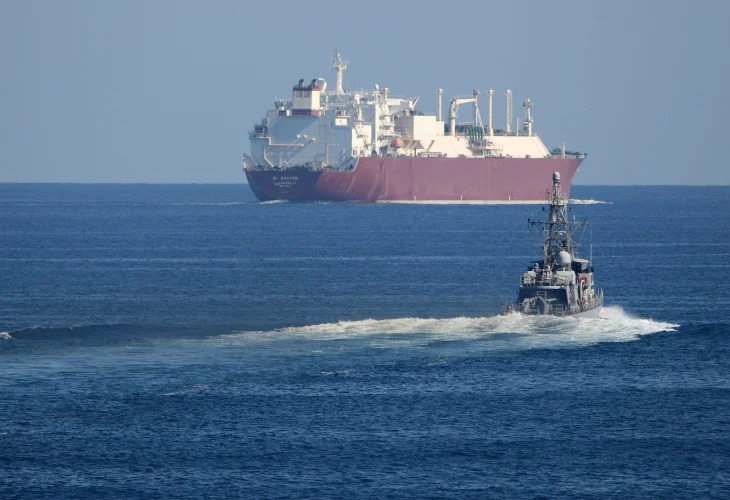 Indra Beaufort/U.S. Navy
The U.S. military has quietly established a protected shipping corridor through the Strait of Hormuz, allowing 15 to 20 oil tankers to cross the vital waterway each day despite continuing Iranian attacks. The operation is moving roughly 10 million barrels of oil out of the Persian Gulf daily, according to U.S. officials familiar with the effort, about half the volume that passed through the strait before the war.
The tankers use a southern route close to the coast of Oman. Each night, a large convoy exits the strait during a fixed window, while a separate convoy enters the Gulf at another time. The schedule minimizes the vessels’ exposure to Iranian attack.
U.S. Air Force fighter jets protect the convoys from Iranian cruise missiles and drones, which have repeatedly targeted areas where the vessels are believed to be sailing. The aerial escort has become a central part of the operation as Iran continues its attempts to disrupt traffic through the strait.
The corridor became possible after U.S. strikes severely damaged Iran’s radar and maritime surveillance network in recent weeks, sharply reducing Tehran’s ability to track vessels along the southern route. Iran now relies largely on a small number of restored radar systems and Revolutionary Guard fast boats gathering intelligence at sea.
With limited visibility, Iranian forces have often launched drones and cruise missiles toward areas where they believe the tankers are sailing rather than at confirmed targets. Several vessels have been hit, but U.S. forces have intercepted most of the attacks. On one night last week alone, American forces shot down eight Iranian drones and two cruise missiles.
President Donald Trump pointed to the operation as evidence that shipping through Hormuz was recovering, telling reporters that “the strait is open” and that “a lot of boats are going through.” He said oil prices had fallen sharply, contrasting the current price of roughly $84 to $85 a barrel with earlier predictions that prices could reach $350.
Trump also argued that Hormuz would become less critical as alternative routes and pipelines are developed. Asked about diplomacy with Tehran, he said the United States was not currently negotiating with Iran, calling such talks “a waste of time” and describing the country as “a shadow of what it was.”
Shipping data shows that conditions in the strait remain volatile. The number of crossings increased slightly over the weekend but remained in the single digits before slowing again amid concerns that vessels could be attacked. On one recent day, only six cargo ships crossed the strait, down from nine the previous day and below the 10-day average of 11.
Analysts note that some vessels may be crossing with their transponders switched off, meaning the actual number of crossings could be higher than reported.
A senior U.S. official familiar with the details said Iran’s Islamic Revolutionary Guard Corps could still cause problems in the area but did not control the strait.
“They can be a nuisance, but they don’t control the strait. We control it,” the official said.
The Strait of Hormuz connects the Persian Gulf with the Gulf of Oman and the Indian Ocean and is one of the world’s most important shipping routes for oil and gas exports from Gulf states to global markets. A major disruption to traffic through the strait could affect regional stability and global energy prices.

