

World News
U.S. Intel: Iran's Military Is More Intact Than the White House Lets On
A CBS report says that by the start of the cease-fire, roughly half of Iran's ballistic missiles and launchers were still intact—and about 60% of the IRGC's naval arm remained operational.
- Shlomi Diaz
- | Updated
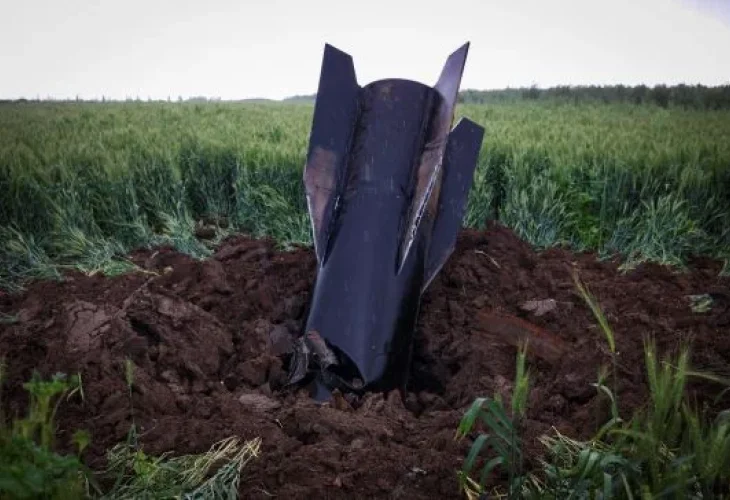 Remains of an Iranian missile in the Golan Heights (Photo: Maor Kinsbursky, Flash90)
CBS reported this evening (Wednesday) that Iran retains more military capabilities than the White House or the Pentagon publicly acknowledge. According to the report, as of the start of the cease-fire, roughly half of Iran's stockpile of ballistic missiles and launch systems remained intact.
Also, about 60% of the Islamic Revolutionary Guard Corps (IRGC) naval arm remains fit and operational, including fast-attack boats. As a reminder, earlier today the Iranian Revolutionary Guard confirmed it had attacked three ships in the Strait of Hormuz.
The CBS report notes that Iran's air power was significantly degraded but not erased. About two-thirds of Iran's air force is still considered active, despite U.S. and Israeli strikes that hit thousands of targets, including storage and production facilities.
It should be noted that more than once in recent weeks, U.S. War Secretary Pete Hegseth, as well as President Donald Trump, have emphasized that Operation \"Epic Wrath\" led to the destruction of Iran's military capability. \"We eliminated their navy, we eliminated their air force, we eliminated their leaders,\" Trump said yesterday.
The War Secretary said in a media interview on April 8 that \"Operation 'Epic Wrath' was a historic and decisive battlefield victory, a major military win. The U.S. military destroyed Iran's army and rendered its fighting ineffective for years to come.\"
Battle damage assessments, according to a source who spoke with CBS, \"show that the joint operation destroyed a substantial portion of Iran's conventional navy, but the IRGC naval arm, built for asymmetric warfare and equipped with many small vessels, remained partially intact, and that navy is what is disrupting the movement of oil shipments in the Strait of Hormuz.\"
The report mentioned that the head of the Defense Intelligence Agency in the U.S. submitted a written statement ahead of a House Armed Services Committee hearing, stating that Iran can still inflict damage.
\"Iran retains thousands of missiles and one-way attack unmanned aircraft that can threaten U.S. forces and partner forces across the region, despite the decline in its capabilities due to both attrition and expenditure,\" wrote General James Adams.
Pentagon spokesman Sean Parnell was asked to comment on the story and said that \"the war was a success, with more than 13,000 Iranian targets hit. In less than 40 days, the U.S. military delivered a crippling series of blows to the Iranian regime. Ninety-two percent of the Iranian navy's largest vessels were destroyed, and about 44 minelayers were destroyed. This was the largest elimination of a navy over a three-week period since World War II.\"

