

Wonders of Creation
110 Quadrillion Kilometers of Fungi: The Hidden World Beneath Our Feet
We see mushrooms above ground, but most of the fungal world remains hidden. New research reveals just how enormous these underground networks really are.
- Yehosef Yaavetz
- | Updated
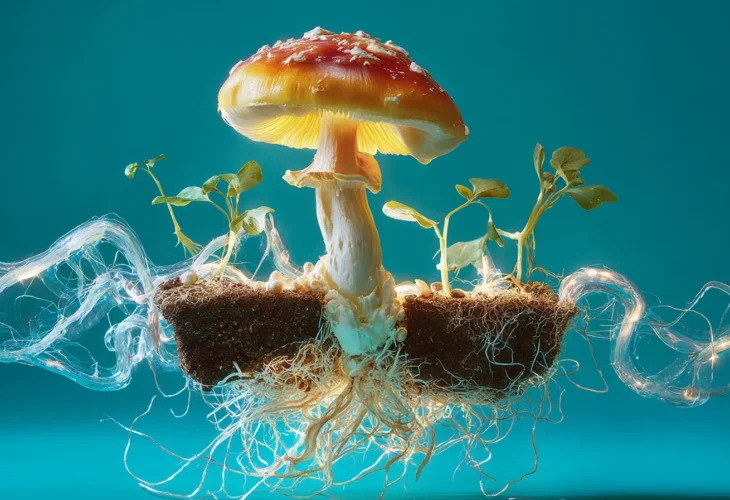
Most of a fungus is hidden from view. When you walk through a field after rain and spot a mushroom emerging from the ground, you are seeing only a small part of the organism beneath your feet.
Much of a fungus may exist underground, inside a tree, or within plant tissue as a network of microscopic threads called hyphae. Millions of these tiny threads branch, connect, and penetrate spaces that even the finest plant roots cannot reach. And the fungal world is far larger than the species familiar to us: researchers estimate that Earth may be home to roughly 2.2 to 3.8 million fungal species, only a fraction of which have been scientifically described.
In June 2026, scientists revealed just how enormous one part of this hidden world may be. An international team of 24 researchers, led by ecologist Justin Stewart and including Prof. Toby Kiers of Vrije Universiteit Amsterdam, published a study in Science that attempted, for the first time, to calculate and map the global density of arbuscular mycorrhizal fungi, known as AMF.
Their estimate is staggering.
The upper 15 centimeters of the world’s soils alone may contain approximately 1.10 × 10¹⁷ kilometers of living AM fungal hyphae. That is around 110 quadrillion kilometers of microscopic fungal threads.
An Underground Network of Almost Unimaginable Size
Importantly, this is not an estimate of the total length of all fungi on Earth. It does not include many other types of fungi, the full extent of networks deeper underground, or visible fungal fruiting bodies such as mushrooms. It refers to just one group of root-associated fungi and only to the upper layer of soil.
Even with those limitations, the scale is difficult to comprehend. If all those hyphae could somehow be removed from the soil, connected end to end, and stretched through space, they would extend roughly three-quarters of a billion times the distance between Earth and the sun.
The researchers also estimated that these hyphae contain approximately 300 million metric tons of carbon, several times the estimated carbon mass of the entire human population.
But the extraordinary scale of these networks is only part of the story. Their relationship with plants reveals an intricate partnership taking place beneath our feet.
In 1885, German botanist Albert Bernhard Frank described tree roots surrounded by fungal tissue. He coined the term “mycorrhiza,” derived from the Greek words for fungus and root, and proposed an idea that was highly unusual at the time: The fungus was not necessarily a parasite stealing nutrients from the tree. It could be a partner.
That same year, Nature reported on the discovery. Frank proposed that fungi helped transfer nutrients from the soil to trees, while the trees provided the fungi with nourishment in return. The idea initially faced resistance, but over the following decades, scientific evidence accumulated supporting the fundamental concept.
Today, we know that this partnership can be remarkably close. Arbuscular mycorrhizal fungi generally depend on host plants to complete their life cycles. Plants, meanwhile, use photosynthesis to capture carbon dioxide from the atmosphere and produce carbon compounds.
From these different abilities emerges a biological exchange.
The plant transfers some of the carbon compounds produced through photosynthesis to the fungus. In return, the fungus extends a branching network of hyphae outward from the roots and into the surrounding soil.
Because fungal hyphae are much thinner than even the finest roots, they can travel between soil particles and enter tiny pores, dramatically expanding the area from which nutrients can be accessed.
Inside the plant’s root cells, the fungus forms intricate branching structures called arbuscules, which resemble miniature trees. Across their large surface area, much of the exchange takes place: nutrients including phosphorus and nitrogen move toward the plant, while carbon compounds move toward the fungus.
Arbuscular mycorrhizal fungi form partnerships with the majority of plant species, moving enormous quantities of material through these underground networks. From the plant’s perspective, the fungus effectively acts as a microscopic extension of its root system. Instead of the root itself having to reach every location containing scarce nutrients, fungal hyphae can explore the surrounding soil on its behalf.
These relationships can improve nutrient uptake and may also influence plants’ ability to cope with challenges such as drought and disease.
How Do You Measure a Network Hidden Underground?
Calculating the length of fungal hyphae was only part of the challenge facing Stewart and his colleagues. Length alone cannot reveal how much fungal material is present, because two hyphae of equal length but different thicknesses do not have the same volume or mass.
To address this, researchers used a robotic imaging system developed at the AMOLF institute in Amsterdam. Colonies of several fungal species were grown under controlled conditions and repeatedly photographed. More than 300,000 measurements of hyphal diameter helped researchers estimate the volume of the networks and, from there, their mass and carbon content.
The resulting estimate was approximately 300 ± 60 million metric tons of carbon contained in AM fungal networks in the upper layer of the world’s soils.
The model also revealed something surprising about where these networks are most concentrated.
The highest predicted densities of arbuscular mycorrhizal fungi were found in grasslands, including mountain meadows and flooded grasslands. In mountain grasslands, predicted hyphal density was about 39 percent higher than in humid broadleaf tropical forests.
In other words, what lies underground can present almost the opposite picture from what our eyes see above it.
A forest impresses us with enormous trunks, branches, and leaves. A grassland may look comparatively low and simple. Yet beneath the grass can lie vast quantities of roots and microscopic fungal networks.
These fungi do more than collect minerals. Carbon also moves through the partnership. Plants capture carbon dioxide from the atmosphere through photosynthesis. Some of that carbon becomes leaves, trunks, or roots, while another portion is transferred to the fungi associated with the plant.
Fungal hyphae therefore represent an important pathway through which carbon captured from the atmosphere by plants enters underground ecosystems.
What Happens When We Plow the Soil?
This newly quantified underground network also raises important questions about one of humanity’s oldest agricultural practices: plowing.
When the researchers compared measurements from agricultural soils with those from uncultivated soils, they found that hyphal density was, on average, approximately 47.3 percent lower in cultivated areas.
Repeated disturbance of the soil can break fungal networks and make it more difficult for extensive hyphal systems to remain intact.
This is one reason researchers are increasingly interested in agricultural practices that reduce soil disturbance, including methods that plant crops without repeatedly turning over the entire soil surface.
What could that ultimately mean for crops such as wheat, for soil health, or even for the food produced from them? There is still much to learn.
What scientists are beginning to uncover, thread by microscopic thread, is an extraordinary world beneath our feet: vast living networks connecting plants and soil, transporting nutrients and carbon, and carrying out processes that remained almost completely invisible to us for generations.
The mushroom we see above the ground is only the beginning.

