

Raising Children
When Your Child Has Cancer: One Family’s Journey of Faith and Hope
After their four-year-old daughter was diagnosed with leukemia, one family faced fear, grueling treatments, and uncertainty. Their story reveals how faith, community, and compassion gave them strength to endure and ultimately inspired them to return to the oncology ward to help other families.
- Michal Arieli
- | Updated
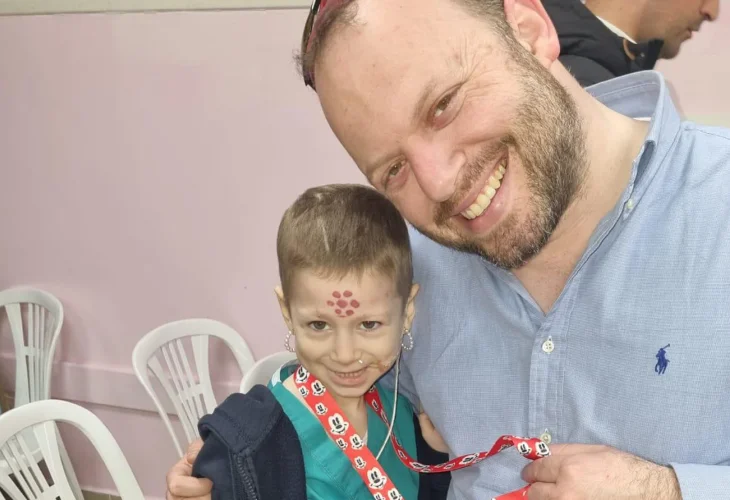 Ayala with her father, Shmaryahu Yeret
“Nothing prepares you for the moment when you are told that your daughter has cancer,” says Shmaryahu Yeret, recalling the days when his youngest daughter, Ayala, just four and a half years old, was diagnosed with leukemia.
“It was at the height of the COVID pandemic,” he recalls. “We arrived at Hadassah Hospital before there was even a clear diagnosis, and when we heard that it was leukemia, it came as a complete shock. We felt as though our entire world had collapsed.
“The first days were extremely difficult and overwhelming. I remember constantly standing near the entrance to the ward, and whenever someone passed by and asked whether I needed help, I would say no. It was as though we didn’t belong in that place at all. Only after two weeks did I begin to understand that there was no real way to get through this without accepting help. The challenge was simply too great to handle alone. It wasn’t that I needed help. I had no choice but to accept it.”
How did the people around you respond to what your family was going through?
“The truth is that at first, we experienced a kind of unspoken social isolation,” he says. “People didn’t know how to deal with us. We would see neighbors and friends notice us on the street and cross to the other side. After the first month, when everyone was still interested and asking what we needed, the phone simply stopped ringing. Everyone disappeared, and you were left alone on the front lines. It was extremely difficult and isolating.”
Shmaryahu says that during those days, it helped enormously to speak with parents whose children had already been through the same journey and were either nearing the end of treatment or had completed it.
“They were the only ones who could truly understand us,” he explains.
“One person who helped us tremendously was Chaim Erenthal, founder of Zichron Menachem, who lost his son to cancer about 30 years ago and subsequently established the organization. He invited us to sit down with him, and for three hours he explained the entire process to us. He had an enormous amount of knowledge and was incredibly reassuring. I have to say that I walked out of that conversation a completely different person. I was calmer, and I knew that, with God’s help, we would get through what lay ahead without being consumed by fear.
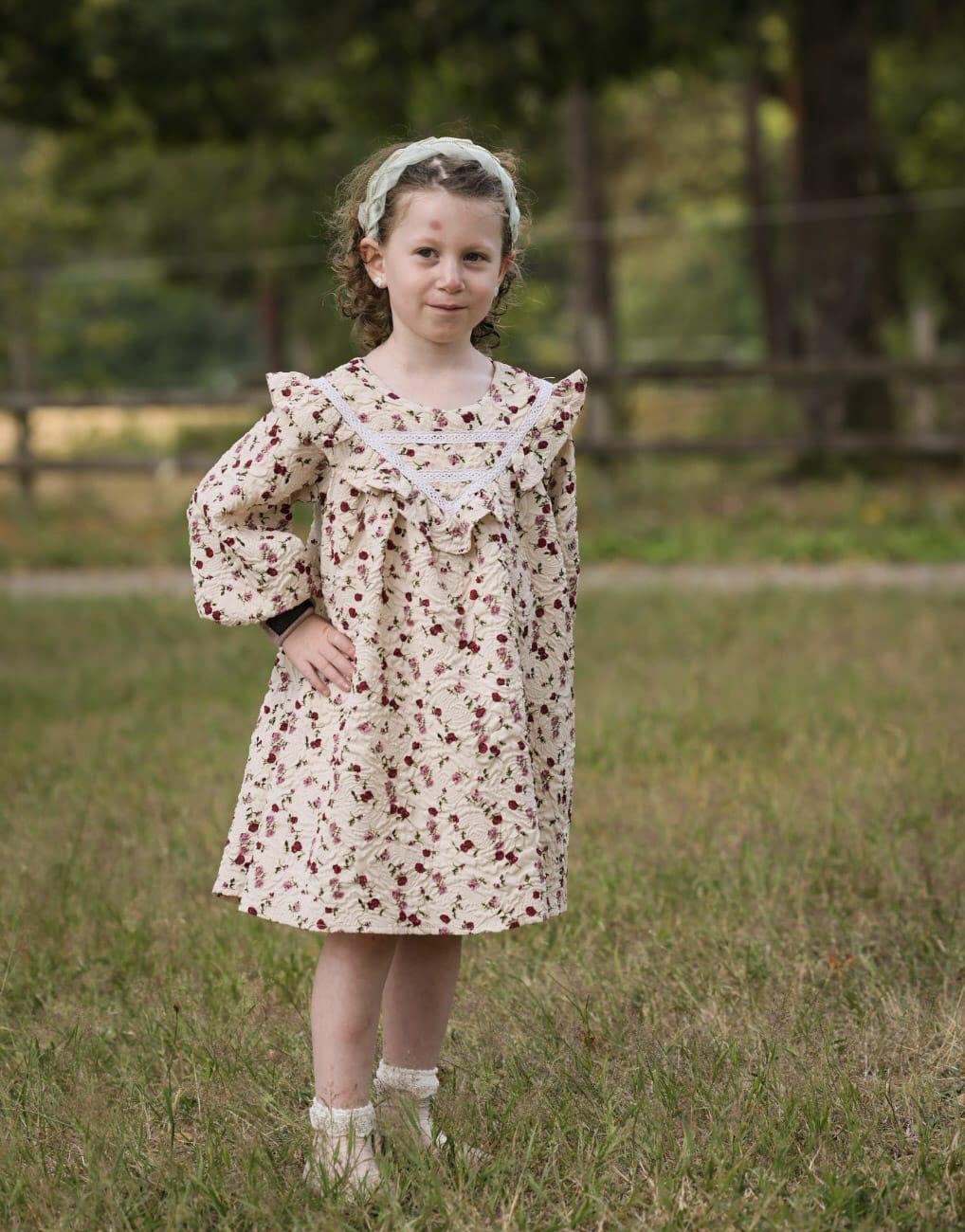 Ayala in camp during recovery
“What I didn’t know at the time was that just when Ayala became ill, Erenthal’s married son had also been diagnosed with cancer. Chaim had been forced to postpone many meetings, yet he still made it a priority to sit with me.”
As parents of three daughters, Ayala and her two older sisters, as well as a baby born in the midst of their battle with the disease, Shmaryahu and his wife, Chavi, understood that the challenge affected every member of the family.
“From the very beginning, we told Ayala and her sisters the truth,” he says. “We explained it on a level they could understand: inside our blood vessels there are ‘good soldiers’ and ‘bad soldiers.’ In Ayala’s body, the bad soldiers had managed to overpower the good ones, so we had to destroy them.
“After consulting with professionals, we explained that cancer is an illness like other illnesses, except that the treatment takes longer and has more side effects, including hospitalizations. The hardest thing, of course, was the hair loss. We explained everything gradually. We preferred to give them all the information, even when it was difficult, because we wanted our daughters to hear it from us rather than from friends or other people who did not have the sensitivity and guidance that we had received.
“The amazing thing is that today, when Ayala is asked whether she remembers the period when she was sick, she says that what she remembers most are the treats and the good things. Her sisters, who were older, also remember the fears. It was natural for them to be afraid, and that was part of the challenge our entire family faced.”
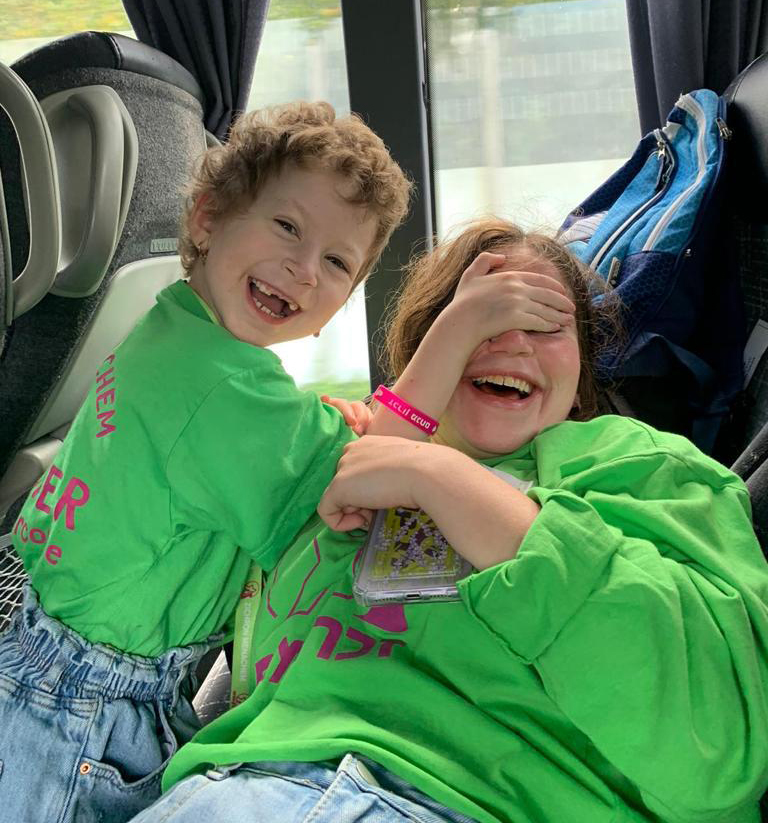 In camp outside Israel
Fighting for Her Life
Shmaryahu points out that the entire ordeal unfolded at the height of the COVID pandemic, when the virus posed a particular danger to people with weakened immune systems, including Ayala.
“We were so frightened that we barely left the house,” he recalls. “We didn’t dare send the girls anywhere.”
How do you survive a reality like that?
“I know it is difficult for people on the outside to understand, but in moments like those, you are simply fighting for your child’s life. And in a war, you do whatever it takes to survive. More than once, we truly felt the shadow of death approaching.
“One of our greatest blessings was the support groups for parents in situations like ours. There, in a protected environment, we weren’t afraid to put even our most difficult feelings on the table, and we received the strength to keep going.”
According to Shmaryahu, one of the most painful challenges for children in such situations is the complete loss of control over their own bodies.
“Imagine what it is like for a little girl when doctors and nurses are constantly doing things to her body. Someone comes in, examines her, gives her an injection, causes her pain, and she has no way to object. At one point, Ayala absolutely refused to be pricked with another needle. My heart broke, but there was no alternative.”
Another complicated struggle involved her medication.
“Try teaching a four-and-a-half-year-old to swallow ten pills every day when there is no liquid alternative. It was a daily battle. I would find myself sitting there crying with her, torn between knowing that this pill was keeping her alive and knowing that she could not understand why she had to suffer so much.
“And then there were the side effects. The medications caused terrible nausea. She vomited constantly and was too exhausted to stand on her feet. Watching your child become frustrated, crying that she just wants to eat normally and sleep peacefully, feeling as though her own body is betraying her, leaves you completely helpless.
“The hardest thing is wanting to promise her that everything will be all right when you know that nobody can truly make that promise, and that the next treatment may be even harder. I would find a dark corner of the ward and cry there alone, just so she wouldn’t see me falling apart.
“She would look at me with tears in her eyes and ask, ‘Daddy, why are they pricking me again? Why do they keep waking me up?’ Then came an entire month of exhausting high fevers. She went through an incredibly difficult ordeal.”
Did your faith sustain you during those moments?
“Faith didn’t just sustain us. It saved us,” Shmaryahu replies.
After spending so much time in the oncology ward, he says he observed a striking difference between families.
“We saw firsthand that people who have faith, and they do not necessarily have to be religious or outwardly observant, go through this grueling journey with far more optimism, resilience, and hope.
“The difference lies in the basic question of who you believe is ‘running’ the situation: you or God? Parents who feel that everything is in their own hands can experience tremendous devastation when their plans fall apart. They feel as though they have failed and struggle to find the strength to continue.
“Faith, by contrast, is an extraordinary tool. It allows you to place everything in God’s hands, to truly believe that things will be good, and to receive an inner strength that is impossible to describe in words.”
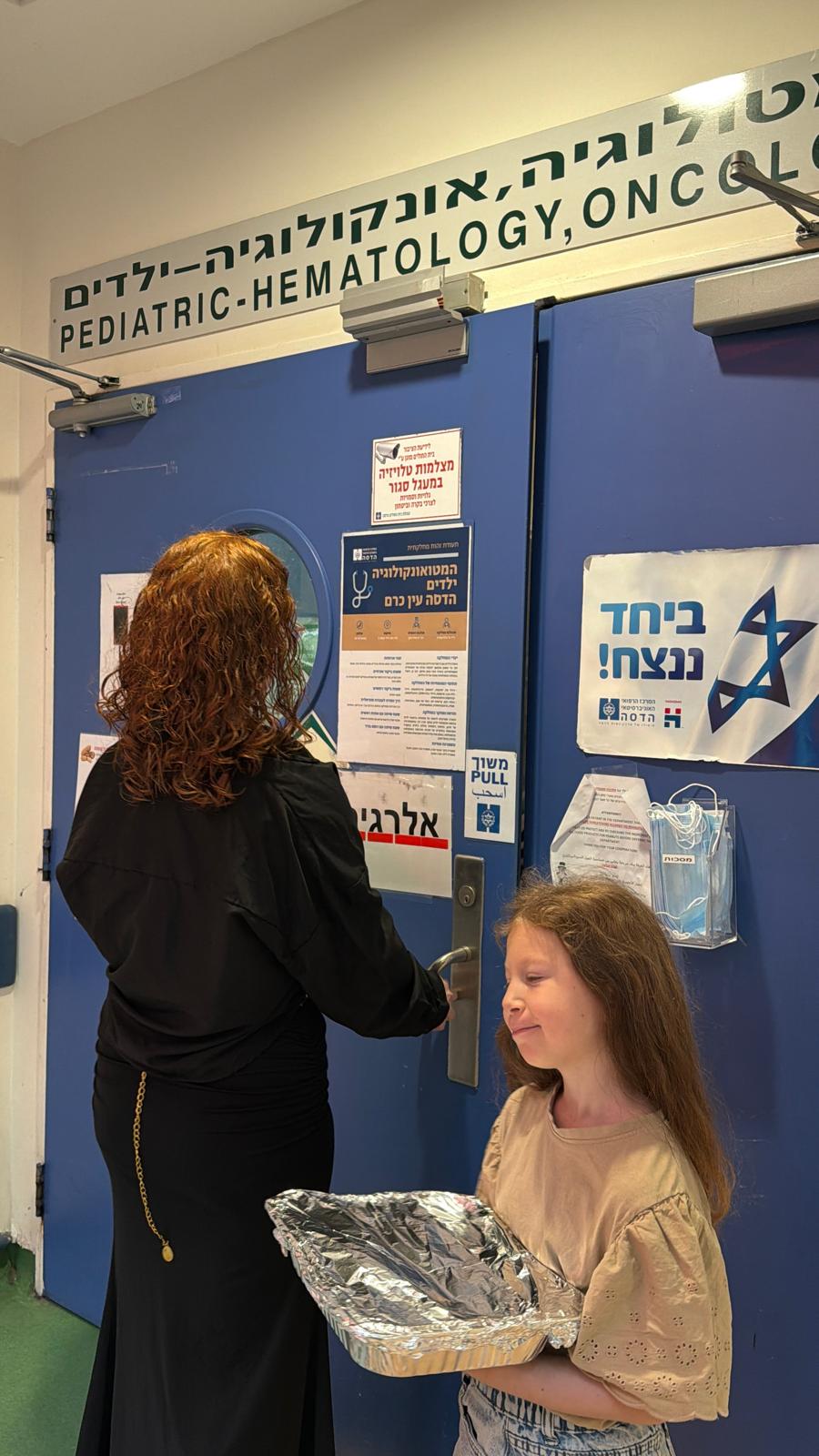 Today, at the entrance to the ward to distribute hot food
What helped you keep going during those days?
“Fortunately, the ward at Hadassah is filled with light. There are lots of games and gifts, as well as incredible volunteers who do everything possible to make the children happy. Alongside the difficult treatments, they manage to bring humor and enjoyment into the routine.
“In addition, Zichron Menachem runs a summer camp, and Ayala attended four times. I will never forget the first time. On the evening before the flight, Chaim Erenthal called me and announced firmly, ‘Your daughter is coming to camp.’
“I explained that her doctor would not approve the trip because of her medical condition, but he refused to give up. ‘I’ll speak to her,’ he said.
“The doctor sent the head nurse to inspect the medical equipment being taken to the camp. Once she saw that the equipment was identical to what was available in hospital wards, and that five heads of oncology departments would be accompanying the trip together with dedicated nurses, it became clear that Ayala would have access to any medical care she might need. The doctor gave her approval.
“We brought Ayala to the airport in a stroller because she was so weak and exhausted. But from the moment she boarded the plane, she never needed the stroller again. That very day, they sent us videos from camp showing her jumping around and dancing. She had an incredible time. When she returned to Israel and had blood tests, all of her levels had risen dramatically.
“For us as parents, those eight days were also incredibly important. For the first time, we could breathe and gather strength for the road ahead. My wife had recently given birth, and those were the only days during that entire chaotic period when she was able to experience even a little of what maternity leave was supposed to feel like.”
Did Ayala attend kindergarten during that period?
“She attended a special kindergarten designed for children with cancer and weakened immune systems,” her father explains. “The children are carefully checked every morning to make sure they haven’t contracted any viruses. In addition to their regular educational routine, they receive physiotherapy, animal-assisted therapy, art therapy, and every other form of support they might need.
“Thanks to that kindergarten, after two years she went directly into first grade. When the school principal met her, she couldn’t believe that Ayala had never attended a regular kindergarten. Her level of knowledge was no lower than that of the other girls and perhaps even higher. Those two years, during which she spent much of her time around adults, made her unusually mature, perceptive, and developed for her age.”
Was there a specific moment when you were told that Ayala had recovered?
“It doesn’t happen in a single moment. It comes gradually. First, we went through a year of intensive treatments. That was followed by another year of pills and follow-up appointments as maintenance treatment.
“Only later were we told that she was ‘clear’ of cancer, and even then she continued receiving biological medication. The most emotional moment came when we were finally told that she no longer needed chemotherapy or any other active treatment.”
What does a moment like that feel like?
“The truth is that it is filled with fear. You are afraid to say it out loud. You are afraid to actually say the words, ‘My daughter has recovered.’
“Of course, there is an enormous sense of victory in knowing that we survived this tremendous challenge. But at the same time, that is when all the difficult moments and everything you have been carrying suddenly come crashing down on you, and you finally begin to process what happened.
“Around that time, we joined a special eight-day trip abroad together with a support group of parents who had been through similar experiences. It was a journey focused on positive thinking and accompanied by a professional team. It gave us the opportunity to process everything we had experienced and learn how to return to normal life.
“Although, really, there is no such thing as returning to your old normal. You never go back to the path you were walking before. Instead, you move onto a VIP track, a different path, and perhaps the best way to describe it is an ‘upgraded’ one.”
Shmaryahu and Chavi decided not to keep the experience and strength they had gained on that new path to themselves. Although they had said goodbye to the oncology ward as patients, they now return every week, this time as people offering support.
Every weekend, Chavi lovingly prepares pots of schnitzel, pasta, and cholent for Shabbat, as well as hot pizzas on Saturday night. Together, they distribute the food to families in the ward. Sometimes Ayala joins them and takes part as well.
Isn’t it difficult to return to the place where you experienced the greatest upheaval of your lives?
“It really does surprise people,” Shmaryahu acknowledges. “After six years of knowing the ward, I can tell you that almost everyone who finishes treatment finds it impossible to set foot there again. For us, it is different. We see it as a mission.
“Precisely because we remember what it was like as parents, and because we remember how much we missed warm, homemade food on Shabbat and weekends, we decided that we didn’t want other families to experience that same absence. Families tell us that the food we bring gives them a taste of home. Even the medical staff and nurses now look forward to our visits.”
Along with physical nourishment, they also try to offer nourishment for the spirit.
“I remind parents and children who are just beginning this journey that medicine has advanced tremendously, that there are excellent treatments available, and that most children recover completely,” says Shmaryahu. “I try to show them that there is a future, that there is hope, and that it is possible to overcome.”

