

World News
A Massive Ice Collapse in the Himalayas Triggered a Deadly Flood, Killing at Least 157
Rescue efforts continue in Nepal and Tibet as hundreds remain missing, including an Israeli tourist. Satellite analysis points to the collapse of an enormous ice mass, while authorities warn that another flood could still strike the region.
 Illustration
Search-and-rescue efforts continued Wednesday evening in Nepal and Tibet after powerful flash floods swept through valleys and communities along the border, leaving widespread destruction behind. According to the latest figures, at least 157 people have been killed, and hundreds more are still listed as missing. Those out of contact include an Israeli tourist who was traveling in the area with a group of foreign visitors.
ZAKA said it received an initial report about an Israeli who had lost contact in the Tibet region. The organization's international unit is in touch with the Israeli Embassy in Nepal and local officials in an effort to determine his condition. At this stage, however, there has been no official confirmation that his name appears on the missing-person lists published in Nepal, and the circumstances of the case remain unclear.
Magnus Search and Rescue has also received requests from parents trying to reconnect with their children who are traveling in Nepal. The company said several cases are currently being handled, including through satellite devices used to locate the travelers, send messages, and verify their condition.
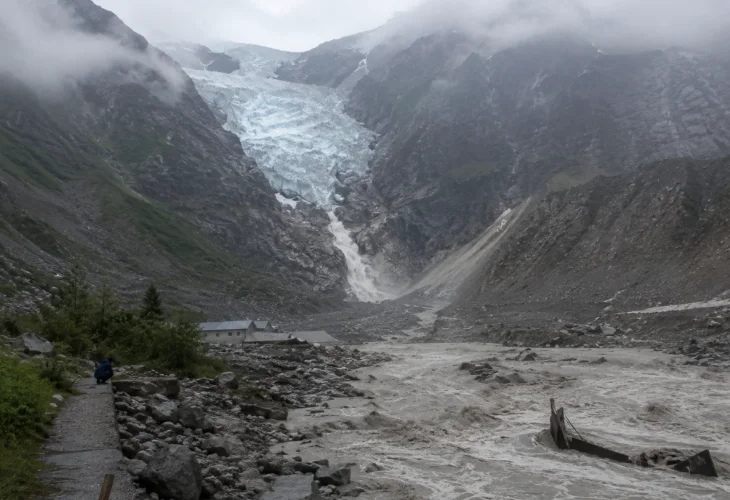
Alongside the rescue operation, investigators are beginning to piece together the chain of events that led to the disaster. According to an initial assessment by geologists and glacier experts, published in the New York Times, an enormous mass of ice broke away from a high-altitude glacier in the Himalayas, plunged toward the valley floor, and shattered into a massive mixture of ice and water.
Analysis of satellite images indicates that the ice mass was about 600 meters wide. Dr. Daniel Shugar, a geologist at the University of Calgary in Canada who took part in the analysis, estimated that the ice broke away at an elevation of about 5,200 meters and fell nearly 1,200 meters to the valley floor. Researchers believe the ice-and-rock avalanche then developed into a powerful flow that swept through the area.
Satellite images taken in the 24 hours before the disaster also showed a significant decrease in snow cover in the area. The finding may point to high temperatures that contributed to the glacier's instability. Still, researchers stress that it is not yet possible to determine with certainty that the ice collapse was the only cause of the flood, and other factors may have contributed to its unusual intensity. Cloud cover in the area is also making it difficult to obtain current satellite images of sufficient quality to definitively establish the sequence of events.
The danger in the region has not yet passed. According to Reuters, another blockage has formed upstream on one of the rivers, and authorities fear it could break loose and trigger another flood. Residents in low-lying areas and along the rivers have therefore been urged to remain alert and move to safe locations.
The scale of the destruction is meanwhile complicating rescue operations. Roads have been blocked, infrastructure damaged, and electricity and communications networks disrupted, making it difficult for rescue teams to reach some of the affected communities and valleys. According to Nepalese authorities, 384 travelers were listed as missing in the affected areas, including 341 foreign nationals. The figures are still being checked against tourism companies, guides, local authorities, and security forces.
Nepal's Prime Minister, Balen Shah, said after the disaster that "the entire nation remains shocked and grieving," describing the event as "sudden." He offered condolences to the families of those killed and stressed that the government had "immediately mobilized all its resources" for search, rescue, and relief efforts for those affected.

