

Jewish Law
The Rambam on Baalei Teshuvah: Why Your Past Does Not Put You Behind
The Rambam reveals the extraordinary place of the baal teshuvah and why overcoming past struggles can become a source of spiritual greatness
- Yonatan HaLevi
- | Updated
You are sitting in a Torah class, and everyone around you seems to know more than you do. You nod at the right moments, but inside, you feel as though you arrived twenty years too late.
The Rambam addressed precisely this feeling, and what he wrote is the exact opposite of what we might expect:
“A person who has repented should not imagine that he is far removed from the level of the righteous because of the sins and transgressions he committed. This is not so. Rather, he is beloved and cherished before the Creator as though he had never sinned.
“Moreover, his reward is great, for he has tasted the taste of sin, separated himself from it, and conquered his inclination.
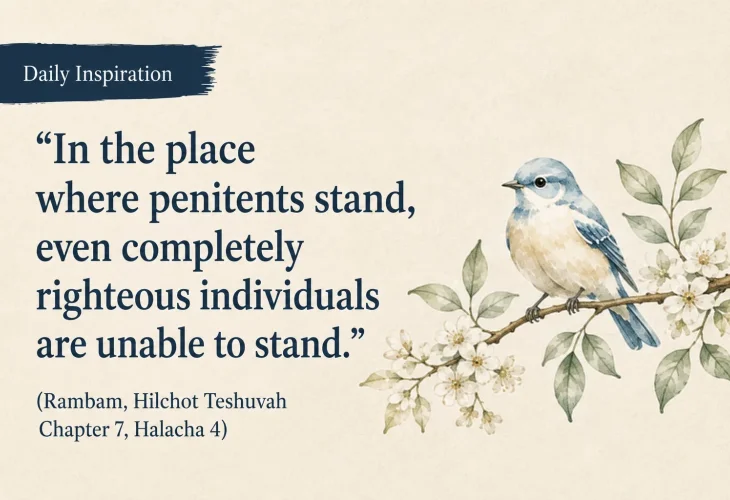
“The Sages said: ‘In the place where penitents stand, even the completely righteous cannot stand.’ That is, their level is greater than that of those who never sinned, because they overcome their inclination to a greater degree.”
— Rambam, Hilchot Teshuvah 7:4
Let us take a closer look at the Rambam’s words.
Stage One: You Are Not Less
“This is not so. Rather, he is beloved and cherished before the Creator as though he had never sinned.”
Not merely “forgiven.” Not given a discount. Not, “Fine, we’ll overlook what happened.”
The Rambam is not describing an account that has been settled but still carries a small negative balance. He describes something far more radical: a fresh account, wiped clean.
Stage Two: You May Have Something More
“And moreover, his reward is great.”
Notice what the Rambam is saying. You are not simply being told that you are no longer behind. There is a unique spiritual greatness in what you are doing now.
The baal teshuvah struggles against an inclination he already knows. He knows exactly what he is giving up. He has experienced the pull firsthand, and yet he chooses to turn away from it.
That is a struggle someone who never committed that particular sin has never had to face. This is why the Sages taught that where baalei teshuvah stand, even the completely righteous cannot stand.
The Rambam is not speaking only about the moment when you first decided to change. He is speaking about what happens every morning after that decision.
Your greatness is not found in the mistakes of your past, but in the struggle you are undertaking today.
What the Rambam Is Not Saying
The Rambam is certainly not saying that a person should sin in order to attain the special level of a baal teshuvah. Sin itself is not an advantage, nor is there anything positive about it. The greatness lies entirely in overcoming the inclination now.
The opposite misconception is also untrue. Someone who has lived an upright life has not lost anything or missed an opportunity. Such a person possesses spiritual qualities and achievements of his own.
This teaching is not intended to lower anyone else. It is intended to lift the person who mistakenly believed that because of his past, he was no longer truly in the running.
Examples From Everyday Life
✓ Someone who became observant later in life may sit in a Torah class feeling that everyone else knows more. But he is not merely a guest in the room. According to the Rambam, there is a unique spiritual place occupied by the person who has fought to return.
✓ Someone who once regularly lost his temper and is now learning to restrain himself is doing more than simply “behaving better.” Every time he controls that familiar impulse, he is exercising precisely the kind of inner strength the Rambam describes.
Take It With You
✓ Your past can become valuable information. Yesterday’s failures and struggles can become a roadmap for today’s victories. You know your weak points, your patterns, and your temptations. That knowledge can now help you choose differently.
✓ “Beloved and cherished” — not merely tolerated. If you imagine that Hashem has reluctantly allowed you back in, you are imagining the opposite of the Rambam’s words. Read them again, slowly: beloved and cherished before the Creator.
✓ The greatness is in the present, not the past. You are not being praised for how far you once fell. The greatness lies in what you choose to do this morning. That is encouraging, because today’s choices are in your hands.
✓ Measure the distance traveled, not only your current position. You may look at someone who appears to be far ahead of you, but you do not know where that person began. You do know where you began and how far you have traveled.
✓ When the struggle is especially difficult, that is precisely the moment that matters. The moment when the old impulse is strongest and you nevertheless choose differently is the very kind of struggle the Rambam is describing.

