

Parashat Vayelech
The Battle Between Body and Soul: Who Is Holding the Reins?
Our bodies pull us toward the physical, while our souls strive upward. Discover a powerful lesson for Yom Kippur and the Ten Days of Repentance.
- Rabbi Avraham Yitzchak
- | Updated
A man called his wife and asked, “Tell me, what did you put in those meatballs we ate yesterday?”
His wife smiled. “They were good, huh? On a scale of one to ten, how much did you like them?”
“101,” her husband answered.
“Thanks, honey,” she replied, “but I’m not giving you the recipe. It’s a family secret.”
“I don’t think you understand,” said the husband. “I felt terrible today, so I called 101 (Israel’s emergency medical number), and an MDA ambulance took me to the ER. Now the doctors want to know what you put in those meatballs...”
Sometimes, that’s how we go through life. We barely understand what we’re supposed to be doing, somehow manage to do something, and yet remain completely confident that we’ve got it all figured out.
When it comes to meatballs, maybe that’s not the end of the world. At worst, you end up in the ER, sleep it off, and hopefully feel better the next morning.
But when it comes to the work of teshuvah during the Ten Days of Repentance, becoming too confident can be far more dangerous. If we convince ourselves that we’re doing just fine, we may stop doing the very work these precious days are meant for.
So how can we make the most of the days that remain?
Can We Really Overcome the Yetzer Hara?
On Yom Kippur, toward the end of the Amidah, before Elokai Netzor, we add the prayer: “My God, before I was formed, I was unworthy,” and so on.
Afterward, some also add:
“And I should say again, ‘I will not do it,’ were it not that I fear the yetzer hara, for it is made of fire and I am flesh and blood, and I cannot overcome it! Then I would add transgression to my sin.”
This wording seems to suggest that because the yetzer hara is made of fire while we are flesh and blood, we simply do not have the power to overcome it. That is why there is concern about promising never to sin again. After all, what power does flesh have against fire?
Indeed, Chazal teach in Kiddushin (30b) that without Hashem’s help, a person cannot overcome his yetzer hara. Yet the wording above seems to indicate that our weakness before the yetzer hara also stems from the very material from which we are made: flesh and blood.
This raises two questions.
First, the yetzer hara was placed within us even though we are made of flesh and blood. Surely that means we must have the ability to overcome it. If defeating it were completely beyond our capabilities, why would Hashem have placed it within us?
Second, everything physical is subject to gravity, and human beings are no exception. By nature, we are drawn toward the physical and material side of ourselves. Just as a physical object cannot simply decide to ignore gravity, how can a person resist the physical nature that constantly pulls him downward?
Who Is Holding the Reins?
Rabbi Yerucham HaLevi, of blessed memory, illustrated this idea with a story.
According to the story, when Columbus arrived in America on horseback, the local inhabitants had never seen a person riding a horse.
As Columbus galloped toward them, they fled in every direction. The faster he rode, the faster they ran.
Then Columbus noticed the chief of the tribe. While the others ran for safety, the chief remained where he was, tightly gripping his spear and waiting to see what would happen.
Columbus raised his hands above his head to signal that he came in peace and then dismounted from his horse.
The chief let out a sigh of relief.
Columbus bowed before him as a gesture of peace, and the chief signaled for the others to return.
Columbus asked why they had been so frightened of him.
The chief explained: “When you arrived, the lookout reported a strange creature galloping toward us. It had six legs, four on the ground and two on either side of a thick neck. It had two heads, one human and one animal, a pair of arms at its sides, and a hairy tail behind it...
“Only when you got off the animal did we realize that you were two creatures, one leading the other.”
The story offers a powerful way to understand the human being.
When describing the creation of humanity, the Torah tells us: “And Hashem formed the human being from dust of the earth, and He breathed into his nostrils the breath of life, and the human being became a living soul” (Bereishit 2:7).
The Torah describes us as being made up of two parts: a physical dimension, “dust of the earth,” and a spiritual dimension, “the breath of life,” a Divine part from Above (Iyov 31:2).
And between those two forces lies our power of choice.
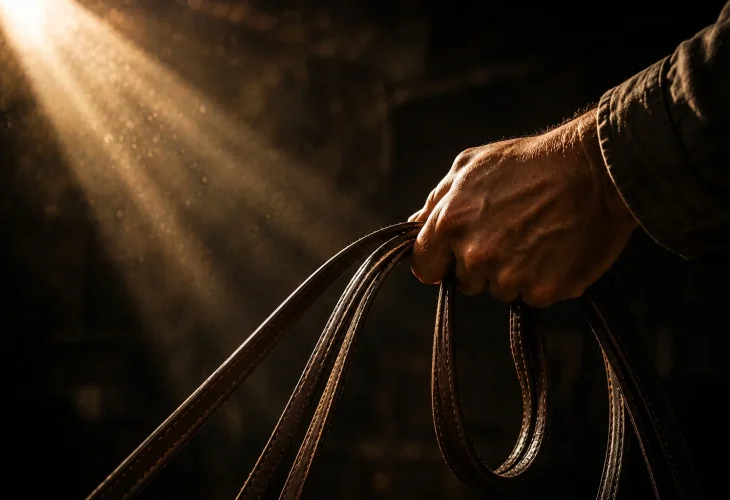
In a sense, free will is the reins.
When a person chooses to give in to the empty promises of the yetzer hara, he hands the reins to the body and allows it to lead the soul. The soul becomes subordinate to the body.
But when a person chooses to overcome temptation and follow Hashem’s will, he hands the reins to the soul and allows it to lead the body. The body becomes subordinate to the soul. (See Sfat Emet, Vayikra-Pesach, year 5632.)
Why the Soul Is Compared to Fire
We can now better understand the wording of the prayer on Yom Kippur.
Yes, we are flesh and blood. But within us is also a Divine part from Above, a soul intended to lead the physical body when a person chooses to follow its will.
On Yom Kippur, we confess all those times when we gave in to temptation instead of overcoming it. In those moments, we remained flesh and blood, allowing the physical side of ourselves to dominate rather than allowing the soul to lead.
When we remain rooted in materiality, overcoming the yetzer hara becomes that much harder. From that perspective, there is indeed reason to fear promising that we will never sin again.
But when a person overcomes temptation, he loosens the grip of materiality, makes the body subordinate to the soul, and connects himself to the Divine part from Above.
In this state, the fire of the yetzer hara has no power over him.
And this brings us back to the question of gravity.
The Torah emphasizes that our physical bodies were created from dust, the most material element, “in the utmost coarseness and murkiness” (Shlah, Asarah Ma’amarot, letter 105). Yet the human being is identified with the soul breathed into him (Shlah, Yoma, letter 185), and the human soul is described as “the spiritual element of fire” (Shlah, Torah Or, Vayikra, letter 13).
Now consider something fascinating.
Physical objects are pulled downward by gravity. Fire, however, rises.
That image captures the spiritual struggle within us.
A person who continually gives in to the yetzer hara and its empty promises remains dominated by the physical and is pulled powerfully toward materiality.
But a person who overcomes forbidden temptations allows the soul to lead the body. He connects to the element of fire within himself, the part that constantly strives upward.
That is our work during the Ten Days of Repentance: to identify the temptations and weaknesses that repeatedly cause us to stumble and make practical plans for overcoming them.
We are not merely flesh and blood. We also carry within us a soul that can rise.
And when we connect with that “Divine part from Above” within us, we crown the Divine One Above as our King.

