

Magazine
Kfir Ohayon’s Legacy: How One Family Turned Tragedy Into Torah and Faith
After Kfir Ohayon was killed in a terrorist attack, his grieving family found strength through Torah, mitzvot, and acts of kindness, transforming their loss into a lasting legacy
- Miriam Solomon
- | Updated
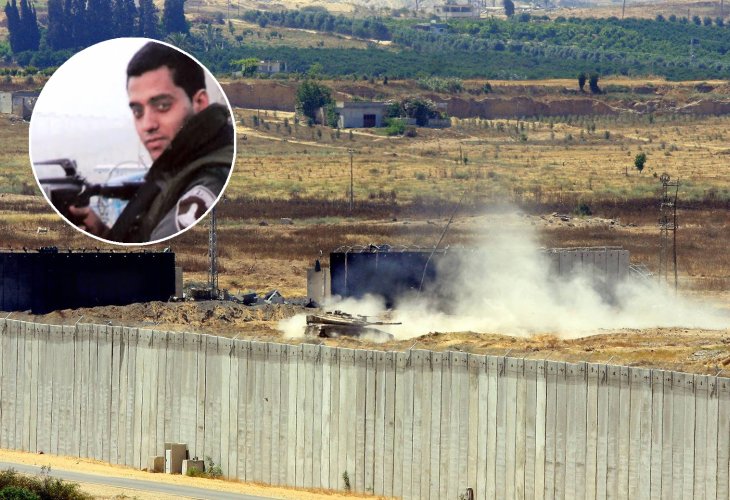 In the circle: Sergeant Kfir Ohayon, of blessed memory (Illustrative photo: Flash 90)
Years have passed since that devastating Shabbat, yet the wound still burns anew each year. The pain has never disappeared. But for Roi Ohayon, whose older brother Kfir was killed in a terrorist attack, grief has also given rise to something else: a determination to build, to grow, and to keep the memory of his beloved brother alive.
“Kfir was my older brother,” Roi begins. “I was only a year and a half younger than him, so my entire childhood was intertwined with his. We were very close. We attended the same school, shared friends, and spent a tremendous amount of time together. As a child, Kfir naturally assumed the role of protective older brother. He looked out for me and wanted me to succeed. Even the ordinary disagreements between siblings could never overshadow the deep affection between us or the sense of security he gave me. I’ll never forget how he would come home late at night and check on me almost like a father, making sure I wasn’t cold in bed. He was such a devoted older brother.”
That same loyalty characterized Kfir’s friendships. He was well loved, constantly surrounded by friends, and always ready to help someone who needed him.
A Heart for Giving
Around that time, Kfir’s mother, Yael, decided to organize food packages for families in need. Kfir immediately embraced the idea. Every Friday, he helped his mother fill baskets with food donated by various people and accompanied her around the city as she delivered them to families.
Kfir also had a warm connection to Judaism. He put on tefillin every day and enjoyed listening to Torah classes from time to time. Ironically, it was his younger brother Roi, who initially had little interest in religion, who became observant first. At sixteen and a half, Roi was sitting with a high school friend when the friend suggested that he listen to an interesting recording. It was a Torah lecture, and Roi was captivated. One class led to another, and slowly something began to change within him. Eventually, he decided to observe Shabbat.
His family responded with warmth and understanding. His father, who had grown up in an observant home and had always maintained a connection to Jewish tradition, would even wake him for prayers on Shabbat morning. Kfir particularly enjoyed hearing Roi sing Shabbat songs at the table. If Roi forgot one of the melodies they had sung the previous week, Kfir would immediately remind him, “Wait, Roi, sing the one you sang last Shabbat.” His favorite was Ahavat Hadassah Al Levavi Niksharah, and the brothers would hum and sing the words together.
About six months later, independently of Roi’s journey, their father also returned to religious observance and became increasingly committed to mitzvot.
Determined to Serve
When Kfir reached military age, the army initially refused to place him in a combat unit because he had mild asthma. But Kfir was determined to serve as a combat soldier. He refused to give up and even spent a short period in military prison after refusing to accept a noncombat assignment. Eventually, his persistence paid off, and he was accepted into a combat unit.
During basic training, Kfir gave everything he had. His natural leadership abilities quickly became apparent. His fellow soldiers later recalled how he constantly encouraged those around him to keep going and not give up, offering support whenever someone was struggling. He completed basic training with distinction and was offered the opportunity to attend a commanders’ course, which he also completed successfully.
Yet even military service did not cause Kfir to abandon the acts of kindness that had become part of his life. Whenever he came home on leave, exhausted as he might have been, he immediately returned to helping his mother distribute food packages.
On one visit home, Kfir noticed that the neighborhood synagogue had recently been renovated, but the walls had been painted poorly. It bothered him. The next time he came home, he took a bucket of paint from the family’s storage room and, on Friday, quietly repainted the walls himself. He did not tell anyone or seek recognition. He simply saw something that could be improved in a house of prayer and took care of it.
The Last Shabbat
Kfir served in the Border Police and, after completing his training, was assigned to the Erez Crossing near Gaza. It was the spring of 2004, a period marked by repeated terrorist attacks in the Gaza area. After another soldier at the crossing was killed in an attack, Kfir was sent to fill his position.
His family knew very little about the danger he was facing. “Kfir didn’t share his fears or the tension with us,” Roi says. “He didn’t want us to worry. With the responsibility of an eldest son, he projected confidence and stability.”
Kfir had enlisted somewhat later than others his age, which meant that Roi began his own military service only about two months after Kfir completed his training. That Pesach, both brothers were given leave and returned home. They celebrated the holiday together with warmth and happiness. When Kfir left to return to the army after Mimouna, the family had no way of knowing that it would be the last time they would see him alive.
The following Shabbat, Parashat Shemini, was Roi’s first Shabbat in the army. He was feeling discouraged, so on Friday he called Kfir. Kfir understood exactly what his younger brother was going through. He reassured him that the beginning was difficult, but that eventually he would adjust and things would become easier.
Then, just before they ended the call, Roi felt an inexplicable inner urge telling him to say how much he loved his brother. It was not typical of him to speak that way, but Roi listened.
“Shabbat shalom, my brother,” he told Kfir. “I love you.”
“I love you too,” Kfir replied emotionally.
Those were the last words the brothers would ever exchange.
The Attack at Erez Crossing
On Shabbat afternoon, the 26th of Nissan 5764, a suicide bomber entered the Erez Crossing. Three soldiers were stationed there at the time. According to the account later given to Kfir’s family by an officer who had been at the crossing, the officer had been standing near the entrance to the terminal. Kfir noticed that he had been outside for much of the day and offered to take his place so that he could rest.
“You’ve been standing outside all day,” Kfir told him. “I’ll stand here now, and you can rest for a while.”
The officer accepted the offer and moved behind the barrier. Kfir took his position near the entrance. The terrorist passed through the security check carrying an explosive device that was not detected. Once he crossed the border, he approached Kfir and detonated the explosives.
Kfir absorbed the force of the blast and was critically wounded. The officer and another soldier were thrown backward by the explosion. The officer, himself injured, got up and began desperately searching for his men.
“Kfir, where are you? Where is Kfir?” he shouted.
Eventually, he found him lying gravely wounded. When he asked Kfir whether he was all right, Kfir initially moved his head before indicating that he was not. His mother was later told that he whispered, “Ima, Ima,” before losing consciousness. Emergency medical teams rushed him by helicopter to Beilinson Hospital, but attempts to save his life were unsuccessful.
A Mother’s Premonition
At that very time, hundreds of kilometers away at the family home in Eilat, Kfir’s mother was overcome with fear. She could not reach her son.
“Something happened to Kfir,” she repeatedly told those around her. “I feel that something is happening to him.”
No one understood why she was so frightened. About half an hour later, there was a knock at the door. A group of soldiers stood outside.
Yael saw them and immediately turned pale. “I don’t want to hear anything from you,” she said, trembling. “Kfir’s father is at the synagogue. Go and call him.”
Her husband, Avraham, was indeed at the synagogue preparing for prayers. The moment he saw the Border Police officers looking for him, he understood. He returned home with them, and the family’s world collapsed.
The News After Shabbat
Roi, meanwhile, knew nothing. He was on his army base observing Shabbat and had not turned on his phone. Images and reports about his brother were already appearing in the media, but Roi remained completely unaware.
“I felt that Hashem protected me from knowing anything and from experiencing that grief on Shabbat,” he recalls. “Shabbat observance was my protection, because pictures of my brother were already appearing in the media, but I didn’t turn on my phone.”
Only after Shabbat did a superior officer summon him to her office. She told him there had been a terrorist attack at the Erez Crossing. Roi immediately asked about Kfir. He was told that his brother had died.
“I walked out of the office barely able to stand, crying,” Roi remembers.
In an extraordinary coincidence, the soldier assigned to share Roi’s tent was Kfir’s best friend from childhood, also named Roi. Out of hundreds of recruits spread across three units and a large camp, the two had somehow been placed together.
Roi could not bring himself to tell his brother’s friend what had happened. He simply cried. Eventually, he told his commander that this soldier had been Kfir’s closest friend and needed to come with him. Permission was granted, and the two began the journey south together. Only along the way was Roi able to explain what had happened. His friend broke down, and the two sat together and cried throughout the journey home.
Trying to Be Strong With a Broken Heart
As they approached Eilat, one of Roi’s uncles called. “Roi, listen,” he told him. “Your family is completely shattered. You have to come home strong. You cannot fall apart there because your parents need you.”
Roi could barely comprehend what was being asked of him. He was only eighteen years old and had just lost the brother who had been beside him throughout his childhood.
“I felt so weak and broken,” he recalls. “How was I supposed to strengthen my family? I looked up toward Heaven and asked Hashem to help me find strength and to give strength to others, because without Him, I knew it would be impossible.”
He arrived home at three in the morning. Standing outside the closed door, Roi knew that unimaginable grief was waiting on the other side. “It was the hardest moment of my life,” he says.
He entered and found exactly what his uncle had described. His parents were sitting broken and crying, surrounded by relatives in tears. Roi embraced his father and wept. When his mother saw him, she rushed toward him, sobbing as she spoke about Kfir and the bond between her two sons.
Over the following hours, Roi struggled to remain the “strong son” his family desperately needed. At moments when he could no longer contain his own pain, he would slip away to a corner and cry, pleading with Hashem to help him endure.
“I knew I had a responsibility to my family, but inside I felt so weak,” he says. “Yet Hashem gave me strength I never knew I had. I would wipe away my tears and return to my family with new strength.”
Searching for Comfort
The funeral was devastating. “I felt as though I had gone from being eighteen years old to seventy overnight,” Roi recalls.
The shivah that followed was filled with seemingly endless tears. One of the few sources of comfort for the family came from the rabbis who visited the home and delivered Torah classes in Kfir’s memory. They spoke about Kfir’s final moments and the fact that, by absorbing the force of the explosion, he had saved the soldiers around him. They also spoke about the significance of his having been killed al Kiddush Hashem.
Kfir had died on Shabbat Parashat Shemini, the Torah portion that recounts the deaths of Aharon’s two sons, Nadav and Avihu. The rabbis spoke about that connection as well.
The extended family surrounded them with extraordinary warmth. Relatives left their workplaces and traveled from across the country to be with them. They listened to stories, cried alongside them, and remained at their side day and night.
When the shivah ended and everyone said it was time to return to life, the family had no idea how to do that. Kfir’s parents were shattered, and Roi feared that the intensity of their grief would destroy them. He himself could barely enter the bedroom he had shared with his brother. Kfir’s belongings remained untouched, almost as though he might walk through the door at any moment and use them again.
Every Friday brought the same impossible feeling: perhaps Kfir would knock on the door and enter with his familiar smile. But he never would.
About a month later, the family received Kfir’s personal belongings from the army. It became another painful moment of separation. “We smelled his clothes and cried,” Roi remembers. “We touched his bags, hugged them, and broke all over again.”
At times, Roi feared that the entire family was being pulled into a dark pit from which they might never emerge.
The Torah That Helped Them Rise
Eventually, Kfir’s parents found something that gave them a reason to begin living again: Torah.
“Only Torah gave us answers that truly brought comfort,” Roi explains. “It spoke about the soul and eternal existence, about bringing merit to a soul and about Kiddush Hashem. That is what gave us the strength to continue.”
The Torah classes the family heard during the shivah had a profound impact on Kfir’s mother. Yael began listening to more and more classes and gradually strengthened her Jewish observance. Every new mitzvah and every step she took in Kfir’s memory gave her renewed strength.
She discovered that she still had a reason to get up in the morning. She could continue Kfir’s legacy, keep his memory alive, and transform her grief into something constructive. Avraham, Kfir’s father, also grew stronger in Torah observance. Together, Kfir’s parents began establishing Torah classes in their son’s memory.
Quietly, something remarkable began happening in Eilat. One Torah class was established, then another, and another. Avraham and Yael worked to bring rabbis to the city and arrange places where people could gather to learn. Large numbers came to hear Torah.
Kfir’s friends, struggling with the loss of someone they had loved so deeply, began attending the classes as well. Gradually, many developed their own connection to Torah. According to Roi, a number of them eventually built Torah homes and went on to devote themselves seriously to Torah study.
“Because of Kfir, I Found a Life of Torah”
Roi’s own life also changed profoundly.
“I personally felt a tremendous push to grow stronger in my Judaism for the elevation of my beloved brother’s soul,” he says. “I felt an inner connection to Hashem unlike anything I had ever experienced before. I felt that only He was holding me and supporting me through those terrible days.”
The loss forced him to confront the deepest questions of life: What is the purpose of life? What remains when everything else is gone? Roi knew that his life could never return to what it had been before.
About three and a half years later, he enrolled in a yeshivah and devoted himself to Torah study.
“Because of Kfir, I merited a life of Torah and faith,” he says. “Since then, I have merited to complete several tractates of the Talmud, and I dedicate all of them to the elevation of my brother’s soul.”
Meanwhile, his mother returned to distributing food packages to families in need, continuing the acts of kindness that had meant so much to Kfir. His father joined her with even greater dedication, and the modest family initiative eventually grew into a full-fledged gemach, distributing food to more than one hundred families every week.
For Kfir’s parents, giving to others breathed new life into a home that had been overwhelmed by grief.
A Torah Scroll in Kfir’s Memory
At the end of that year, the family completed a Torah scroll in Kfir’s memory. It was funded by the family together with donations from friends and acquaintances who wanted to participate in perpetuating his legacy.
The celebration accompanying the Torah scroll was deeply emotional. A joyous procession made its way through much of the city before the scroll was brought into the synagogue. “We were overwhelmed when we brought the Torah scroll into the sanctuary,” Roi recalls. “It almost felt as though we were accompanying my brother to his wedding.”
The years have continued to pass, but time has not erased Kfir from the family’s heart.
“Every transition in life and every family occasion reminds us of Kfir and brings the tears back,” Roi says. “I look at his picture and see how much all of us have changed. We grew older, built homes, and moved forward with our lives, while Kfir will remain young forever.”
Kfir is no longer physically present, but the life he lived continues to leave its mark: in the Torah being studied in his memory, in the families receiving food each week, in the mitzvot performed in his merit, and in the lives of those who loved him.
“He is not here,” Roi says, “but his memory will always live in all of our hearts.”

