

World News
U.S.-Iran Escalation Widens: American Strikes in Iran Met With Missile Fire Toward Iraq and Jordan
The U.S. military struck Islamic Revolutionary Guard Corps targets in southern Iran in response to Iranian activity in the Strait of Hormuz and attacks on American forces. Tehran responded by launching missiles and drones at U.S. bases across the region.
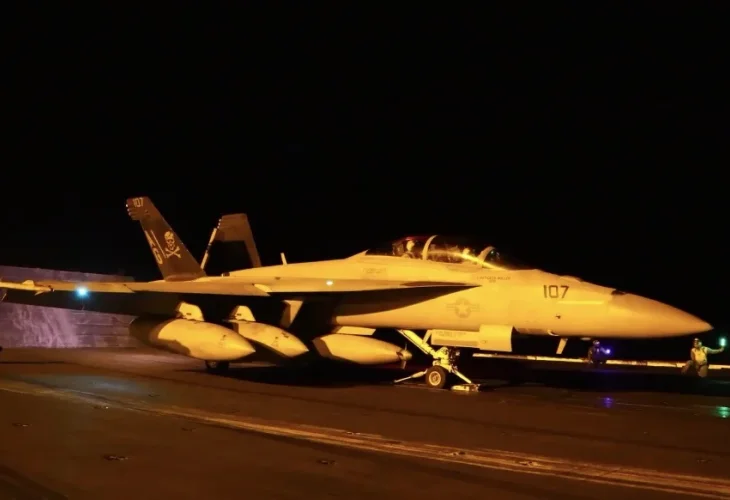 (Photo: U.S. Central Command)
The escalation between the United States and Iran widened overnight, between Tuesday and Wednesday. The U.S. military launched a broad wave of strikes against Islamic Revolutionary Guard Corps targets in Iran, responding to Iranian attacks on commercial ships in the Strait of Hormuz and on American troops stationed in the region.
U.S. President Donald Trump addressed the strikes overnight in a post on Truth Social, writing: "I like our position now much better, with almost total control of the Strait of Hormuz, and their economy completely collapsing." He later added: "They are only delaying the inevitable. When will the Iranian people rise up and fight?"
The American attack focused on several areas in the south of the country. Iranian television reported that five explosions were heard in the village of Masan on Qeshm Island, along with four more in the area of Hormuz. The Fars news agency reported explosions in Konarak and Chabahar in Sistan and Baluchestan Province, as well as in Assaluyeh, a major gas hub, where an explosion was reported at a gas plant. Tasnim also reported explosions along southern Iran, including on the southern coast of Qeshm Island.
According to additional Iranian reports, a Revolutionary Guard base in Khabar was attacked with six missiles. About two hours after the attack began, while it was still underway, Iranian television reported a strike at Jifort Airport in the south of the country. At the same time, air-defense systems were activated in eastern Tehran, according to the Mehr news agency.
Iran's response came shortly after the strikes began. Tasnim announced that attacks against "enemy" targets had begun, and reports said missiles and unmanned aerial vehicles had been launched. The agency also reported sounds of explosions in Erbil, Iraq. Iran claimed that the Revolutionary Guard carried out extensive attacks using ballistic missiles, and especially drones, against U.S. bases in Bahrain, Kuwait, and Iraq.
At the same time, reports in Iran said missiles had been launched toward Muwaffaq al-Salti Air Base in Jordan. Following the incident, explosions were also heard in Eilat, and footage circulated from the city showed an interceptor launched from the area toward Aqaba, Jordan. Jordan's military announced that 10 of the 13 ballistic missiles launched from Iran toward the country were intercepted, while three others fell "in open areas, far from population centers."
The Revolutionary Guard claimed that in the latest attacks against U.S. bases in the Middle East, "a large number of American soldiers were killed." That claim has not yet been verified. Revolutionary Guard spokesperson Hossein Mohabi warned in response to the attack: "The United States is going to regret it." The organization added that the American strikes would "tighten the grip on the Strait of Hormuz." At the same time, Tasnim quoted a military source as saying, "Iran will certainly respond to the American attack."
The Khatam al-Anbiya Headquarters joined the threats, stating that "in response to the airstrikes by the United States Army at several locations in Sistan and Baluchestan and Hormozgan provinces, Iran's armed forces will deliver crushing blows to the pathetic American enemy."
Trump confirmed the attack yesterday, writing on Truth Social: "The United States is attacking, as we speak, Iranian targets near the Strait of Hormuz." According to him, "The strikes are broad and powerful, and are being carried out in response to the Iranians' failed attempt to lay naval mines in the strait, which now has no mines at all (they were completely removed or detonated!), and in response to the Iranians launching eight missiles at our military base in Jordan, all of which were successfully intercepted."
Trump warned Tehran against further retaliation: "If the failed country of Iran responds to this justified attack, it will be attacked again, with much greater force and at a higher level." He added: "This will not be the greatest attack of all, that is still waiting for the right moment, and when it is over, very little will remain of the Islamic Republic of Iran."
In an interview with Fox News, the American president further intensified his tone, warning that if Iran continues responding again and again to U.S. strikes, it could "be completely wiped out as a country."

