

Facts in Judaism
Meet the Chabad Hasid Teaching Judaism to the Arab World
Shalom Kovesh is reaching hundreds of thousands of Arabic speaking viewers with videos about Judaism, Torah, and Jewish life, using conversation and curiosity to break down barriers
- Michal Arieli
- | Updated
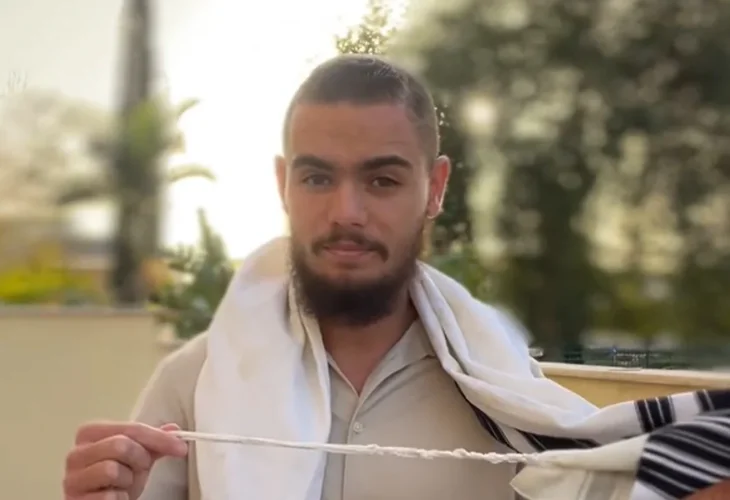 Shalom Kovesh
At least once a week, a young Haredi man suddenly appears on the phone screens of hundreds of thousands of viewers across the Arab world. Speaking calmly in fluent, precise Arabic, he explains the mitzvah of eating matzah on Passover, the meaning of words in the prayers, why Jews wear tzitzit, and a growing range of other Torah topics.
Many of those watching do not know that the man on their screen is Shalom Kovesh, a young Chabad Hasid whose life story is no less fascinating than the content he creates.
From Hungary to Israel
"I grew up in a family of Chabad emissaries in Hungary," Kovesh relates. "My mother grew up in Israel, in the Krayot area. My father, Rabbi Shlomo Kovesh, is Hungarian and became religious later in life. Today, he heads Chabad's activities throughout Hungary.
"I spent my childhood in Hungary. At home, we spoke only Hebrew, but since we studied in Hungarian at school and spoke Hungarian outside the home as well, we became fluent in the language. At 14, I was sent to a Chabad yeshiva in Belgium. I attended yeshiva gedolah in Israel and afterward spent a year on shlichut (outreach) in Hebron."
While living in Hebron, Kovesh was exposed to Arabic for the first time and decided he wanted to learn the language. "I started taking a course with an expert teacher, and I have continued studying with him ever since."
What was it about Arabic that attracted you so much?
"Arabic has always interested me. I liked Middle Eastern music and also connected with Middle Eastern culture. I had always wanted to learn the language, and when I finally had the opportunity, I was thrilled."
Kovesh did not abandon his Arabic studies when he later served in the Givati Brigade. Even when he returned to Hungary for another two years, he continued studying the language. He also pursued Arabic academically through Israel's Open University.
"Last year, I returned to Israel and lived with my grandfather in Krayot. Baruch Hashem, I got married this past month, and I now live in Kochav Yaakov."
Where did the idea of creating videos in Arabic come from?
"It started after I finished my army service. I was thinking about what I was going to do next, and very quickly the idea of making videos in Arabic came to me.
"To me, it seemed like the obvious thing to do because it is unusual. There aren't many Haredi Jews with beards and full traditional Haredi dress who speak Arabic, Hungarian, and English. I also have communication skills, so I realized this could be a real opportunity to shed light on subjects that had previously been completely unfamiliar to an entire audience."
The idea actually began taking shape about a year ago.
"I returned to Hungary for a visit and went to get a haircut at a barbershop next to a kebab shop. I saw a Hungarian man trying to ask the Arabs working there for a cigarette, but they were having trouble understanding him because he spoke only Hungarian and not English.
"I went over, translated between them, and helped him get the cigarette. Since it was cold and I was wearing a hat, they couldn't tell that I was Jewish. One of the men started talking to me because he thought I supported the Palestinian cause. He asked how I knew Arabic, and we started talking. I told him I was Israeli and came from the Krayot area. He was shocked and didn't believe me. When I told him my name was Shalom, he said, 'Prove it.'
"At the time, I had a podcast in Hungarian about the Middle East. But when I got home and told my father what had happened, he said, 'You need to start creating content in Arabic, and not just a podcast, because the potential audience is much larger.' He encouraged me to go for it, and that's how I started producing videos in Arabic about Judaism."
How do you decide which topics to discuss in your videos?
"I go with what I find interesting, questions I receive from viewers, and subjects that are relevant to the time of year or the holidays. Beyond that, there are topics I know will generate a lot of interest, such as relationships between men and women, marriage, and relationships in general. I look at what people are asking in the comments and identify where there is genuine interest."
Have any particular subjects unexpectedly taken off?
"Definitely the video about the laws of family purity. They found it fascinating. They were amazed to discover that there is an entire spiritual world behind these laws."
But some of these subjects are very complex. How do you condense profound concepts into a minute and a half?
"I don't think there is such a thing as a 'difficult subject.' There are more complex subjects that require more thought. The real challenge is distilling the idea. I have a minute and a half to two minutes at most, so I have to think very carefully about which essential points need to be included so that viewers understand the concept without losing interest.
"So far, I haven't really encountered a subject that created a serious problem in terms of how to present it, except for one topic I haven't addressed yet: the Temple. I'm trying to find the most sensitive way to discuss it without offending other people's beliefs and without compromising our own truth."
Do you believe the videos help them see us in a more positive light?
"I think so. To understand this more deeply, we need to compare two historical forms of hatred toward Jews: hatred in Europe and hatred in the Islamic world.
"In Europe, antisemitism is deeply rooted in Christian culture. Because of that, it can be very easy for people to believe lies, and simply presenting them with facts often doesn't help because the roots go back to historical Christian culture. From my experience, many Europeans would not necessarily consider themselves antisemitic, yet they can still easily believe absurd lies spread about us in the media because of prejudices that are so deeply rooted in European Christian culture.
"By contrast, throughout most of history and in most places in the Islamic world, hatred specifically directed at Jews, as opposed to hostility toward minorities in general, was not rooted quite as deeply. During periods of tension and regional violence, the majority often targeted Christians in particular. The major shift occurred around the period of the World Wars, and especially with the establishment of the State of Israel. When they realized that a Jewish state was going to be established here, it clashed with certain religious ideas, while at the same time a new form of Arab nationalism was developing.
"In my opinion, the hatred today is fueled and sustained primarily by enormous falsehoods that people absorb from the time they are very young. When you read what they write and think on social media, you see that they are saying things that are completely detached from reality simply because they don't know anything else. To them, Zionism means an ideology of Jewish supremacy and support for killing children. That's the only version they have been told."
How do you think this can be changed?
"Definitely by presenting the human side of who we are, similar to what is done in political advocacy, but in Arabic. The only way to reach their hearts and break down those walls is to introduce them to the religion and to the human being behind the story.
"Beyond that, I can clearly see that there is enormous curiosity about Jews, even among people who define themselves as strongly anti-Zionist or anti-Israel."
What kind of responses do you receive from viewers on the other side?
"There are many responses, but one of the most common, which I hear all the time and which continues to surprise me, is: 'I want to convert to Judaism. How do I do it?' I even made a video about that.
"I also receive many private messages. People write to tell me they support me and appreciate what I'm doing, while asking me to make a clear distinction between Zionism and Judaism.
"I try to respond to everyone, although it's difficult to keep up. I don't get into the complicated nuances of religious Zionism or different Jewish movements. I stick to the most basic and straightforward explanation. What's beautiful is that quite a few people understand it and don't even try to argue with me."
Do people ever recognize you on the street?
"Yes, I'm recognized quite often here in Israel. Just last week, someone came to install doors in my home and suddenly recognized me. It happens pretty frequently."
Do Jews recognize you as well?
"That's less common. Occasionally, Jews ask me in the comments, 'Why don't you add Hebrew subtitles?' But I do that deliberately. I don't want to confuse the algorithm or cause the content to be directed toward a Jewish audience because my target audience is Arabs. If Jews watch it and enjoy it, that's wonderful, but my goal is focused outward.
"To me, this entire project connects perfectly with the approach of the Lubavitcher Rebbe. The Rebbe strongly encouraged spreading awareness of the Seven Noahide Laws. In the past, it was considered unusual in the Jewish world for Hasidim to actively engage and communicate with non-Jews.
"Just as Chabad established campaigns encouraging Jews to put on tefillin and have mezuzot, the Rebbe also urged people to devote attention to the Children of Noah. What I'm doing fits directly into the foundation and mission of Chabad."
Do you watch Arabic news yourself?
"Absolutely. I watch a lot of news in Arabic. It teaches me a tremendous amount about the language and local dialects, but even more importantly, it gives me new insights into how people think and behave.
"The main insight I've gained is that not everyone hates us, or at least they don't see themselves as hating Jews. Many Muslims genuinely believe that they hate only the State of Israel and that Zionism and Judaism are completely separate things.
"I find that somewhat encouraging. Obviously, I know that things don't change overnight. But from my experience, sometimes you discover that there is someone you can talk to and that there is openness. Other times, you feel as though you're facing an impenetrable wall.
"Either way, even if you don't convince someone in an instant, the conversation itself creates change."

