

World News
Iran’s New Threat: Targeting the ‘Lifeline’ of the Global Internet
Hossein Shariatmadari, the Iranian leader’s representative and editor of the conservative Iranian newspaper Kayhan, has called for attacks on undersea internet cables running through the Strait of Hormuz, including cutting them entirely.
- Yuval Aviv
- | Updated
Iran’s military announced today (Thursday) that it attacked American military sites at Kuwait’s Ahmad al-Jaber Air Base using missiles and drones. According to the Iranian military’s statement, the targets included U.S. satellite communications systems, equipment warehouses, and hangars housing fighter jets.
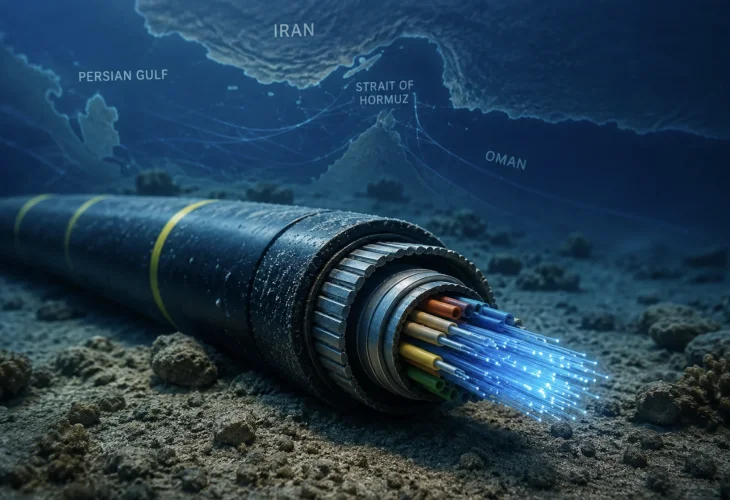
As the conflict continues, and as blocking oil exports through the Strait of Hormuz becomes less effective for Iran, a new call is being heard in Tehran: to exploit another regional vulnerability, undersea communications cables running beneath the Persian Gulf and the Strait of Hormuz, which are a central part of the world’s internet infrastructure.
Hossein Shariatmadari, editor of the conservative Iranian newspaper Kayhan and a representative of Iran’s supreme leader, published an editorial titled “The Cables Are Waving to Us!” In it, he called on Iran’s military and the Islamic Revolutionary Guard Corps to disrupt the region’s fiber-optic cables and even cut them.
“Is it not our undeniable right to bring these sources of evil to their knees and sever their lifeline, to prevent internet cables from passing through the depths of the Persian Gulf and the Strait of Hormuz?” Shariatmadari wrote. According to him, “This necessary step can be carried out through severe disruption of the cables’ operations or even by cutting them.”
About seven major cable systems pass beneath the Strait of Hormuz. Undersea communications cables carry the overwhelming majority of global internet traffic and financial communications, connecting Europe, Asia, and Gulf states. According to Shariatmadari, even limited damage to this infrastructure could cause widespread disruptions and affect more than 80% of commercial, banking, and military communications, as well as artificial intelligence systems and other areas.
The Kayhan editor acknowledged that deliberately damaging the cables could violate international rules and harm countries not directly involved in the conflict. But he argued that American attacks against Iran were themselves illegal: “You say other countries will also be harmed. We say: Are the crimes of America and its evil allies not crimes against all of humanity? Why do they not rise up against them?”
At the end of his article, Shariatmadari addressed senior regime officials and Iranian security forces, especially the military and the Islamic Revolutionary Guard Corps: “Look carefully. The global internet cables beneath the Strait of Hormuz and the eternal Persian Gulf are waving to us and calling out in a thousand voices: Why have you forgotten our role in this war?”
Shariatmadari is considered a figure associated with Iran’s hardline camp, and his views are seen as reflecting the mood within parts of the conservative leadership. This is also not the first time that figures linked to the Islamic Revolutionary Guard Corps have pointed to undersea cables as a potential source of leverage.
As early as the beginning of May, the Tasnim news agency, which is affiliated with the Islamic Revolutionary Guard Corps, called on Iran to generate revenue from the undersea internet cables passing through the Hormuz region.

