

Magazine
“I Asked Hashem for Another Chance”
Chana Miriam Bejarano Gutierrez survived a medical crisis that changed her life. Years later, discovering her own autism would transform her understanding of her children, her faith, and the meaning of belonging.
- Shira Dabush
- | Updated
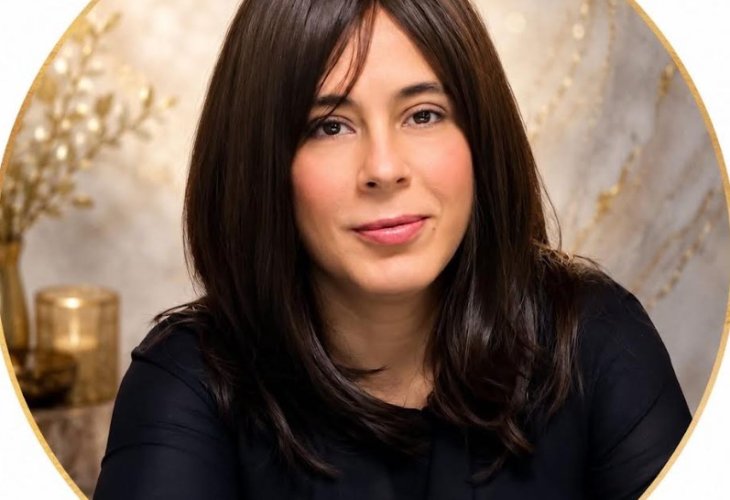
Rebbetzin Chana Miriam Bejarano Gutierrez wears many hats. She is a wife and mother, author, speaker, artist, educator, and advocate for people on the autism spectrum. She is also the owner and editor of Jewish Posh Living Magazine, and much of her work explores the intersection of Torah, emotional life, creativity, and the way we relate to people whose experience of the world may differ from our own. But to understand what drives her today, we need to return to the moment when almost everything ended. Just after the birth of her third child, Chana Miriam lost consciousness in a hospital bed. Moments earlier, she had managed to tell the friend beside her, “Call my husband”. Then her body collapsed.
In a way she still cannot fully explain, part of her consciousness remained alert. She could hear what was happening around her, yet she was unable to speak when the doctors tried to get her to respond. Trapped in that terrifying space, unable to reassure anyone that she could hear them, she did the only thing she was still capable of doing: she prayed. “I asked Hashem for another chance”, she recalls. “Another chance to live, a chance to raise the baby I had just brought into the world, and a chance to go home to the two little children who were waiting for their mother”.
She survived.
But survival did not mean returning to exactly the same life. Before the crisis, she says, her relationship with Hashem was still there, but something about it had become mechanical. Torah was part of her life and her faith remained intact, yet a connection that was meant to feel alive and vibrant had, to some extent, settled into routine. Coming face to face with the possibility that she might never return to her children shattered that routine. “When I recovered, I knew I couldn’t simply go back to living exactly as I had before”, she recalls. “I made a firm decision that my relationship with Hashem had to change fundamentally”. But transformation did not happen overnight. In the months that followed, she had to contend not only with physical recovery, but also with post-traumatic stress and the emotional consequences of knowing just how close she had come to losing her life.
“We Need to Make Them Feel They Belong”
That medical crisis was not the only time Chana Miriam would be forced to look at her life through entirely new eyes. Years later came a very different kind of discovery. It did not threaten her life, but it compelled her to revisit almost every chapter of it and ask herself a startling question: How had she lived for so many years without understanding this fundamental part of herself?
Autism first entered her life through her eldest son. When he was diagnosed on the spectrum, Chana Miriam did what many mothers do: she turned all of her attention toward him. She immersed herself in learning about autism, trying to understand how his brain worked, what he needed from her, and how she could become the best mother and advocate for him. At the time, she never stopped to wonder whether some of what she was learning might also describe her. Only years later did the pieces begin to fall into place.
As her younger son grew and his autistic traits became more apparent, Chana Miriam began recognizing things in her children that felt deeply and intimately familiar. “That was when I began looking back”, she says. Suddenly, an entire lifetime took on a different meaning. The sense of being different that had followed her since childhood, the loneliness, social difficulties, sensory sensitivities, the way she processed emotions and relationships, and even aspects of her marriage, motherhood, and religious life began to form a coherent picture.
Instead of repeatedly asking herself, “Why am I like this?”, she began asking a different question: “How does my brain actually work?”. Eventually, she decided to undergo a professional assessment. When the results confirmed that she, too, was autistic, her first emotion was not fear. It was relief. But relief was accompanied by something more painful: grief for the child she had once been. “Alongside the relief, there was also pain, because I couldn’t stop thinking about the little girl I had been, and how differently things might have looked if someone had understood me earlier. Maybe I would have been kinder to myself and wouldn’t have spent so many years interpreting neurological differences as personal failures”.
She could not go back and give that little girl the understanding she had needed. But she could decide what to do with that understanding now. “Autism taught me to look beyond behavior and ask what might be happening inside the person”, she says. The discovery awakened in her a profound interest in the connections between the brain, emotions, sensory experiences, trauma, communication, and the neshamah. But for Chana Miriam, that conversation cannot remain theoretical or confined to her own home. It has to reach the places where Jewish families are supposed to feel that they belong: synagogues, schools, and communities.
What do you think people on the outside still fail to understand about the experience of a family like yours?
Her answer begins with a scene that may seem ordinary to everyone except the family living through it: a child walks into a synagogue and cannot behave in precisely the way the people around them expect. “A family should not have to walk into a synagogue worrying that their child will be stared at, misunderstood, or judged because they need to move, regulate themselves, communicate differently, step outside when experiencing sensory overload, or experience prayer in a way that does not look exactly like everyone else’s”.
For Chana Miriam, it is not enough for a synagogue simply not to ask that child to leave. Nor is it enough to allow the family to remain. “True inclusion of these children is not simply about allowing someone to be present in the room”. Instead, she believes communities need to ask a far more demanding question: “Have we created a genuine way for this neshamah to participate, belong, and connect with Hashem from where they are?”.
That, to her, is the true meaning of inclusion. Not merely tolerating another person’s presence, but asking what they need in order to become a genuine part of the community. “If we are speaking about unity, then we have to be willing to make room for souls whose presence may ask a little more of us. More patience. More understanding. More flexibility. And sometimes, simply more chesed”.
“There were things I had to learn to see differently”
Autism did not change only Chana Miriam’s public work. It transformed the way she understands motherhood. “It is easy to carry an image in our minds of the child we hope to raise: how they will behave, how they will learn, how they will progress, and even what their spiritual connection will look like. But children are not raw material placed in our hands so that we can sculpt them into a figure that conforms to the plan we created”.
As a mother, it hurt to realize that your children’s lives might not look the way you had imagined. How did you learn to let go of your expectations without feeling that you were giving up on your dreams for them?
“There were definitely things I had to learn to see differently”, she replies. “As mothers, we naturally create a picture of our children’s future. We imagine how they will develop, how they will behave, what they will do, and even what their relationship with Hashem will look like. But over time, I realized that my role as a mother is not to take my children and try to fit them into a picture I had already created for them”.
She did not have to stop dreaming for her children. She had to learn to dream differently.
“My children are whole human beings, with their own personalities, strengths, sensitivities, challenges, and unique ways of experiencing the world. My responsibility is to know them as they are, stand beside them, guide them, give them appropriate boundaries and tools, and help them discover who Hashem created them to be”.
For Chana Miriam, this realization extends to their spiritual lives as well. She does not want her children to look like everyone else merely to prove that they belong. She wants them to build an authentic relationship with Hashem from within who they are. “The question we need to ask is not whether every Jewish child looks the same when connecting with Hashem, but whether we are helping every Jewish soul develop the deepest relationship with Hashem that they are capable of developing”.
This question, for Chana Miriam, is inseparable from faith. An autistic child or adult, she believes, deserves the opportunity to experience a deep and meaningful relationship with Hashem, even if that relationship does not look exactly like everyone else’s from the outside. “It is never too late to draw closer to Hashem. It is never too late for the soul to experience a close and meaningful relationship with Hashem and His Torah”.
It is a point she returns to repeatedly: the goal is not to produce Jewish people who all look identical when they connect with Hashem. The goal is to enable each soul to build the deepest connection it is capable of building. That worldview may also explain why Chana Miriam’s interests, which can appear so different on paper, continually intersect. Art and color, emotional regulation and neuroplasticity, autism, education, and Torah all return her to one fundamental question: “How do we understand the person Hashem created, and how do we care for them?”.
When Strength No Longer Meant Holding Everything Together
There is a temptation, when telling a story like Chana Miriam’s, to look backward and arrange every painful moment into a neat narrative of growth. She refuses to do that. There was faith along the way, but there was also fear. There was growth, but there was also anger, exhaustion, grief, and uncertainty. There were moments when she did not feel transformed or inspired. She simply felt broken.
“There were many times when I felt Hashem had given me more than I could carry”, she admits. “And there were many moments when I felt broken”.
It matters to her to acknowledge that now, even though she can see some of what eventually grew from those painful places. “There were moments of exhaustion, fear, grief, frustration, and uncertainty. There were times when I simply did not know how I would continue carrying everything that motherhood and life demanded of me”.
It was precisely there that her definition of strength began to change. “I used to think being strong meant not breaking. Today I understand strength very differently. Sometimes strength is admitting that you cannot carry your burden alone. Sometimes strength is allowing yourself to fall apart and cry, even when you do not have a beautiful explanation for what you are feeling. And sometimes strength is simply getting up in the morning because your children need breakfast”.
After nearly losing your life, struggling with post-traumatic stress, and later having to understand yourself all over again through autism, do you ever miss who you were before, or do you feel completely at peace with your new identity?
Her answer is complex. The crises she endured did not become good things simply because something eventually grew from them. Nor does she believe that suffering always needs to be wrapped in a neat explanation. But when she looks at her life today, she can see that the woman who emerged from those experiences is not the same woman who entered them, for better and for worse.
“Through motherhood, my own soul was educated as well”, she says. “My children taught me patience. They taught me to look beyond behavior, to understand that communication can take many forms, and that another person does not have to experience the world the way I do for their experience to be real”.
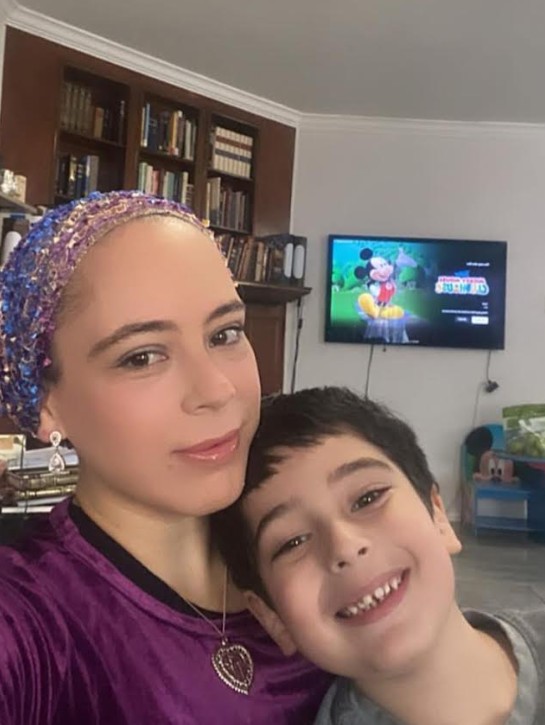 Chana Miriam Bejarano Gutierrez with her son
That may be why she now feels a particular closeness to people who find themselves somewhere in the middle of the journey: the woman rebuilding herself after a crisis, the mother fighting for a child whom the world struggles to understand, the neurodivergent woman who discovers later in life that there is a name for experiences that have accompanied her for years, and even the person who feels that her relationship with Hashem has become so distant that she no longer knows how to find her way back.
It feels especially fitting, then, that after everything she has been through, Chana Miriam is now writing a new book titled The Neshamah Remembers: From Gan Eden to Yerushalayim. It is a book about a journey, but not only her own. Chana Miriam traces the spiritual journey of the soul through the Torah’s story of creation, closeness, exile, longing, and return.
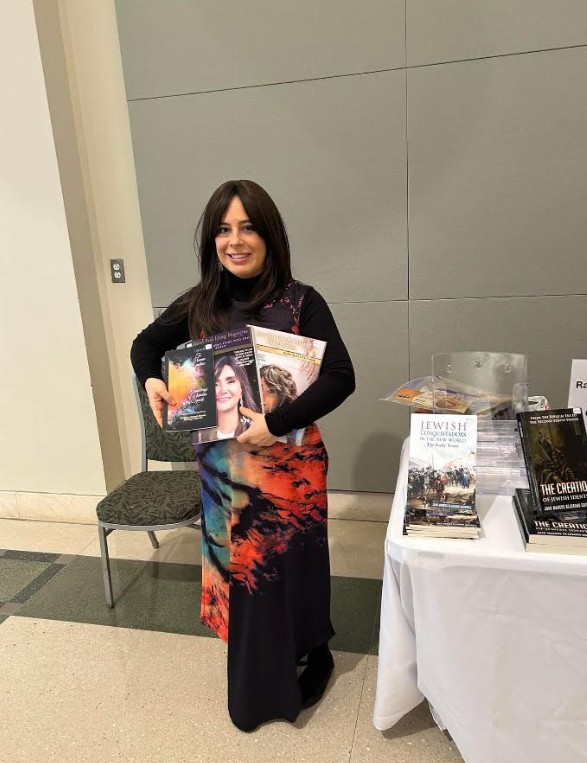 Chana Miriam Bejarano Gutierrez with her books and magazine
Why did you choose to call your new book The Neshamah Remembers?
“Because even when we experience distance from Hashem, something within the neshamah remembers the closeness for which it was created and continues searching for the way home”.
It is difficult to hear those words without thinking back to the woman lying in that hospital bed years earlier. Her body would not respond. She could hear the people around her, but she could not answer them. She did not know whether she would ever hold her newborn again or walk through the door to the children waiting for her at home.
And yet, in that moment, something inside her still knew where to turn.
She prayed.
Years later, after post-traumatic stress, motherhood, autism, questions of identity, advocacy, art, education, and the long process of learning to understand both her children and herself, she is writing about a neshamah that remembers the way home.
For Chana Miriam, Torah does not demand that a person erase their complexity in order to draw closer to Hashem. Quite the opposite. “Our struggles, our thoughts, our families, our tears, our creativity, our questions, and even those parts of ourselves that we are still learning to understand can become the very places where we encounter Hashem most deeply”.
And perhaps that is where her story comes full circle. The woman who once lay unable to speak while silently pleading with Hashem for another chance is now trying to make sure that other people, especially those whose voices or behavior may not look the way society expects, are truly seen and heard.
Her life did not return to what it had been before that hospital room. Neither did she.
But maybe that was never the destination.
Sometimes the way home does not lead us back to the person we once were. Sometimes it leads us toward a deeper understanding of the person Hashem created us to become.

