

Torah Personalities
The Medieval Rabbi Whose Words We Still Say on Yom Kippur
His journey began in medieval Italy, but his piyyutim would become part of Ashkenazi prayer for generations. Meet Rabbi Meshullam ben Kalonymus.
- Yehosef Yaavetz
- | Updated
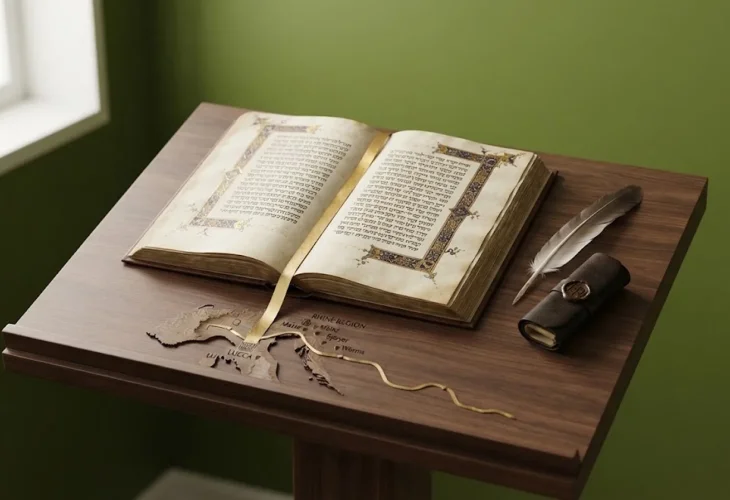
In the late 10th and early 11th centuries, a remarkable figure emerged from Italy who would help shape Jewish spiritual and liturgical life in Europe. Rabbi Meshullam ben Kalonymus was a Torah scholar, poet, and spiritual leader whose influence extended from the Jewish communities of Italy to the developing Torah centers of Ashkenaz.
Over the centuries, many traditions grew around him: stories of his extraordinary wisdom, his journey from Italy to the centers of Torah learning in Babylonia and Ashkenaz, his connections with the leading sages of his generation, and his role in establishing the rich Ashkenazi tradition of piyyut.
From One of Medieval Jewry’s Most Important Families
Rabbi Meshullam ben Kalonymus belonged to the Kalonymus family, one of the most important Jewish families in Italy and Ashkenaz during the early Middle Ages. According to later traditions, the family originated in the Land of Israel before moving to Babylonia, Italy, and eventually Ashkenaz.
Members of the Kalonymus family played a central role in the development of the early Ashkenazi Torah world. Their descendants included leading figures associated with Hasidei Ashkenaz, among them Rabbi Judah the Pious and Rabbi Eleazar of Worms, author of HaRokeach.
Rabbi Meshullam himself was born in Lucca, Italy. But how did an Italian boy become one of the leading sages of his generation, deeply versed in the teachings of the Babylonian Geonim?
A remarkable later tradition recorded by Rabbi Samuel ben Danan, one of the sages of Fez in the generations following the Expulsion from Spain, offers an extraordinary answer.
According to this account, when Meshullam was 14 years old, merchants kidnapped him from his hometown and sold him into service in Babylonia. Eventually, he found himself working in the kitchen of the academy of Pumbedita.
At night, however, the brilliant young boy would secretly enter the room of the head of the academy, Rav Hai Gaon, study his writings, and add annotations based on Torah teachings he had learned from his father.
When this was discovered, the Babylonian Geonim realized that the young servant was an exceptionally learned Torah scholar who also possessed traditions from the Land of Israel that had been preserved among the sages of Italy. According to the tradition, the head of the academy even offered Meshullam his daughter’s hand in marriage. Meshullam declined, explaining that he had been forcibly separated from his father and could not make such a decision against his father’s wishes.
The sages of Babylonia then sent him back to Italy with great honor, where he became one of the leading scholars of his community.
From Italy to the Torah Centers of Ashkenaz
Later traditions connect the Kalonymus family’s move northward with the development of Jewish communities along the Rhine. Emperor Otto I (912–973), the Holy Roman Emperor, sought to encourage Jewish settlement and commerce in the growing cities of the region. Jewish scholars and merchants from Italy were among those who made their way north.
Rabbi Meshullam became one of the great names associated with the establishment of the Kalonymus tradition in Ashkenaz. His reputation remained powerful generations later. Rashi refers to him with the distinguished title “Rabbeinu Meshullam bar Kalonymus Gaon.”
But perhaps Rabbi Meshullam’s most enduring legacy can still be heard today—in the prayers of Yom Kippur.
The Yom Kippur Piyyut Still Recited Today
Rabbi Meshullam ben Kalonymus composed numerous piyyutim, particularly for the High Holy Days. Twelve of his liturgical poems have survived.
The best known is the Avodah service, “Amitz Koach Kabir VeRav Onim,” which remains part of the Ashkenazi Yom Kippur Musaf tradition.
In this remarkable work, Rabbi Meshullam poetically reconstructs the Temple service performed by the High Priest on Yom Kippur. He describes the priestly garments, the lotteries, the incense, the blood service, the confessions, and the High Priest’s entry into the Holy of Holies, weaving the details into an elaborate poetic sequence.
One of the most compelling passages comes after the Temple service has ended. Rabbi Meshullam shifts from describing the rituals themselves to their result. The High Priest emerges from the sanctuary, and the world receives the news that the service has been accepted.
The poet describes the Jewish people and even nature responding with joy:
“The faithful messenger will complete his escort to the House; the snow will rejoice upon hearing that the scarlet has turned white; you will be adorned with salvation and wrapped in a robe of righteousness; you will bring forth jubilation and express joy and gladness.”
He then describes the fields receiving dew, the earth becoming saturated, and the harvest being gathered.
A Vast Collection of Liturgical Poetry
Rabbi Meshullam also composed the kerovah for the Shacharit service of Yom Kippur, beginning with “Eimecha Nasati Chen Be’erki.”
A kerovah is a type of piyyut traditionally incorporated into the chazzan’s repetition of the Amidah. Rabbi Meshullam’s “Eimecha Nasati” is particularly noteworthy because of its enormous scope. It contains dozens of piyyutim of different types and was accepted in Ashkenazi and French rites.
Much of it continued to appear in large Yom Kippur machzorim, although many sections were eventually omitted from the standard machzorim used today as communities shortened the practice of reciting lengthy kerovot.
Rabbi Meshullam also composed another Avodah service, “Asochech Nifleotecha,” which was recited in some medieval Ashkenazi communities, as well as a major yotzer cycle for Pesach, “Afik Ranan VeShirim,” two zulot poems dealing with the subjugation of kingdoms, and additional piyyutim.
The Poetry That Was Meant to “Run”
One of the interesting features of Rabbi Meshullam’s work is his extensive use of rehitim.
A rahit is a type of piyyut composed of short lines, often arranged according to the Hebrew alphabet, with a particular word or phrase repeated throughout. According to one explanation, the chazzan would recite these passages in a rapid melody, possibly explaining the name rahit, related to the Aramaic word for “running.”
These elaborate literary techniques demonstrate that the piyyutim were not simply additions to the prayers. They formed a sophisticated world of Torah, poetry, language, and communal worship.
Did a Copyist Change Rabbi Meshullam’s Words?
More than two centuries later, Rabbi Judah the Pious examined one of the lines in Rabbi Meshullam’s kerovah. In the version before him, the line read: “As is Your greatness, so are Your creatures.”
Rabbi Judah the Pious found the wording difficult. How could a poet say, “As is Your greatness, so are Your creatures,” seemingly comparing created beings with the greatness of the Creator?
Rather than assuming that Rabbi Meshullam had written something problematic, Rabbi Judah the Pious suggested that the text had been corrupted during generations of copying.
In his view, Rabbi Meshullam may originally have written, “As is Your greatness, so is Your creation”—meaning that the entirety of creation reflects the greatness of its Creator—and that a copyist later changed the word.
The episode offers a fascinating glimpse into the way Jewish liturgical texts were transmitted, examined, and preserved over generations.
A Legacy That Outlived Him
Other works by Rabbi Meshullam have also survived. “Al Yisrael Emunato” was incorporated into the kerovah for Yom Kippur, while “Berach Dodi El Mechon” expresses a longing for the return of the Shechinah to the Temple, drawing on the language of Shir HaShirim: “Flee, my beloved, to the dwelling place of Your abode.”
Rabbi Meshullam was remembered as deeply versed in the hidden dimensions of Torah and as a bearer of ancient traditions associated with the sages of the Land of Israel. Those traditions found expression in the piyyutim he left behind.
His influence also continued through the Kalonymus family, which became one of the most important families in the Ashkenazi Torah world. Its later generations produced leading figures of Hasidei Ashkenaz, including Rabbi Judah the Pious and Rabbi Eleazar of Worms.
Another figure associated with Rabbi Meshullam was Rabbi Shimon ben Isaac of Mainz, known as Rabbi Shimon the Great, himself one of the outstanding early Ashkenazi paytanim. The two belonged to the formative generations of Ashkenazi liturgical poetry, and later traditions describe Torah connections between them and discussions concerning halacha and piyyut.
Rabbi Meshullam’s story therefore reaches far beyond the life of a single medieval sage. The Torah traditions carried from Italy into Ashkenaz helped shape an entire religious culture, while the poetry composed more than a thousand years ago entered the prayers of generations of Jews. Even today, when worshippers recite his words on Yom Kippur, they continue a tradition stretching back to the earliest foundations of Ashkenazi Jewish life.

