

World News
Austria’s School Hijab Ban Takes Effect, Setting Up a New Legal Fight
Austria has begun enforcing a ban on Muslim head coverings for schoolgirls under 14, with fines possible for violations. Muslim leaders are preparing a court challenge, while the far right is calling for even broader restrictions.
 Illustration
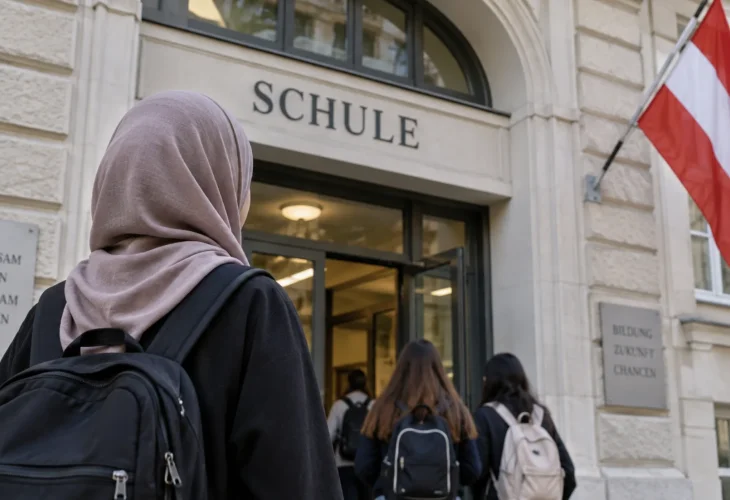
After months of public and political debate, Austria began enforcing its ban on Muslim head coverings in schools today (Monday). With the start of the school year, girls under 14 will no longer be allowed to attend classes wearing a hijab or burqa. This is already drawing opposition and is expected to once again reach the Constitutional Court.
The law was advanced by Austria’s governing coalition, made up of the conservative People’s Party (ÖVP), the Social Democratic Party (SPÖ), and the liberal Neos party. According to the government, the measure is intended to "protect girls’ freedom and promote gender equality." It was approved by Parliament in December with support from the far-right Freedom Party of Austria (FPÖ), while the Greens were the only party to oppose it. Integration Minister Claudia Bauer described the head covering as "a symbol of oppression and a tool for controlling girls from an early age."
On the other side, the Islamic Religious Community in Austria (IGGÖ), the official organization representing Muslims in the country, announced that it would challenge the law in court. Karla Amina B’Jajati of the organization told the BBC: "In our view, it unjustifiably restricts the fundamental right to freedom of religion and has a disproportionate impact on Muslim girls." She added, "Instead of protecting children, it singles out a particular religious practice and may lead to the exclusion of the very children it claims to support."
The legal battle over the issue is not new. In 2020, the Constitutional Court struck down an earlier law banning head coverings in elementary schools, ruling that it discriminated against Muslims and violated the principle of the state’s religious neutrality. In July of this year, petitions against the new law were rejected because it had not yet gone into effect at that stage. Now that enforcement has begun, further legal efforts to challenge its constitutionality are expected. Education Minister Christoph Wiederkehr was asked whether the current law could also be struck down and replied that "you can never be completely certain," but noted that the government held extensive consultations before passing it.
Responsibility for enforcing the ban falls largely on schools. If a student comes to school wearing a head covering prohibited under the law, the school will be required to speak with her and involve her legal guardians. In cases of repeated violations, child welfare services will also be required to intervene, and guardians may face fines of between 150 and 800 euros when appropriate.
The new obligations are also drawing opposition within the education system. Left-leaning student organizations have called for demonstrations, and some teachers have voiced concerns about the responsibility placed on them. Sigi Maurer of the Greens accused the education minister of "creating new conflicts and passing them on to teachers." Teachers, she said, "are already under enormous pressure," and now he is seeking "to assign them the role of police officers."
Meanwhile, the Freedom Party of Austria argues that the law does not go far enough and is demanding a blanket ban on head and face coverings in schools that would apply to both students and teachers. Ricarda Berger of the party declared: "There is no place for political Islam in Austria, and certainly not in our schools." Chancellor Christian Stocker, leader of the People’s Party, has also recently called for a constitutional ban on "political Islam," telling public broadcaster ORF that he does not "want to live in an Islamic country."

