

The Month of Elul
How to Forgive Yourself: A Jewish Approach to Teshuvah and Letting Go
Discover why forgiving yourself is an important part of leaving past mistakes behind and moving forward
- Yonatan HaLevi
- | Updated
We all know how to forgive other people. But the person we often judge more harshly, without leniency and without a statute of limitations, is ourselves. We continue carrying the mistakes of our past as though they define who we are today.
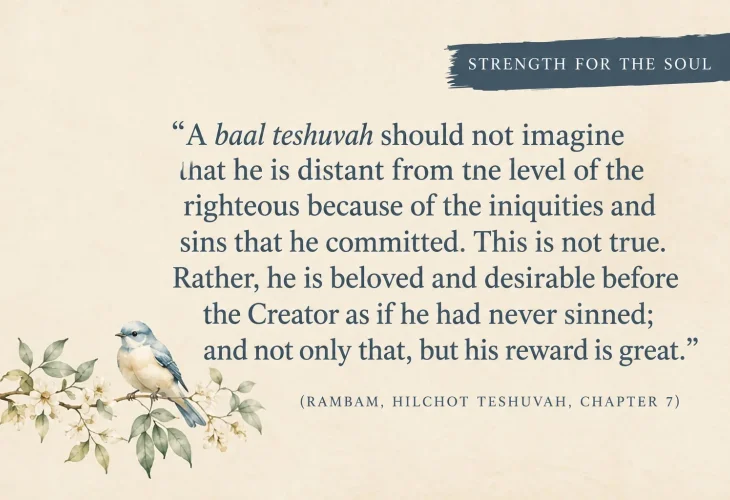
The Rambam writes in Hilchot Teshuvah (Chapter 7): “Let a person who has repented not imagine that he is far removed from the level of the righteous because of the sins and transgressions he committed. This is not so. Rather, he is beloved and cherished before the Creator, as though he had never sinned. Moreover, his reward is great.”
To know that we have truly done our part, it is helpful to remember what teshuvah requires. The Rambam describes several essential elements: regret for what we have done, abandoning the sin and no longer repeating it, confession before Hashem, and a commitment for the future not to return to it.
When the wrongdoing involves another person, there is an additional step to make amends with the person we hurt and ask for forgiveness.
This is the process of teshuvah. Once we have sincerely moved through it, we have done our part.
Then we need to forgive ourselves. If Hashem, who sees everything and knows everything, is prepared to forgive us and allow us to begin again after we have done teshuvah, why should we continue holding ourselves accountable for a debt He has already forgiven?
When we refuse to forgive ourselves, we are effectively imposing a harsher judgment on ourselves than Hashem does.
Accepting That We Are Imperfect
Self forgiveness begins with acceptance. We must accept that we are not perfect. We have less admirable sides to ourselves, moments in which we failed, and decisions we would make differently today. Admitting this can be uncomfortable, but this acknowledgment can set us free.
As long as we demand perfection from ourselves, every mistake can feel like a threat to our entire sense of who we are. Only when we allow ourselves to be human, with both strengths and imperfections, does a mistake return to its proper size. It becomes something that happened, but not something that defines us.
Self forgiveness means being able to say: “I did this. I acknowledge it. But I choose not to carry its weight forever.”
We can regret an action without punishing ourselves for the rest of our lives. We can learn from a mistake without turning that mistake into our identity.
Something to Take With You
When you catch yourself speaking harshly to yourself, stop and ask: Would I speak this way to a good friend who had made the same mistake? If not, perhaps you deserve the same compassion you would offer that friend.
When an old mistake comes back to haunt you, remind yourself of the work you have already done. You regretted it. You confessed it. You stopped repeating it. You committed yourself to doing differently in the future. Continuing to punish yourself for the same mistake is no longer part of repairing it. It is simply additional punishment.
When letting go feels difficult, try saying aloud: “I forgive myself for what happened.” It may feel strange at first, but words can have tremendous power.
When you feel that you are somehow “unworthy,” remember that your worth is not measured by the worst mistake you have ever made. Your value is inherent. It existed before you ever proved anything.
A new page is always available. You do not need to earn the right to turn it. You do not need to become perfect before you can begin again. The page is there, open before you, whenever you are ready to forgive yourself and start anew.
If you are carrying something right now that you find difficult to release, a mistake, a disappointment, or a version of yourself you wish had never existed, know that you are allowed to put it down.
Not because it did not happen, but because you are so much more than what happened.
Hashem has forgiven you. Now it is your turn.

