

Israel News
Britain Announces Sanctions on Jewish Communities in Judea and Samaria, Citing "Ethnic Cleansing" Claims
Britain has announced economic sanctions against Jewish communities in Judea and Samaria and is working to bring other countries into the effort. Israeli officials sharply criticized the move, while the U.S. warned it could have consequences for London.
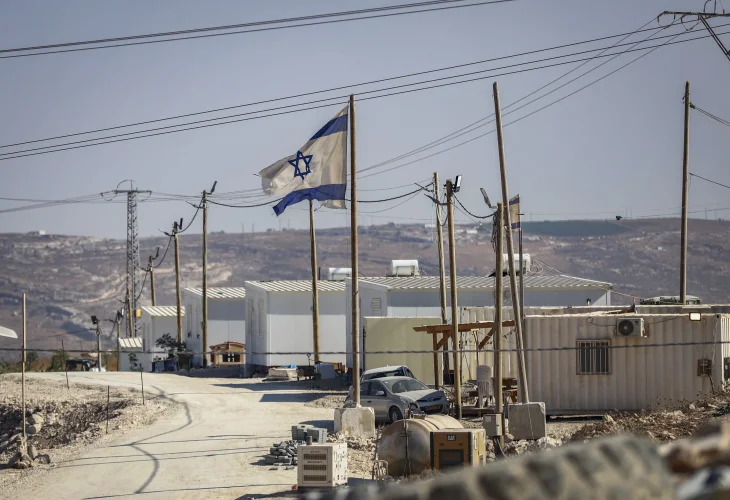 Maaleh Arugot in Gush Etzion, Judea and Samaria (Photo: Wissam Hashlamoun/Flash90)
British Foreign Secretary Ed Miliband announced today (Tuesday) that Britain will impose economic sanctions on Jewish communities in Judea and Samaria, as part of a policy shift being advanced by the government in London toward Israel. The announcement follows Miliband's statement in recent weeks that he intended to “reset” Britain’s policy on the issue.
At the start of his statement in the House of Commons, Miliband sought to clarify that security ties between the two countries would continue: “Britain and Israel will continue to cooperate on shared national security interests.” At the same time, he made clear that, in his government’s view, “securing a two-state solution is the North Star of our government’s policy.”
The British foreign secretary then sharply criticized Israeli policy in Judea and Samaria: “The British government agrees that there is ethnic cleansing in Palestinian areas of the West Bank carried out by Jewish terrorists, and the Israeli government turns a blind eye to it, and worse: members of the government make statements and support the forced displacement of Palestinians.”
Alongside the criticism, Miliband emphasized his personal connection to Israel and its right to exist: “To anyone who doubts Israel’s right to exist, you are wrong.” He later said: “I am proud of my Judaism and of my unwavering support for Israel.”
According to him, even amid political disagreements, cooperation between Britain and Israel on matters of shared national security interests will continue. He added that “our disagreement is not with the people of Israel, but with the conduct of its government.”
Regarding the future of the Gaza Strip, Miliband stated that Hamas can have no role in its future governance and that the terror organization must surrender its weapons. He said Israel has the right to live without fear and without being under threat from a “terror regime,” but argued that this right does not justify what happened in Gaza. He noted that approximately 70,000 people were killed in Gaza, including about 20,000 children.
A central part of his speech focused on the two-state solution, which he described as the guiding principle of British government policy: “Securing a two-state solution in its entirety is the North Star of this government’s policy.” According to him, Britain’s goal is “to save the only chance for peace, the two-state solution.” Miliband added that his country will also impose several sanctions on Hezbollah’s financial institution, “Al-Qard Al-Hasan.”
As part of the new policy, the British foreign secretary announced the creation of a comprehensive sanctions regime against companies and individuals that provide services contributing to the expansion of Jewish communities. The sanctions will apply, among others, to parties in construction, infrastructure, financing, and real estate.
In addition, Britain will ban imports of goods from what Miliband described as “illegal settlements in the occupied territories.” Alongside the import ban, the government will also impose export restrictions: it will deny applications for arms export licenses and other export applications in cases where, according to Miliband, the exports make a substantial contribution to the “occupation.”
The measures are not expected to take effect immediately. Under the timeline presented by Miliband, the legislation needed to implement the new policy is expected to take effect within six to nine months.
The British move has received support from a number of other countries. The foreign ministers of 12 countries, Britain, France, Canada, Denmark, Finland, Iceland, Ireland, Norway, Poland, Portugal, Spain, and Sweden, issued a joint statement against Israeli policy in Judea and Samaria, announcing their intention to advance restrictions on trade with “settlements defined as illegal under international law.”
In their statement, the countries linked continued settlement activity to the future of the two-state solution, arguing that “Israel’s actions in the West Bank undermine this possibility.”
Bloomberg reported that British diplomats told American officials that the sanctions to be imposed on settlements at this stage are “mostly symbolic,” and are not expected to substantially affect the broader relationship between Britain and Israel in trade and security.
At the same time, diplomatic efforts are underway to calm the Trump administration’s response, amid concerns that the move could become the first significant obstacle in relations between Washington and Britain’s new prime minister, Andy Burnham. U.S. Ambassador to Israel Mike Huckabee warned in an interview with the BBC of possible consequences: “If Britain continues to advance the sanctions, there is no doubt there will be an American response, at the diplomatic or federal level.” According to him, such a response could “have an enormous impact on the British economy.”

