

Rosh Hashanah
The Father Who Takes Us by the Hand
On Rosh Hashanah, we stand before the King in awe. But He is also the Father who gently leads us back when we lose our way
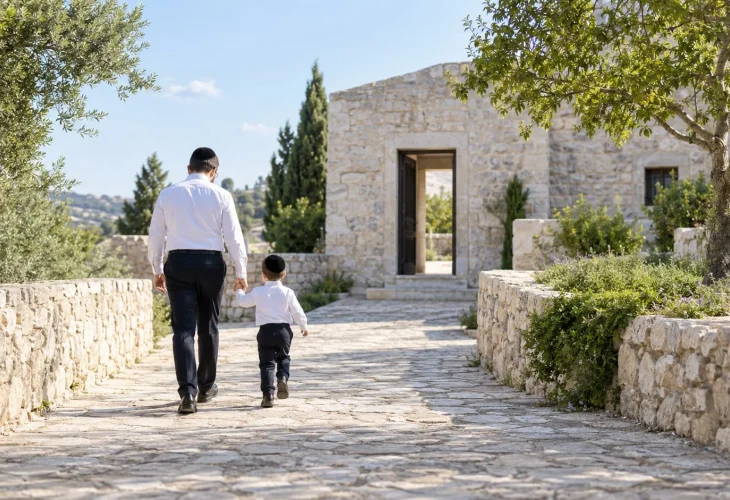
One late afternoon last week, after a long day, I sat down on the living room couch and, for the first time in ages, grabbed a pen and paper to write down a to-do list for the rest of the evening.
We have largely transitioned as a society to relying on devices for most organizational activities, but there is something different, more peaceful and therapeutic, about the old-school method of putting pen to paper — actually taking your hand and writing things down — even though typing is certainly more efficient.
I was sitting there peacefully, laying out the tasks, and then grabbed a book next to me to read. Then, in the blink of an eye, my joyful redheaded 3-year-old son, who had been silently watching me write, grabbed the pen to imitate my note-taking and, in a typical mischievous, silly thing that a 3-year-old does, wrote a few scribbles on the paper with the black ink — and then some more long, crisscrossing lines on the arm of the couch, just for fun.
I turned my head, noticed the marks on the couch and let out a sharp, “No!” My wife immediately heard me, looked over and came over to see what had happened. He stood there watching us in curious shock as we examined the damage. We then both gave him a strong reprimand: “There is no writing on furniture. We only write on paper.”
I watched his face as he struggled to hold back some tears. He knew he had done something wrong. He walked into the playroom, sat down by himself with his head buried in a pillow on the couch and stayed there, not wanting anyone to come in.
After a little while, I went in to check on him.
“Are you OK?” I called from the door.
He didn’t answer.
“Do you want a hug?”
“No,” he replied, still upset.
“OK then. I’m going to shul now. I’ll see you soon.”
Suddenly, his whole tone changed. He perked up and called out, “Can I come with you?”
“Yes. Let’s go.”
I walked toward the door, and he came trotting excitedly after me.
Seeing this, my wife said, “Wait, he just wrote on the couch, and now you’re taking him to shul? Why are you rewarding him?”
I didn’t really see it as a reward. He had already been reprimanded and understood what he had done. I was simply comforting him and taking him with me to a safe place, an environment of holiness, where he could have a good memory with his father.
To be sure, there is certainly merit to both perspectives. Showing warmth, chesed, after a moment of critical gevurah, sternness, is an important idea in parenting and also in self-reflection. But what caught my attention was my own natural instinct as a father.
And it made me think: In our personal relationship, is God more like a father, or is He more like a distant ruler or boss?
Of course, the answer is: both. It depends on the time and the context. God contains the perfection of all attributes. A king, an ancient and oft-cited analogy for the Creator, gives commandments that establish a path of morality and truthful living in line with his will. (The analogy may seem somewhat foreign today, but it is woven into Jewish life: every time we make a blessing, we call Hashem “Melech ha’olam” — King of the universe. Kingship is not merely about power or authority; it describes a relationship between the Creator and His creation, in which we acknowledge that He is the source of our existence and willingly align ourselves with His will.)
On Rosh Hashanah, we relate to God primarily through recognizing His kingship — His complete authority over our fate. That is the dominant description that pervades the holiday liturgy. It is a feeling of awe and of distance. But underneath it all is the knowledge that He is also our Father.
And perhaps this is what makes these final days of Elul so special. In Elul, the warmth of the King is uniquely present. During the year, we are constantly slipping in one way or another, sometimes knowingly and sometimes unknowingly. We make choices that take us away from where we want to be. We get caught up in things that we later realize weren’t good for us. But the essential relationship doesn’t disappear — it just needs to be reestablished at the forefront of our minds.
Choose Life!
This is part of the message of the Torah portion we read as we approach Rosh Hashanah. The Torah places two paths before us: “See, I have placed before you today life and good, and death and evil” (Devarim 30:15). Life and good are juxtaposed, as are death and evil, showing that these concepts are intertwined. Life is not merely physical existence; it is the life that comes from goodness, connection and living according to the path of Torah and mitzvot. Likewise, “evil” here is broader than malevolence in the ordinary sense; it refers to a path that takes us away from that goodness and connection.
This theme — wherein we are presented with two roads, two portions from which to choose — is reiterated shortly afterward: “I have placed before you life and death, the blessing and the curse. You shall choose life” (Devarim 30:19).
Rashi, the most basic commentary on the verses, offers a remarkable analogy to explain the addition of these words, “You shall choose life.” He compares it to a father who says to his son, “Choose for yourself a fine portion of my inheritance,” and then directs him toward the best portion, saying, in effect, “This is the one you should choose.” Rashi concludes that God is, so to speak, placing our hand on the good portion and saying, “Take this for yourself.”
In doing so, Rashi is addressing the seeming repetition in the verses. The Torah has already presented the two paths and identified the good path. What, then, is the additional message of “You shall choose life”? The analogy reveals that there is an additional dimension. It is one thing for a father to show his child the right portion; it is another for him to take the child’s hand and place it there.
The world we encounter, with all its moving parts, is like an inheritance placed before us. It is God’s world. He runs the show. But within that world, we are continuously writing our own story. We have free choice, but even when we can see the right path, there are plenty of inner obstacles, distractions and confusion that can cause us to get lost. It is not always enough simply to be told what is right. We need to be guided, and we need the strength to choose it.
And this is what the additional command, “You shall choose life,” accomplishes. God doesn’t simply lay the choices before us and leave us on our own. Like the loving father in Rashi’s analogy, He takes our hand and gives us an extra heavenly push toward the right path, helping us overcome the inner resistance and confusion that can stand in our way.
Returning to the Road
But what happens when we stray and choose the opposite? There is certainly judgment. There are consequences to our actions, as the Torah and Jewish ethical works explain. If not, there is no real significance to mitzvot and no meaningful free choice. And the Day of Judgment that sets the tone for the year ahead is approaching.
We may make mistakes, knowingly or unknowingly. Sometimes, like a child who wants to bury his head in a pillow and be left alone after realizing that he did something wrong, we may feel disconnected and want to withdraw. But we are never beyond the possibility of turning back, following the Father toward the door, into the light. And there is something deeply comforting — and fulfilling — about that reconnection.
This is a key piece of what we are meant to carry with us into Rosh Hashanah. We stand before the King with awe, praying with solemn tunes, asking forgiveness, pleading for a good and sweet year, conscious of our shortcomings and fragility. But we also know that the King is our Father. He wants us to choose life. And even when we have strayed, we can turn back — not only to the right path, but back into the essential relationship. And we can — and must — discover that choosing life feels good.
Rabbi Dan Lewin is director of the nonprofit Maayan Chai Foundation. For information, visit maayan-chai.org.

